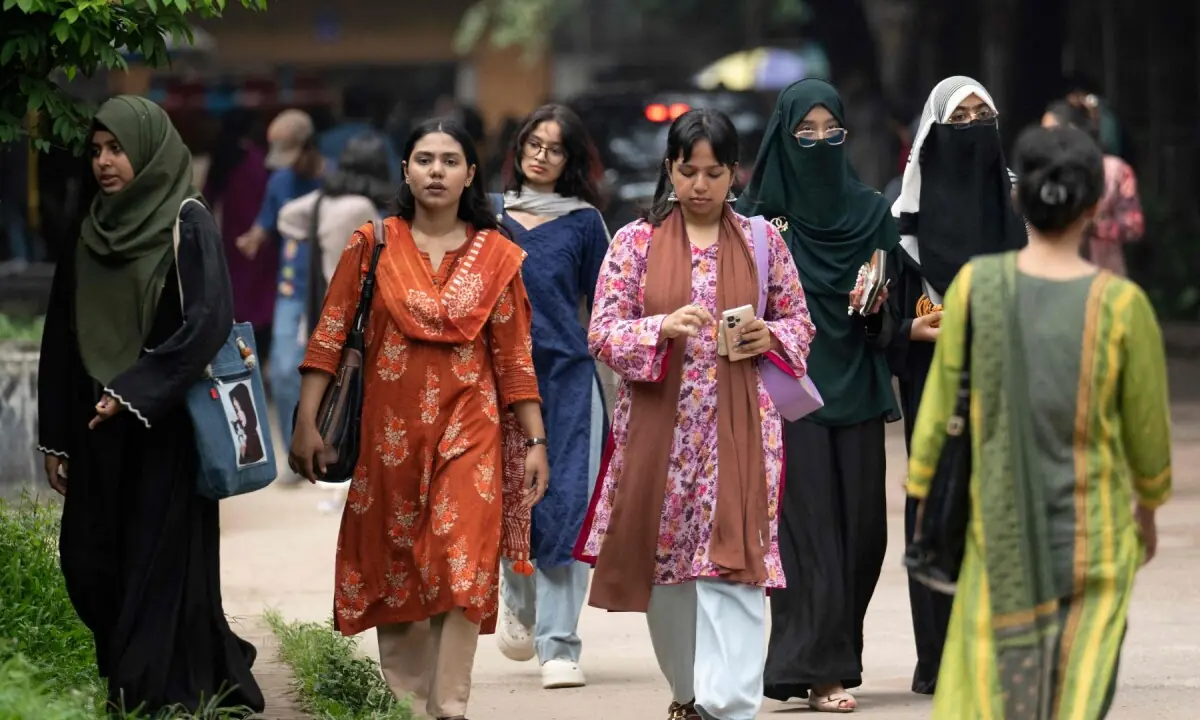
Bangladesh’s 2024 student-led uprising was fuelled by a demand that coveted government jobs be awarded on merit, not through quotas.
asserted
jobs → lead → quotas
The movement succeeded, the government was overthrown, and the quota system was largely scrapped — but the reform has had unintended consequences.
Women are securing a shrinking share of public sector jobs in the Muslim-majority nation of 170 million people.
asserted
Women → succeed → people
Tothapi Azad, a 25-year-old Dhaka University graduate, supported calls to end quotas — but says she should have supported retaining them for women.
asserted
she → support → women
“For me, who had my family’s support, a quota might not have been essential — but for an average woman, it was essential,” she told AFP.
uncertain
she → have → AFP
For rural women, it is more than that — a survival tactic, a shield to resist domestic violence.”
asserted
it → resist → violence
Data shows that the share of female government recruits has fallen since quotas were cut, shrinking an already limited number of civil service roles held by women.
asserted
quotas → show → women
Until 2018, quotas accounted for 56 per cent of Class I posts, the top ranking civil service and public sector jobs.
asserted
quotas → account → posts
That included 10pc for women, as well as 30pc for descendants of those who fought for Bangladesh’s independence in 1971.
asserted
who → include → 1971
Another 16pc was reserved for underprivileged regions and people with disabilities.
asserted
16pc → reserve → disabilities
In 2018, after student protests, the then prime minister Sheikh Hassina scrapped quotas.
asserted
minister → scrap → quotas
In 2024, it was proposed to reinstate quotas, sparking student protests.
asserted
it → propose → protests
That escalated into a mass uprising, and Hasina was overthrown.
asserted
Hasina → escalate → uprising
Today, 93pc are filled on merit.
asserted
93pc → fill → merit
A 7pc quota is reserved for those related to freedom fighters and other smaller groups, and there is no quota for women.
asserted
quota → reserve → women
The Bangladesh Public Service Commission (BPSC), which runs the recruitment examinations, has around 300,000 applicants each year for 2,500-3,000 Class I jobs.
asserted
which → run → jobs
Before the quota was scrapped in 2018, women accounted for up to 35pc of recruits, including both quota and merit-based appointments.
asserted
women → scrap → quota
That has dropped to 19pc, according to figures from the last exam round.
uncertain
That → drop → round
A BPSC official, who spoke on the condition of anonymity, said the body “finds the outcome uncomfortable”, but that its “duty is limited to conducting the examination”.
AKM Abdul Awal Majumdar, a former bureaucrat, backs merit-based recruitment but advocates coaching to help women compete.
asserted
women → speak → coaching
“My female colleagues were unparallelled,” he said.
asserted
he → say → ?
The government elected in February also backs merit-based recruitment.
asserted
government → elect → recruitment
Md Abdul Bari, a public administration minister, described it as a “rational reform” in parliament.
asserted
Bari → describe → parliament
But some officials fear the decline in female recruitment will become increasingly visible.
asserted
decline → fear → recruitment
“At this moment, at least 21 women are leading 21 districts,” said a female bureaucrat with 20 years of experience, speaking on condition of anonymity.
asserted
bureaucrat → lead → anonymity
The impact goes beyond the civil service.
asserted
impact → go → service
Police data shows that only 267 women out of 2,651 candidates qualified as constables this year.
asserted
women → show → constables
Only six of the 184 candidates who qualified as police sub-inspectors were women.
asserted
who → qualify → inspectors
No women qualified as sergeants, compared with 96 men.
asserted
women → qualify → men
“We can’t continue without them,” a police officer told AFP, noting that every station has dedicated desks for women and children.
asserted
station → continue → women
Bangladesh previously had 60pc quotas for women in primary teaching positions.
asserted
Bangladesh → have → positions
That has also ended.
asserted
That → end → ?
Asif Shahan, a Dhaka University professor of Development Studies, said fewer women in government would impact policymaking.
“Their issues get reflected in policy,” he told AFP.
asserted
he → say → AFP
The debate has split students.
asserted
debate → split → students
Md Mazharul Islam, a Dhaka University students’ union career advisor, a supporter of the Islamist party Jamaat-e-Islami, backs a merit system.
asserted
Islam → back → system
“Society was much more conservative before, and girls were not allowed to pursue higher education,” he said.
asserted
he → allow → education
“That has changed.”
asserted
That → change → ?
Philosophy student Adity Islam said abolishing the women’s quota was wrong.
asserted
abolishing → say → quota
“We measured women across all walks of life with the yardstick of female students at Dhaka University,” said Islam, who is involved in leftist politics.
asserted
who → measure → politics
“Cutting the quota for women would eventually impact the overall governance system.
asserted
Cutting → cut → system
We have already seen that in some districts.
asserted
We → see → districts
So aspiring candidates in many other places will lose hope.”
asserted
candidates → aspire → hope
…and 1 more, not listed.
 The Aporia