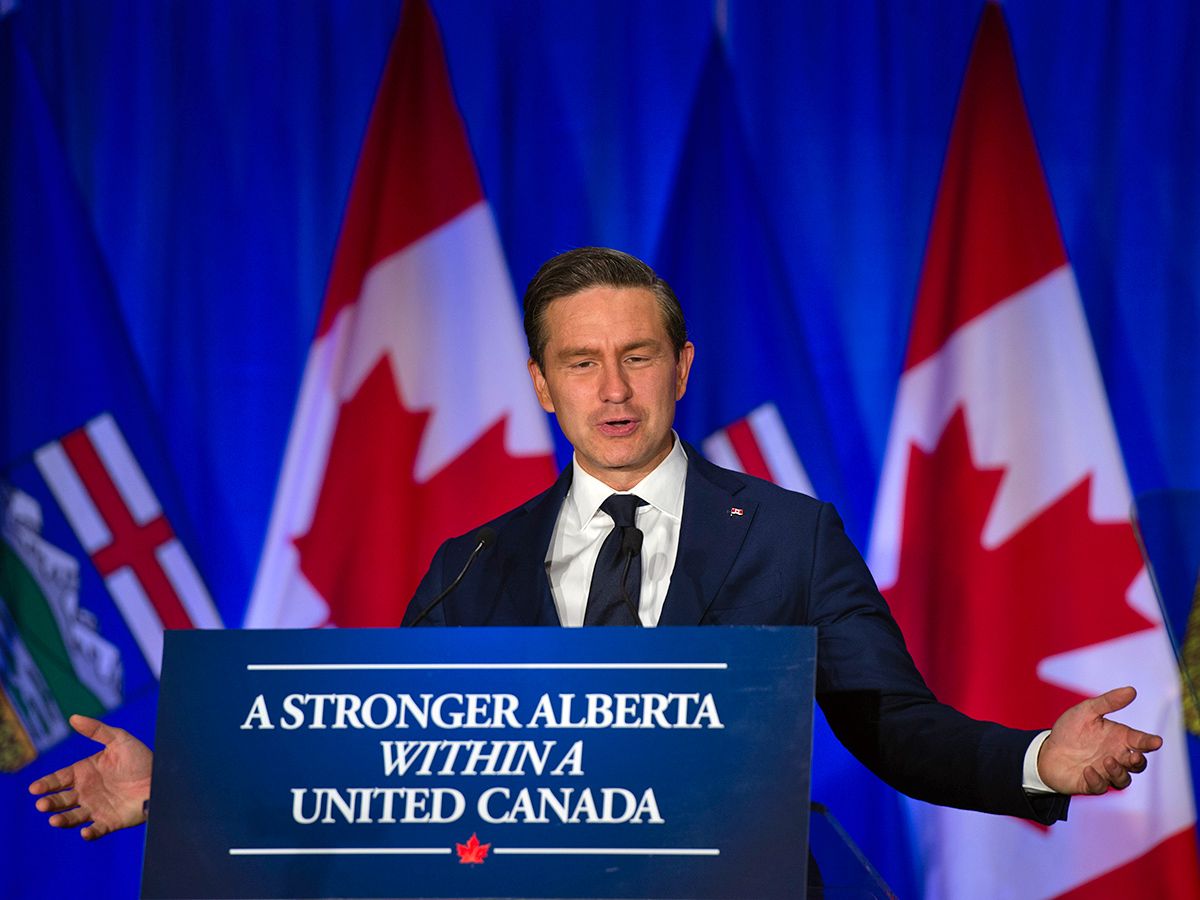
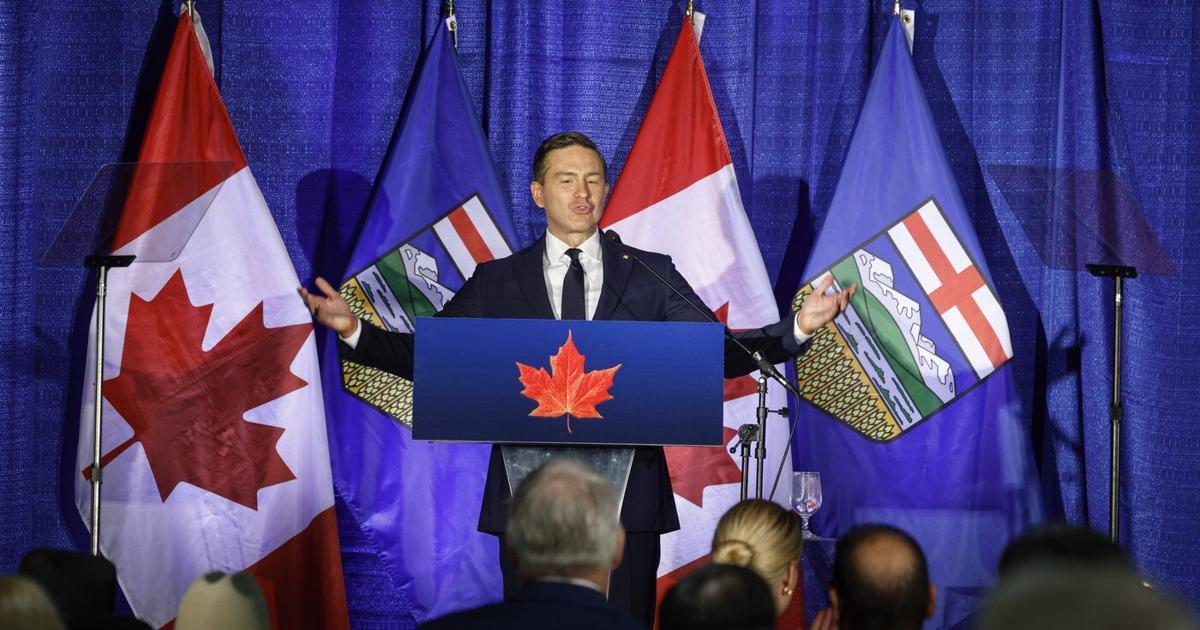
Pierre Poilievre, the leader of the Canadian Conservative Party, addressed supporters in Edmonton, advocating that Albertans vote against separation from Canada in an upcoming referendum on October 19. He argued that Alberta's grievances stem from excessive federal government intervention rather than fundamental issues with Canada itself, pointing to areas such as resource regulation and personal freedoms where he believes Ottawa oversteps its constitutional role. Poilievre emphasized the importance of provinces like Alberta maintaining control over local matters while allowing the federal government to handle national concerns like immigration and military spending.
Written locally by qwen2.5:14b on 2026-09-30,
using this article's own text rather than the other coverage of the
same event (that is the story summary below).
Conservative Leader Pierre Poilievre urged Albertans to vote to stay in Canada in the province’s upcoming referendum, arguing that Alberta’s resentments are best addressed by doubling down on the values that the Canadian Constitution was originally meant to uphold.
asserted
Constitution → urge → that
At a keynote speech in Edmonton, Poilievre made a classical conservative case for why the province’s deep resentments toward confederation are actually due to years of relentless government overreach rather than issues with the country itself.
asserted
resentments → make → country
“What Albertans are complaining about is not Canada,” he told a gathering of Conservative supporters.
asserted
he → complain → supporters
“It is the government policies that are actually inconsistent with how Canada was meant to work in the first place.”
asserted
Canada → mean → place
At the root of the problem, Poilievre said, is that Ottawa has continued to expand its reach into areas of public life that it was never mandated to preside over, while trampling on the personal freedoms of citizens for political gain.
asserted
it → say → gain
“Simply put, the last decade the federal government has done terribly at the things that are actually its job: immigration, crime, military spending, borders, while intruding into things that are not its job: regulating our resources, going after hunting rifles which are private property, just to name a few examples.
asserted
which → put → examples
“The problem with all of these things is not Canada,” he said.
asserted
he → say → things
“Separation will not solve those problems.”
asserted
Separation → solve → problems
Poilievre’s address comes as more pro-federalist voices have started to make the case for keeping Alberta within confederation just weeks ahead of the Oct. 19 referendum.
asserted
voices → come → referendum
The federal Conservatives have long opposed Alberta’s separation, and earlier this month launched a “Conservatives for Canada” campaign in an effort to sway public opinion.
asserted
Conservatives → oppose → opinion
Support for separation on the Canadian prairies has reached new highs in the last few years, spurred on by frustration over everything from Ottawa’s over-regulation of its oil and gas sector to the federal government’s COVID-19 vaccine mandates during the pandemic.
asserted
Support → reach → pandemic
Notably, Poilievre’s speech never once mentioned the federal Liberal Party or Prime Minister Mark Carney, leaving aside politically-charged attacks in favour of a more statesmanlike appeal to the problem of government excess.
asserted
speech → mention → excess
The Canadian project was explicitly intended to give Alberta and other provinces control over its own affairs, Poilievre said as part of his address, with governments expected to intervene only within narrow and specified areas of public life.
asserted
governments → intend → life
That means provincial governments sticking to matters like health care and education, and Ottawa focusing on matters like borders, national defence and criminal law.
asserted
Ottawa → mean → borders
Canada’s founding constitutional document, the British North America Act, gives governments direct instructions to “mind your own business,” the Conservative leader said.
asserted
leader → found → business
Poilievre also made a more practical case for Alberta staying in Canada, saying the province ought to “lock arms” with the rest of the country under a shared border and common military.
“Simply put, Alberta has had more independence in the past, and we’ll have more independence in the future as part of a united Canada as part of that gigantic country, sharing a military and borders with millions of other Canadians than we would ever have if we were isolated and alone.”
asserted
we → make → Canadians
Poilievre, who is from Calgary but spent much of his political life in Ottawa before losing his seat in the city in the 2025 federal election, also made an emotional plea on behalf of Alberta’s unique identity and the shared traits of its people.
asserted
who → spend → people
“I love Alberta,” he said.
asserted
he → love → Alberta
“I love what it represents — hard work, generosity, unpretentiousness, resilience, common sense.
asserted
it → love → represents
I love the grit of the people.”
asserted
I → love → people
The Conservative leader also called on the rest of Canada to listen to the anger among some Albertans over its treatment within the federation, saying that efforts to appease that anger would likely benefit the broader country.
asserted
efforts → call → country
“If you listen carefully to what Albertans are asking for, they don’t want to take away anything from anyone else.
asserted
they → listen → anyone
In fact, their demands would not only make Alberta better off, it would make all of us better off.”
asserted
all → make → us
 The Aporia