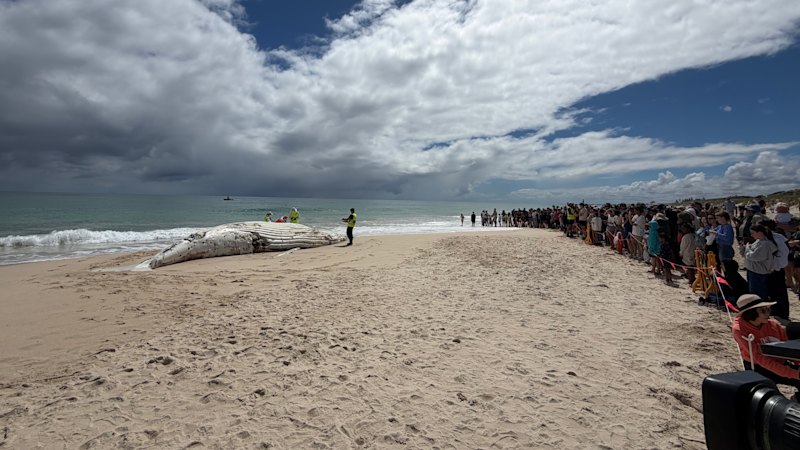
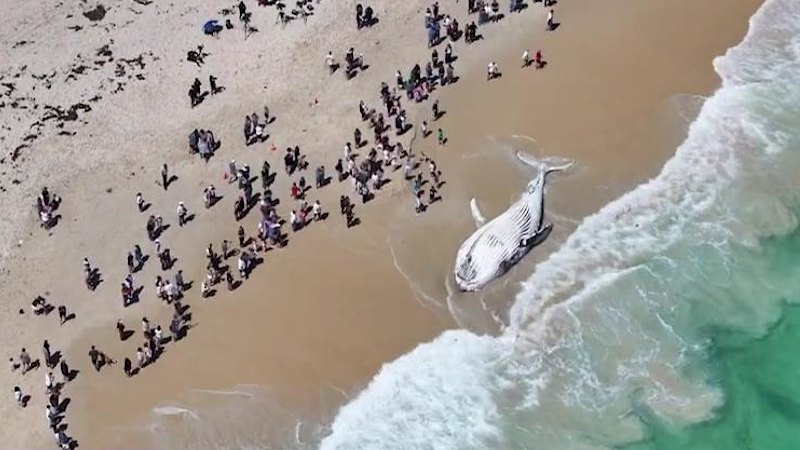
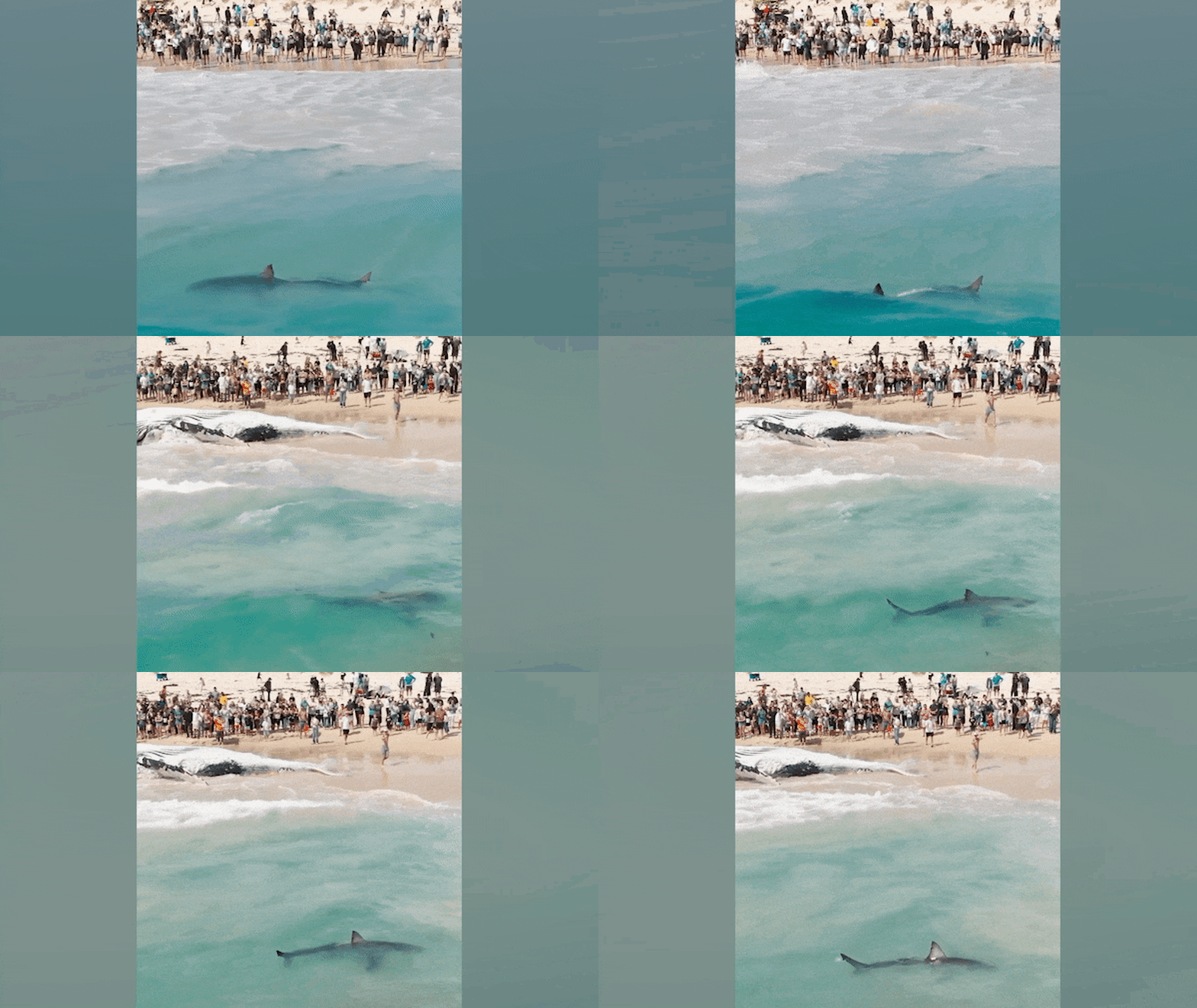
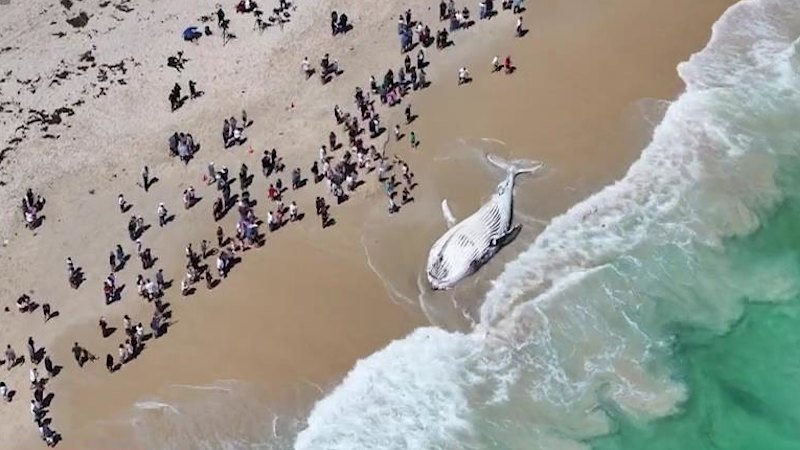
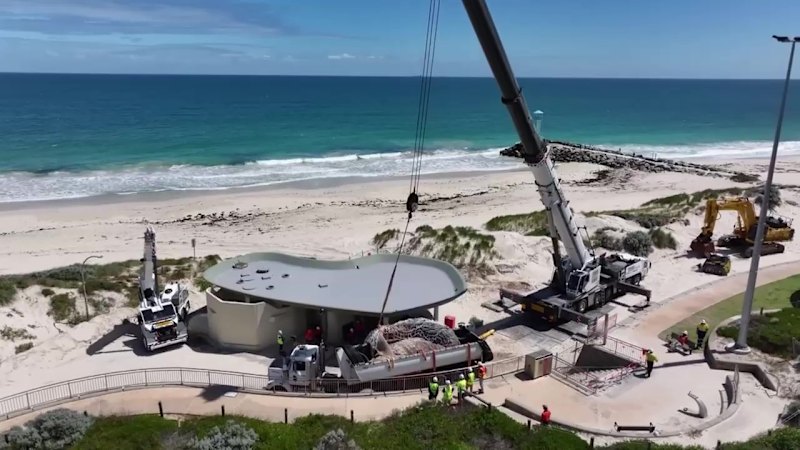
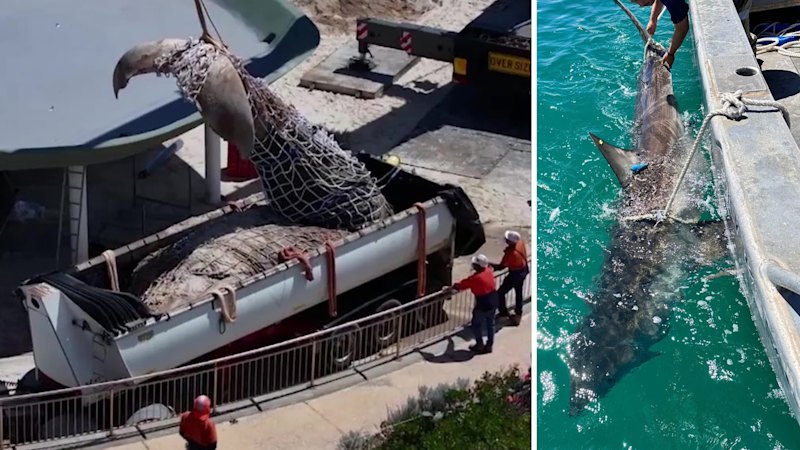
A 13-metre-long whale weighing approximately 31 tonnes washed ashore at City Beach in Perth on a public holiday morning. The Town of Cambridge faces significant challenges to remove it due to logistical and environmental concerns, including attracting sharks and closing the beach for safety reasons. Disposal methods include towing the carcass back out to sea or transporting it to landfill, but both options are costly; for instance, cleaning up a similar whale in 2014 cost $188,000 with half covered by state funds. Experts suggest avoiding explosive disposal due to past incidents.
Written locally by qwen2.5:14b on 2026-09-29,
using this article's own text rather than the other coverage of the
same event (that is the story summary below).
Story summary
On Monday, a 13-metre-long, 31-tonne humpback whale carcass washed up on South City Beach in Perth, attracting multiple great white sharks, including one measuring five metres long. The Department of Primary Industries and Regional Development (DPIRD) issued shark warnings due to the increased risk of shark activity around the beach. Surf Life Saving WA reported seeing several sharks circling near the whale carcass. Authorities closed the beach for public safety and planned to remove the carcass using heavy machinery, costing an estimated $60,000 to $100,000. The operation began on Wednesday, involving specialist crews with excavators and trucks to transport the carcass to landfill.
Written for “Whale Carcass Removal City Beach” on 2026-10-05,
grounded in this article and the 11 other(s) covering the same event.
It turns out, removing tonnes of organic material from a beach isn't an easy task.
asserted
removing → turn → beach
When a dead 13-metre-long whale, weighing an estimated 31 tonnes, washed ashore at City Beach in the early hours of Monday morning, a public holiday no less, the council has no easy fix.
As the sun rose, the carcass decayed, and the waves carried its scent into open waters, luring sharks toward one of Perth's most popular beaches and closing it to swimmers.
Disposing of whale carcasses is a logistical ordeal.
asserted
Disposing → weigh → carcasses
Experts say this is how it should, and shouldn't, be done.
asserted
it → say → ?
An explosive solution
One method officials probably won't consider was put into practice a few decades ago in the town of Florence in the US state of Oregon.
asserted
officials → consider → Oregon
About 20 cases of dynamite, or 450 kilograms' worth, was used to dispose of a much smaller whale carcass, with predictable results.
Chunks of blubber flew into the air, and a car parked almost half a kilometre away was caved in by falling debris.
asserted
car → use → debris
Granted, it was the 1970s, and the world learned a lot from that one experience, namely, don't blow up whale carcasses.
asserted
world → grant → carcasses
The prevailing wisdom is to tow carcasses back out to sea or carry them to the dump, according to University of Western Australia marine biologist Kate Sprogis.
uncertain
wisdom → prevail → Sprogis
"If it's a big swell, big weather, big wind, and they can't get a boat out or a large enough boat to tow it, then landfill might be an option," Dr Sprogis said.
uncertain
Sprogis → get → it
Regardless, it's likely to be expensive, as Town of Cambridge Mayor Gary Mack said he has been warned.
asserted
he → say → Cambridge
In 2014, it cost $188,000 to clean up a whale carcass on Scarborough Beach.
asserted
it → cost → Beach
Then-mayor Giovanni Italiano convinced the state government to pay half.
asserted
Italiano → convince → half
But typically, the local council foots the bill, and the longer it takes to get rid of the mess, the longer the beach needs to stay closed.
asserted
beach → foot → mess
"Any sort of large animal like that, full of blubber, is really attractive for sharks," Dr Sprogis said.
asserted
Sprogis → say → sharks
Loading...Migration season
The lone whale carcass on City Beach's shores isn't an unexpected occurrence, according to Dr Sprogis, who said the months of September and October are typically a time of migration for humpback whales.
uncertain
months → load → whales
"During this time, there's a whole range of reasons why some of them end up dying," she said.
asserted
she → be → them
Dr Sprogis said a necropsy is typically required to determine the cause of death, but if there aren't obvious signs of trauma on the carcass, the whale could have died from natural causes.
uncertain
whale → say → causes
"When they die, they generally float on the surface.
asserted
they → die → surface
Their body gets filled with gases," she said.
asserted
she → fill → gases
"If there's, say, a big wind, say a westerly wind, it might push the animals onto the shore if they're floating.
uncertain
they → be → shore
The death of a whale isn't all bad, and carcasses can still yield important samples for researchers.
asserted
carcasses → yield → researchers
But Dr Sprogis warned that decomposition was a problem.
asserted
decomposition → warn → ?
"As soon as it starts decomposing and breaking down, that's when the number of samples is reduced, because a lot of analysis in the lab can only be done with fresh samples," she said.
asserted
she → decompose → samples
The dead whale, which has drawn hundreds of onlookers over the past two days, is expected to be removed from the beach this morning.
asserted
which → draw → beach
 The Aporia