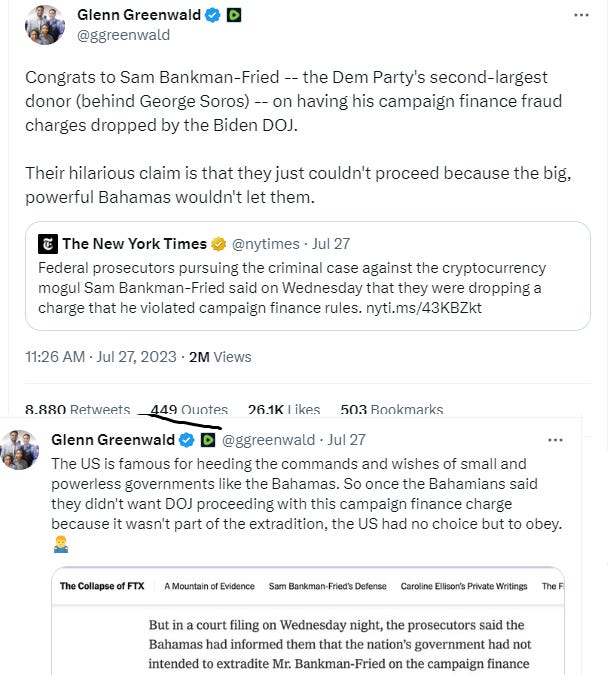
Glenn Greenwald, compulsive Fox guest and professional agitee, has written many smart and important things over the course of his career about abuses of power by the United States government.
asserted
Greenwald → write → government
Glenn is agitated because the United States decided to drop a charge of conspiracy to commit campaign finance violations it had previously brought against infamous manchild Sam Bankman-Fried, the answer to the question “how bad could it be, being raised by two Stanford professors?”
uncertain
it → decide → professors
Glenn views this as a conspiracy to protect SBF, Democrats, and presumably Hunter Biden:
asserted
Glenn → view → SBF
Since Glenn is absolutely not dumb, Glenn’s speaking from lazy ignorance, bad faith, or blinding hatred of the Democratic establishment and U.S. Department of Justice.
asserted
Glenn → speak → Justice
In fact, the United States dropped campaign finance charges against SBF to comply with its treaty obligations.
asserted
States → drop → obligations
The treaty sets forth the procedures for the United States and the Bahamas to request extradition of accused criminals from each other, and governs which crimes qualify for extradition.
asserted
crimes → set → extradition
Like most extradition treaties, this one incorporates the Rule of Specialty.
asserted
one → incorporate → Specialty
That familiar rule provides that, with a few exceptions, the requesting country (here, the U.S.) can only prosecute a defendant for crimes for which the extraditing country (here, the Bahamas) agreed to extradite them.
asserted
country → provide → them
This is intended to prevent requesting countries from saying “please send us this dude, he murdered someone,” and then prosecuting them for sedition or blasphemy or something else unacceptable to the extraditing country.
asserted
he → intend → country
There are a few exceptions, the most important of which is that the requesting country can ask the sending country for its consent to prosecute the defendant for additional crimes beyond those in the extradition order.
asserted
country → be → order
Here’s how the United States Attorney’s Manual describes those exceptions and how federal prosecutors should deal with them:
asserted
prosecutors → ’ → them
Every extradition treaty limits extradition to certain offenses.
asserted
treaty → limit → offenses
As a corollary, all extradition treaties restrict prosecution or punishment of the fugitive to the offense for which extradition was granted unless (1) an offense was committed after the fugitive's extradition or (2) the fugitive remains in the jurisdiction that requested extradition after expiration of a reasonable time (generally specified in the extradition treaty itself) following acquittal or completion of his or her punishment.
asserted
that → restrict → punishment
This limitation is referred to as the Rule of Specialty.
asserted
limitation → refer → Specialty
Federal prosecutors who wish to proceed against an extradited person on charges other than those for which extradition was granted must contact the Office of International Affairs (OIA) for guidance regarding the availability of a waiver of the Rule by the sending State.
asserted
extradition → wish → State
Here’s how the extradition treaty between the U.S. and the Bahamas articulates the rule:
(1) A person extradited under this Treaty may only be detained, tried, or punished in the Requesting State for the offense for which extradition was granted, or --
(a) any offense committed after the extradition;
(b) any offense in respect of which the executive authority of the Requested State, in accordance with its laws, has consented to the person's detention, trial, or punishment; and for the purposes of this subparagraph the Requested State shall require compliance with the extradition procedures specified in Article 8 and the submission of the documents specified in that Article . . .
The Bahamas’ Limited Extradition of SBF
When the United States initially charged Sam Bankman-Fried, it brought a variety of charges including conspiracy to defraud the United States and violate campaign finance laws.
uncertain
it → articulate → laws
Sam Bankman-Fried decided to waive extradition proceedings and consent to extradition.
asserted
Fried → decide → extradition
The Bahamian Minister of Foreign Affairs executed a warrant of surrender governing the extradition.
asserted
Minister → execute → extradition
Notably, however, the Warrant of Surrender didn’t extradite SBF on all of the charges in the indictment.
asserted
Warrant → extradite → indictment
It omitted conspiracy to commit campaign finance fraud:
Why?
asserted
It → omit → fraud
To indulge in speculation, the Bahamas might have seen the campaign finance charges as “political” rather than substantive, something that countries are historically reluctant to extradite over.
uncertain
countries → indulge → that
SBF’s Unsuccessful Motion To Dismiss and The Bahamas’ “Clarification”
The United States later filed superseding indictments adding a bunch of additional charges.
asserted
States → dismiss → charges
SBF filed a motion to dismiss the charges that were not in the Warrant of Surrender — that is, the charges that the Bahamas had not expressly agreed to extradite SBF on.
asserted
Bahamas → file → SBF
United States District Court Judge Lewis A. Kaplan ruled that SBF did not have standing to argue that the United States was violating the Rule of Specialty.
asserted
States → rule → Specialty
Following the majority rule, he said that’s up to the Bahamas to enforce:
asserted
that → follow → Bahamas
The Extradition Treaty here at issue does not provide that it may be enforced by an individual.
uncertain
it → provide → individual
Nor is there any language indicating that The Bahamas and the United States intended it to be so enforceable.
asserted
it → indicate → ?
Accordingly, under the Second Circuit's binding precedent, the rule of specialty may be invoked here only by The Bahamas.
uncertain
rule → bind → Bahamas
The defendant lacks standing to do so.
asserted
defendant → lack → standing
Judge Kaplan also noted that the United States has conceded that it is bound by the Rule of Specialty, but argued that it thought that the Bahamas mistakenly omitted the campaign finance charges from the Warrant of Surrender and they were asking the Bahamas to clarify and would abide by its decision:
asserted
they → note → decision
The Court notes that the United States has notified The Bahamas of the additional charges in the S5 Indictment and is seeking a specialty waiver for the post-extradition charges.
asserted
States → note → charges
It concedes that The Bahamas' “response will be dispositive,” and that the government will not proceed on the new counts if The Bahamas denies its request.
asserted
Bahamas → concede → request
As to the campaign finance charge - Count Eight of the original indictment and Count Twelve of the S5 Indictment - the government maintains that the rule of specialty does not apply because the “extradition record as a whole suggests that the defendant was extradited on all counts in the original indictment.”
uncertain
defendant → maintain → indictment
Nevertheless, “[i]n an abundance of caution,” the United States “has conveyed to The Bahamas its understanding that the omission of the campaign finance charge [from the defendant's warrant of surrender] was inadvertent, and informed The Bahamas that, absent timely information to the contrary from The Bahamas,” it intends to proceed on that charge.
asserted
it → convey → charge
The government has represented that it will not proceed on the campaign finance charge if The Bahamas objects.
asserted
Bahamas → represent → charge
So the United States asked the Bahamas to clarify that it meant to allow the U.S. to prosecute the campaign finance fraud charge, or else to consent to its prosecution.
asserted
U.S. → ask → prosecution
SBF went to court in the Bahamas and got an injunction temporarily barring the Bahamas from agreeing to that on the theory that it deprived him of his right to object under Bahamas law.
asserted
it → go → law
As far a I can tell the Bahamas are still deciding what stance to take on most of the new charges the United States has added — that is, whether to consent under the Rule of Specialty to the United States prosecuting them even though they weren’t part of the extradition.
asserted
they → tell → extradition
However, on July 28, 2023, the United States reported to Judge Kaplan that the Bahamas had confirmed it did not intend to extradite SBF on the campaign finance count, and therefore the United States would abide by its treaty obligations and not prosecute that count:
asserted
States → report → count
The Government has been informed that The Bahamas notified the United States earlier today that The Bahamas did not intend to extradite the defendant on the campaign contributions count.
asserted
Bahamas → inform → count
…and 20 more, not listed.
 The Aporia