A pigeon with a ‘bleeding heart’ has returned after 20 years in Philippines, but its comeback may not be good news

Read the original at Times of India ↗
Cite

TOI Science Desk. (2026, September 4). A pigeon with a ‘bleeding heart’ has returned after 20 years in Philippines, but its comeback may not be good news. Times of India. https://timesofindia.indiatimes.com/science/a-pigeon-with-a-bleeding-heart-has-returned-after-20-years-rare-philippine-bird-spotted-in-2026-but-why-its-comeback-may-not-be-good-news/articleshow/133755269.cms

Dated when The Aporia collected the article, usually within hours of publication. Check the original for its exact date and byline.

Times of India · collected 2026-09-04 · by TOI Science Desk

Quick Summary

A camera trap in Puerto Galera rainforest on the Philippine island of Mindoro captured a critically endangered Mindoro bleeding-heart pigeon, confirming its survival after a 20-year absence. The photograph, taken by an Indigenous-led initiative, is the first confirmed image of the species in two decades and solidifies the importance of Puerto Galera as a UNESCO biosphere reserve. The bird was previously considered a "lost" species due to prolonged absence, but this new record may not necessarily be good news for conservation efforts. According to BirdLife International, birds that appear on both the Search for Lost Birds list and the IUCN Red List are of particular concern.
Written locally by qwen2.5:14b on 2026-09-05, using this article's own text rather than the other coverage of the same event (that is the story summary below).

AI analysis runs on qwen2.5:14b, locally

Story summary

In August 2023, a camera trap in the Puerto Galera rainforest on the Philippine island of Mindoro captured a photograph of the critically endangered Mindoro bleeding-heart pigeon, also known as Gallicolumba platenae. This is the first confirmed image of the species in 20 years and confirms that it still survives in the wild. The photo was taken through an Indigenous-led initiative by the Iraya Mangyan community, who have been monitoring the area with the help of researchers from the Centre for Conservation Innovation Ph Inc. (CCIPH). The sighting is significant because it highlights the importance of preserving the Puerto Galera rainforest as a UNESCO biosphere reserve and sanctuary for this critically endangered species.

Written for “Mysterious Bird Returns Home” on 2026-10-21, grounded in this article and the 0 other(s) covering the same event.

Story

📰 Mysterious Bird Returns Home
Environment · 1 article(s) covering the same event.

Compared with similar articles

Nothing to compare against. No article is close enough to this one for the pipeline to have linked or judged the pair.
How this article was measured signals, leaning charts, publisher record, byline, topics and claims

Signals How these are calculated →

Claims extracted
32
sentences that state something as happening or true
Uncertain
12%
4 of 32 hedged ("reportedly", "may", "according to")
Leaning
not political
takes no side on a contested political question
Publisher signals
59/100
Times of India's corrections and hedging, across everything collected from it. Not a measure of accuracy.
Outlets on this story
1
Environment
Same framing elsewhere
1
articles that frame the event the way this one does
Analyzed 2026-09-05 · how these are computed

How this is being covered How these are calculated →

Article leaning vs. publisher reliability
Source leaning vs. consistency

Publisher

Times of India · 3035 article(s) · 2 correction(s) detected
Running correction rate · 2 correction(s)

Who wrote this

TOI Science Desk
279 article(s) here · 1 carrying a prediction
🔮 Once all the sites are established, almost 65,000 hectares of national park estate will be free of feral predators.
🔮 Rather than focusing only on the number of trees, the programme also considered where planting could deliver environmental benefits.
🔮 (Scientists would point out that humans are grouped with apes, not monkeys.
🔮 Rather than simply putting up with it, she began thinking about something that might make the experience easier for other children.
🔮 The technology could eventually support reconfigurable antennas for satellites and aircraft, although further development is needed.
🔮 According to Nasa Earth Observatory, the springs may account for as much as 12% of the lake’s total water budget, far above the roughly 3% previously assumed by hydrologists.
🔮 Such records help explain why a snake’s location may be known through telemetry even when a researcher cannot readily see the animal.
🔮 The equipment was known as a californium neutron flux multiplier, or CFX, whose purpose was to produce a supply of neutrons, tiny particles found inside atoms, which scientists could use to study different materials.
🔮 Her ability to track scents led Sim, a marine ecologist, to explore whether the Labrador could help identify an invasive species threatening marine habitats.
🔮 Even when a bystander is willing to help, getting the depth and speed of chest compressions right can be challenging.
Wire or desk byline, not an individual reporter.
Also by TOI Science Desk
Nothing else under this byline is closely related to this article, so these are simply their most recent.
All 279 articles by TOI Science Desk →

Topics

CCIPH Centre for Conservation Innovation Ph Inc. Indigenous Iraya Mangyan Philippine

Subjects

CCIPH ORG · 6× Berryman PERSON · 2× Gonzalez PERSON · 2× Philippine NORP · 2× Alex PERSON · 1× Centre for Conservation Innovation Ph Inc. ORG · 1× Indigenous NORP · 1× Iraya NORP · 1× Iraya Mangyan NORP · 1× Melenciano PERSON · 1×

Narrative

“This record not only proves that this very rare species continues to persist in these steep rainforests, but solidifies the importance of Puerto Galera as a UNESCO biosphere reserve and an important sanctuary for this critically endangered species,” said Juan Carlos Gonzalez, an ornithologist and curator for birds at the Museum of Natural History at the University of the Philippines Los Baños, to Mongabay.
framing: assertive · carried by 1 article(s) · first seen 2026-09-05
🔮 Other encounters were subsequently reported, but not all could be verified, CCIPH said.

Claims (32 extracted, 4 hedged)

A camera on the Philippine island of Mindoro captured one of the country's rarest birds, confirming that the critically endangered Mindoro bleeding-heart pigeon still survives in the wild. asserted
pigeon → capture → wild
The bird was spotted in August in the Puerto Galera rainforest, and is the first confirmed photograph of the species Gallicolumba platenae in two decades, according to the nonprofit organisation Centre for Conservation Innovation Ph Inc. (CCIPH). uncertain
bird → spot → Inc.
“For an extremely rare and secretive species, a single image can carry enormous weight,” CCIPH researchers wrote in a September 3 announcement. asserted
researchers → carry → announcement
“It confirms that the bird continues to survive within the landscape.” asserted
bird → confirm → landscape
The photograph resulted from an Indigenous-led initiative inside the Iraya Mangyan ancestral domain. asserted
photograph → result → domain
CCIPH attributed it to Iraya patrollers Alex, Melenciano, Cristito, Jay, and Sonnyboy, citing their landscape knowledge, sustained forest presence, and stewardship of their ancestral domain. asserted
CCIPH → attribute → domain
Working with them, CCIPH researchers John Bibar and Joshua Manila deployed the camera traps under the Mindoro Forest and Biodiversity Conservation Programme. asserted
researchers → work → Programme
“This record not only proves that this very rare species continues to persist in these steep rainforests, but solidifies the importance of Puerto Galera as a UNESCO biosphere reserve and an important sanctuary for this critically endangered species,” said Juan Carlos Gonzalez, an ornithologist and curator for birds at the Museum of Natural History at the University of the Philippines Los Baños, to Mongabay. asserted
Gonzalez → prove → Mongabay
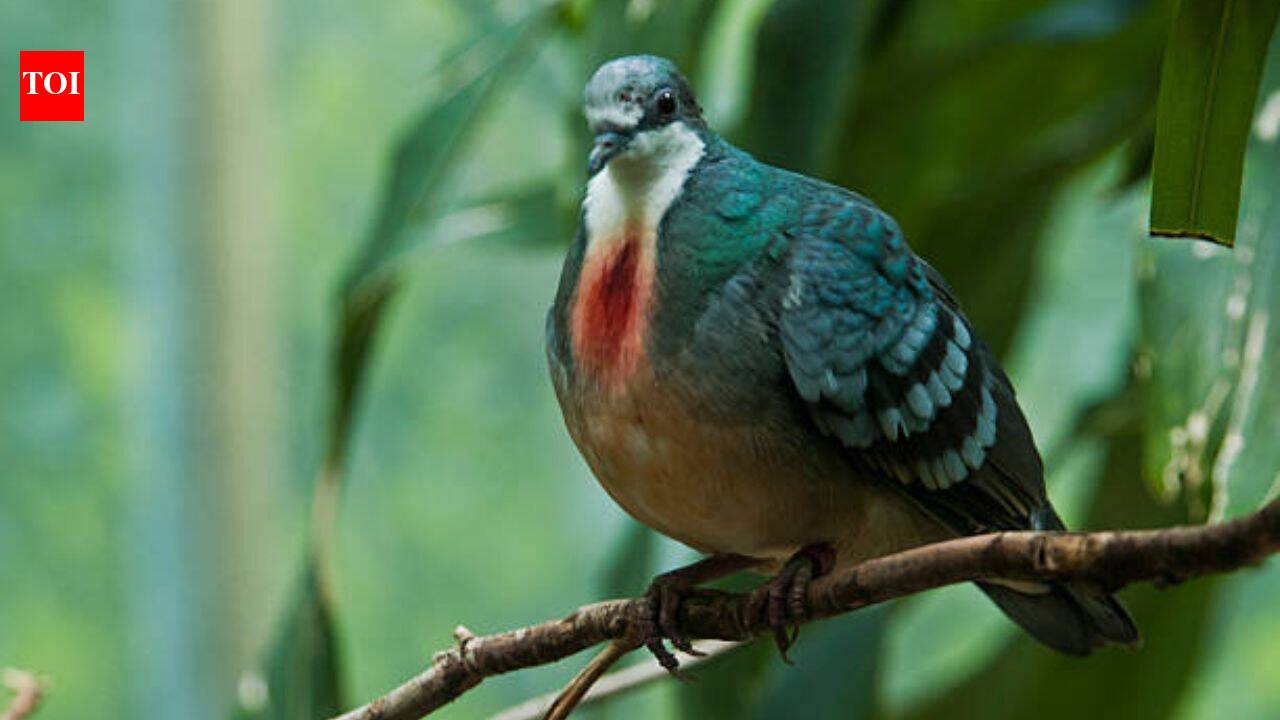
The orange-red spot on the bird's otherwise white chest along with the iridescent green plumage on its head and neck, makes it readily identifiable. asserted
it → make → head
Gonzalez also pointed to its blue-green and brown upper parts, brown wings and single whitish wing bar, which distinguish it from other Philippine bleeding hearts. asserted
which → point → hearts
They are also called 'bleeding heart' because they have a vivid red or orange patch of feathers on their white chest that looks like an open, bleeding wound. asserted
that → call → wound
The Mindoro bleeding-heart is a ground-dwelling pigeon endemic to Mindoro. asserted
heart → bleed → Mindoro
While historical accounts described it as common in the island's forests, confirmed encounters became extremely rare during the second half of the 20th century. asserted
encounters → describe → century
The last confirmed record came in 2005, when an individual was caught in a snare intended for red junglefowl near a fruiting fig tree. asserted
individual → confirm → tree
Other encounters were subsequently reported, but not all could be verified, CCIPH said. uncertain
CCIPH → report → ?
The prolonged absence led the Search for Lost Birds program to list the pigeon as a “lost” species, a designation covering birds not documented by science for at least 10 years. asserted
program → lead → years
The bird is also listed as critically endangered on the IUCN Red List, meaning it faces an extremely high risk of extinction. asserted
it → list → extinction
“Birds that find themselves on both these lists are of particular concern,” said Alex Berryman, who oversees species conservation assessments for Asia at the NGO BirdLife International. asserted
who → find → NGO
New records set asserted
records → set → ?
The species has generally been described as a lowland forest specialist, typically occurring at elevations of around 400 meters (1,300 feet), and occasionally up to 800 m (2,600 ft). asserted
species → describe → meters
But the camera trap photographed it above 900 m (nearly 3,000 ft). asserted
trap → photograph → m
“A lowland specialist appearing in high-elevation forest is not necessarily a species expanding its horizons,” CCIPH researchers wrote. asserted
researchers → appear → horizons
“It may be a species running out of lowland to live in.” uncertain
It → run → lowland
Moist lowland and transitional mid-mountain rainforest can still occur at around 900 m in the steep range, Gonzalez said. asserted
Gonzalez → occur → range
Much of the lower slopes of Puerto Galera have been degraded as tourism grows, potentially pushing the birds toward less-accessible upper forests. asserted
tourism → degrade → forests
Berryman said the high-elevation record “raises hope that there might be more out there.” uncertain
record → say → hope
Protecting the species However, the spotting is not all positive as the birds' habitat, the forest, is under threat as well. asserted
habitat → protect → threat
Berryman said the next priorities should be to safeguard as much suitable habitat as possible and conduct a comprehensive assessment of the species' population. asserted
priorities → say → population
Gonzalez called for establishing a legislated protected area covering the Mount Halcon-Mount Malasimbo Range, which he said currently has no government-designated protected area covering its entirety. asserted
he → call → entirety
Moreover, he also called for a stop to illegal logging and poaching, strengthening conservation education and preventing traps intended for red junglefowl from catching bleeding-hearts. asserted
he → call → hearts
He proposed safer trap designs and using Indigenous wildlife-tracking expertise to support regulated ecotourism. asserted
He → propose → ecotourism
“Whether it continues to beat for another twenty years or another hundred will depend on whether we treat this image merely as an extraordinary record or allow the evidence it carries to change what we do next,” the CCIPH researchers wrote. asserted
researchers → continue → what

💬Give feedback
🕘History 🎫Support