After months of anticipation, Donald Trump and 18 people who thought it was a good idea to trust Donald Trump have been indicted by a grand jury in Fulton County, Georgia.
asserted
it → think → County
Fulton County District Attorney Fani Willis — notoriously fearless, particularly of cameras — is prosecuting them on a 41-count trek through Georgia criminal law.
asserted
Willis → prosecute → law
But one law leads every story and falls from every lip — RICO.
asserted
law → lead → RICO
Yes, Ms. Willis has charged the defendants with conspiracy to violate Georgia's Racketeer Influenced and Corrupt Organizations law, commonly known as RICO, modeled on the infamous federal statute.
asserted
Willis → charge → statute
Georgia RICO’s statute contains a core prohibition:
It shall be unlawful for any person employed by or associated with any enterprise to conduct or participate in, directly or indirectly, such enterprise through a pattern of racketeering activity.
The indictment charges the defendants with violation of the conspiracy component of the statute:
It shall be unlawful for any person to conspire or endeavor to violate any of the provisions of subsection (a) or (b) of this Code section.
asserted
person → contain → section
A person violates this subsection when:
He or she together with one or more persons conspires to violate any of the provisions of subsection (a) or (b) of this Code section and any one or more of such persons commits any overt act to effect the object of the conspiracy;
asserted
one → violate → conspiracy
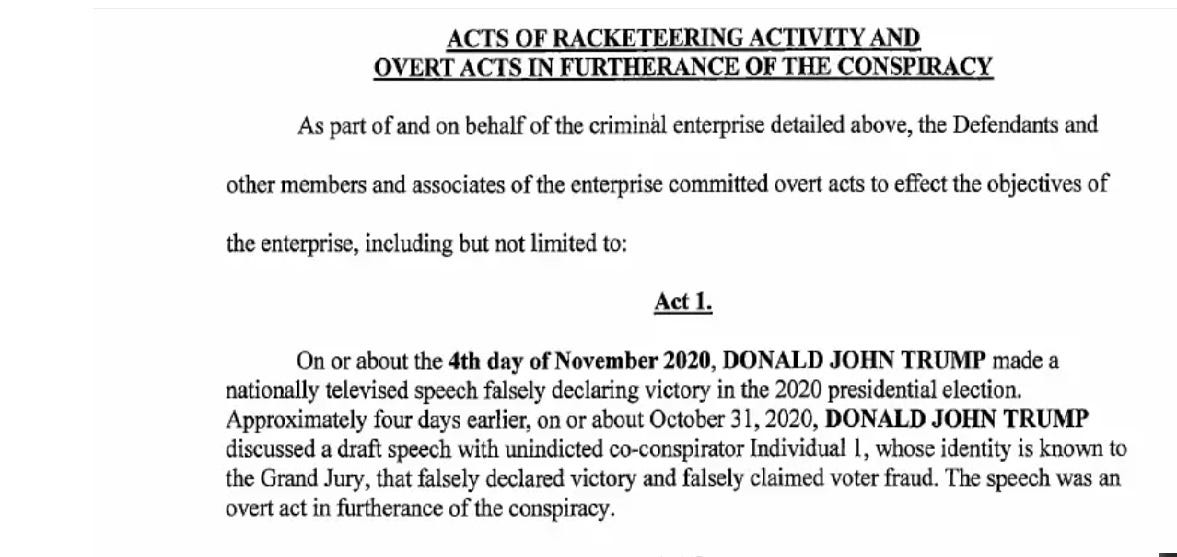
After the preliminary charging language, the indictment launches into a 52-page, 161-act list of acts committed by the defendants:
asserted
indictment → launch → defendants
This has led to much comment and confusion.
asserted
This → lead → comment
Some of it is contrived and in bad faith, some of it reflects honest concern or confusion.
asserted
some → reflect → concern
The thrust of it is this: wait, some of the acts on that list aren’t crimes, are they?
asserted
they → wait → list
And aren’t some of them speech protected by the First Amendment?
asserted
some → protect → Amendment
Here’s a not-good-faith example:
asserted
example → ’ → ?
Political theater and propaganda aside, there are some reasonable questions here: how can a tweet (like act 101) or statements at a press conference (Act 3) be a crime?
asserted
tweet → be → conference
The answer is that they’re not crimes — or, at least, that’s not what the indictment claims.
uncertain
indictment → ’re → what
They’re overt acts.
asserted
They → ’re → ?
An overt act is some step, however small, intended to promote that illegal goal.
asserted
act → intend → goal
Many conspiracy laws require — like the Georgia RICO statute here — that the government prove that at least one member of the conspiracy committed one overt act.
asserted
member → require → act
There’s no need to prove multiple overt acts, and no need to prove that each defendant committed one.
asserted
defendant → ’ → one
The requirement is a reaction to the tyrannical experiences with laws that criminalized mere thought or discussion.
asserted
that → criminalize → thought
For instance, the Treason Act of 1351 made it a crime to “compass or imagine the death of our Lord the King,” something that could be and was interpreted to cover mere discussions or idle talk without action.
uncertain
that → make → action
The Treason Act of 1351 gradually became understood to require proof of some overt act beyond mere talk, though there are disputes about whether that was mere tradition or a legal requirement, and about whether it reflected sensibilities about the adequacy of evidence of intent or some sort of minimum action requirement to qualify as a crime.
asserted
it → understand → crime
At any rate, the concept that conspiracy should require an overt act was well-developed at the time of the Constitution, as reflected in the Constitutions’ carefully narrow definition of treason:
No Person shall be convicted of Treason unless on the testimony of two Witnesses to the same overt Act, or on Confession in open Court.
asserted
Person → require → Court
All of this reflected several traditions and sensibilities.
asserted
All → reflect → traditions
The first was recent memory of how accusations of treason and conspiracy had roiled England and led to violence and tyranny.
asserted
accusations → roil → violence
Another — given the notoriously hard-drinking life of the Founders — is that what a bunch of idiots agree to do in their cups, and what they are interested into putting into effect in the morning, are two very different things.
asserted
they → give → morning
As one scholarly work puts it:
Its primary purpose is to show the operation of the conspiracy.
asserted
purpose → put → conspiracy
Put another way, the requirement of an overt act represents an acknowledgement that talk (the agreement) is cheap.
asserted
talk → put → acknowledgement
A second purpose of the overt act is to provide a locus pœnitentiæ, or a chance for a conspirator to withdraw from the conspiracy without accruing any liability.
asserted
conspirator → provide → liability
The overt act requirement is intended to limit the definition of conspiracies and ensure that only people who have actually conspired are indicted.
asserted
who → intend → conspiracies
The requirement should, for example, prevent mere braggarts from being prosecuted for “agreeing” to rob a bank or kill a political figure with whom they particularly disagree.
asserted
they → prevent → whom
So you can think of an overt act as a sort of evidentiary requirement, and overt acts as evidence of a criminal conspiracy, not as the crime themselves.
asserted
you → think → crime
These days the custom is for prosecutors to use the overt act requirement to tell the story of the case at length in the indictment.
asserted
prosecutors → use → indictment
Prosecutors also use it as a gambit to make it more likely that evidence will be admitted at trial (it’s a strong case to admit evidence of something if you’ve called it out as an overt act), and often try to connect every defendant to an overt act, even though that’s not a requirement, just so the defendant can’t say at trial “look, I didn’t even commit an overt act.”
asserted
I → use → act
Once you view overt acts as a sort of evidence, it’s easier to see why they don’t have to be crimes themselves, and why they can even be acts that would otherwise be not only legal but protected speech.
asserted
that → view → evidence
The First Amendment protects my right to indulge in nationalistic and racist rants against, say, the Belgians.
asserted
Amendment → protect → Belgians
If my friends and I engage in loud calls to kill all the Belgians, and walk up and down my Belgian neighbor’s house observing the entrances and exits, and if I ask my priest whether it is morally and scripturally appropriate to kill the Belgians, all of those things are legal and protected by the First Amendment.
asserted
all → engage → Amendment
But if my Belgian neighbor winds up murdered in his bed, those things are all evidence that I did it and of my intent when I did it, and also potentially overt acts in a conspiracy with my anti-Belgian friends to do it.
asserted
I → wind → it
“The overt act, without proof of which a charge of conspiracy cannot be submitted to the jury, may be that of only a single one of the conspirators, and need not be itself a crime.”
uncertain
charge → submit → conspirators
Somewhat less clear is the concept that an overt act — since it is only evidence of the criminal conspiracy, not the crime itself — may be speech protected by the First Amendment.
uncertain
it → protect → Amendment
Back 1957 in Justices Black and Douglas, two of the most important thinkers on the First Amendment, had a rip-snorting debate on this concept in the dissent to one of the anti-Communist cases, arguing rather persuasively that at the least the government should have to prove at least one overt act not protected by the First Amendment in order to convict someone of conspiracy.
asserted
government → have → conspiracy
…and 46 more, not listed.
 The Aporia