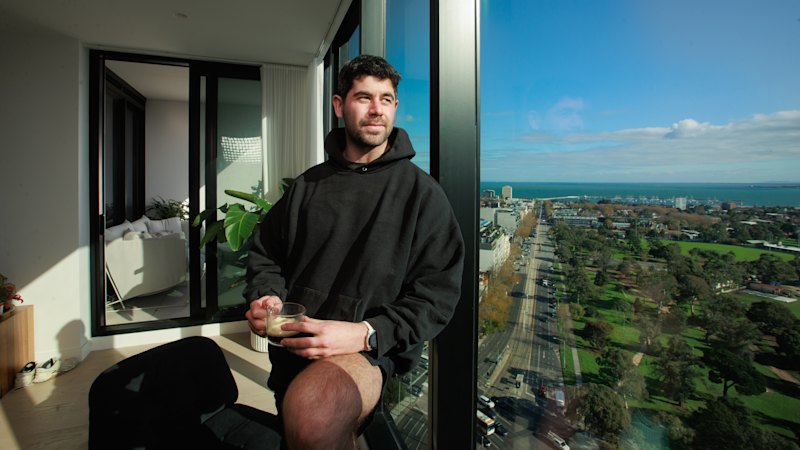
Travis Fein’s St Kilda Junction apartment has one of the most seductive views of Melbourne that money can buy.
asserted
money → have → that
On an upper floor in one of St Kilda’s tallest towers, his unit’s floor-to-ceiling windows give an uninterrupted view of the patchwork of open spaces around Albert Park Lake, Middle Park’s multimillion-dollar cottages far below and the curved shoreline of Port Phillip Bay beyond.
asserted
windows → give → Bay
But Fein didn’t buy the view; he leased it.
asserted
he → buy → it
The 28-year-old property investor and social media identity sold his apartment and moved into a two-bedroom pad in Beach House, a 297-unit build-to-rent development that towers over St Kilda’s northern gateway.
asserted
that → sell → gateway
Fein pays $1275 a week for his luxe apartment, virtually double St Kilda’s $650 median price for a two-bedroom unit.
asserted
Fein → pay → unit
“But for context on that – because that’s a big number – it’s a beautiful apartment,” he said.
asserted
he → ’ → that
“I have Albert Park views, beach views, city views, so it’s one of the top-tier apartments.”
asserted
it → have → apartments
Built by Melbourne developer Gurner Group for $300 million, Beach House bills itself as a place to “live like a millionaire, mortgage free”.
asserted
House → build → millionaire
Its amenities would not be out of place on a cruise ship: a heated pool lined with banana lounges, dimly lit billiards room, 10-pin bowling alley, cinema, plush private bar with city views, day spa, pet spa.
asserted
amenities → line → views
The opulent complex is part of Melbourne’s first wave of build-to-rent developments, inner-city buildings marketed at lifestyle-conscious renters happy to pay over the odds for a central pad with perks.
asserted
complex → rent → perks
”To be able to just use a sauna, ice bath and the whole wellness area and then go home to sleep, you’d need to spend $30,000 to $40,000 to have that at home privately,” Fein said.
asserted
Fein → use → home
“You’re not paying for a normal rental.
asserted
You → pay → rental
You’re paying for a nice lifestyle, which would cost a shit-ton of money otherwise.”
asserted
which → pay → money
Footloose, financially flush and renting because he wants to, Fein could be a poster child for Melbourne’s burgeoning build-to-rent housing market, which has burst out of the ground and into the city’s skyline with a promise to make renting simultaneously more glamorous and more secure.
uncertain
renting → rent → promise
Governments desperate for solutions to the housing crisis have laid out the welcome mat for some of Australia’s biggest builders, including Lendlease, Mirvac, Grocon and Salta, along with operators from the US, Japan and Singapore.
But some experts say the influx of high-priced housing is doing nothing to ease Melbourne’s rental affordability crisis.
asserted
influx → lay → crisis
An analysis by The Age of 12 months of rental data from hundreds of listings at 14 completed build-to-rent developments bears out this criticism: they are 20 to 70 per cent more expensive on average than other nearby rental homes.
asserted
they → complete → homes
Meanwhile, some tenants interviewed for this story have said the experience does not live up to the glamorous sales pitch, or justify the high-end rents.
asserted
experience → interview → rents
Build-to-rent isn’t mainstream housing.
asserted
Build → build → rent
It’s pitched at a select cohort with money to spare.
asserted
It → pitch → money
But the model is muscling in on Melbourne’s struggling apartment sector so rapidly that some property analysts predict it will soon grow to be a major player in the rental market.
asserted
it → muscle → market
One set of numbers, calculated by property advisory firm Charter Keck Cramer, captures the seismic shift under way.
asserted
set → calculate → way
In 2021, an estimated 14,000 new apartments were built in Melbourne.
asserted
apartments → estimate → Melbourne
Not one was a build-to-rent unit.
asserted
one → build → rent
In the 12 months to July 2026, an estimated 8200 new apartments were built in Melbourne.
asserted
apartments → estimate → Melbourne
More than half of them, 4400, were build-to-rent.
asserted
half → build → rent
It’s the first time the incipient housing model has overtaken the delivery of conventional (or build-to-sell) apartments in Melbourne, or any other Australian city.
asserted
model → ’ → Melbourne
Build-to-rent towers have sprung up around Docklands, South Melbourne and Southbank, near train stations and tram lines in Kensington and Brunswick, and along the city’s hippest high streets in Fitzroy and Collingwood.
asserted
towers → build → Fitzroy
Several thousand more are in the pipeline, funded by a mix of domestic and foreign institutional capital that is swooping in to take advantage of federal and state tax breaks and friendly planning laws aimed at buoying investment in build-to-rent (BTR) housing.
asserted
that → fund → housing
Projects that had previously stalled are being revived and repurposed as build-to-rent:
asserted
that → stall → ?
Southbank’s STHBNK, conceived and sold off-the-plan as Australia’s tallest apartment building, were altered last month to a smaller build-to-rent tower.
asserted
STHBNK → conceive → tower
Plans for a 39-storey CBD office tower on Lonsdale Street were also dumped in August in favour of build-to-rent.
asserted
Plans → dump → rent
Multiple BTR high-rises have just been approved around Arden underground station.
asserted
rises → approve → station
It’s a remarkable rise for a sector that barely existed in Australia five years ago.
asserted
that → ’ → Australia
But housing analysts warn the boom is a symptom of a dysfunctional housing market in which the annual number of new apartments being built in Melbourne has shrunk to lows last seen in the global financial crisis, while the city absorbs well over 100,000 new residents each year.
asserted
city → warn → residents
“I remember the good old days in 2016 and 2017, when we did 19,000 [new apartments a year]; that’s really the level that we should be building to bring Melbourne back into balance,” Charter Keck Cramer national executive director Richard Temlett said.
asserted
Temlett → remember → balance
“People still need a place to live, and a lot more of them are just being forced to rent.”
asserted
lot → need → them
“We drive to a house in Preston
We see police arresting
A man with his hand in a bag
How’s that for first impressions?
This place seems depressing
It’s a California bungalow in a cul-de-sac.”
Melbourne singer-songwriter Courtney Barnett’s 2015 tune Depreston was a forlorn indie anthem for a generation who believed ever-escalating property prices – up more than 400 per cent in Melbourne since 2000 – had denied them the Australian dream.
asserted
prices → drive → dream
Renting has historically been a transitional form of housing for most Australians, said Dr Tom Alves, acting managing director of the Australian Housing and Urban Research Institute.
asserted
Alves → say → Institute
But in the 21st century, a growing cohort of lifelong renters has emerged.
asserted
cohort → grow → renters
In two generations, Australians aged 25 to 34 have changed from mostly home owners to mostly renters.
asserted
Australians → age → renters
…and 90 more, not listed.
 The Aporia