In 1989, Detroit Zoo began saving lost snails; 37 years later, 500 head 5,000 miles to Tahiti

World News, Today World News, Latest International News, World Breaking News, Trending News of World - Times of India · collected 2026-09-04 · by TOI Science Desk
Read the original at World News, Today World News, Latest International News, World Breaking News, Trending News of World - Times of India ↗

Summary

A decades-long conservation effort by the Detroit Zoo has led to the release of 500 Partula snails, part of an international program that has returned over 17,000 snails to their native islands in French Polynesia. The zoo began breeding and caring for these endangered snails in 1989 after invasive predators caused their populations to collapse. The latest shipment will be released into the wild on Tahiti, more than 5,000 miles from Michigan. This effort has successfully reintroduced 11 Partula species that were once considered extinct in the wild.
Written by the local model on 2026-09-04, using this article's own text rather than the other coverage of the same event (that is the story summary below).

Signals How these are calculated →

Claims extracted
39
claim-shaped sentences
Uncertain
10%
4 of 39 hedged
Leaning
not political
takes no side on a contested political question
Publisher trust
94.3
red-flag proxy, not a credibility rating
Outlets on this story
1
Environment
Narrative spread
1
articles carrying this framing
Analyzed 2026-09-04 · how these are computed

AI analysis (generated at analysis time, not now)

Story summary

Five hundred Partula snails raised at the Detroit Zoo are being transported over 5,000 miles from Michigan to Tahiti, where they will be released into the wild as part of a conservation effort. This journey is the result of a long-running project that began 37 years ago in 1989, when the Detroit Zoo started saving lost snails and breeding them to help restore populations of these endangered native snails. The Detroit Zoological Society has been involved in this international conservation program, which has successfully returned over 17,000 Partula snails to their native islands. This effort has also helped bring back 11 extinct species** of Partula snails that were once thought to be gone forever. The project is aimed at restoring the populations of these small, tree-dwelling mollusks after an invasive predator, the rosy wolf snail, caused their numbers to collapse in the wild.

Written for “Detroit Zoo Snail Migration” on 2026-09-05, grounded in this article and the 0 other(s) covering the same event.
Why this leaning score
This article does not take a side on a contested political question, so it has no leaning score. That is an answer rather than a gap: a match report or a rescue can be warmly or critically written without being left or right, and scoring it anyway is how approval of a subject gets recorded as a political position.
No political leaning scored for article 4001 · logged 2026-09-04

Story

📰 Detroit Zoo Snail Migration
Environment · 1 article(s) covering the same event. This is the one the site leads with.

How this is being covered How these are calculated →

Article leaning vs. publisher reliability
Source leaning vs. consistency

Compared with similar articles

Nothing to compare against. No article is close enough to this one for the pipeline to have linked or judged the pair.

Publisher

World News, Today World News, Latest International News, World Breaking News, Trending News of World - Times of India · 176 article(s) · 0 correction(s) detected
SignalValueWeight
Correction rate 0.000 0.4
Uncertainty density 0.115 0.25
Assertive mismatch rate 0.000 0.35
No corrections detected for this publisher. That may mean careful reporting, or simply that nothing has been checked.

Who wrote this

TOI Science Desk
28 article(s) here · 1 carrying a prediction
🔮 A single breeding pair of rats could, within a few years, rebuild a population large enough to threaten seabirds again.
🔮 The study looks at the Kv1.3 voltage-gated potassium channel, an ion channel found on immune cells that researchers believe may help control neuroinflammation linked to Alzheimer’s disease and other neurodegenerative conditions.
🔮 In the summer of 2026, workers and residents around the Williston Reservoir in northern British Columbia witnessed something that sounded like folklore: a large, forested island broke free from the shoreline, drifted across the lake, disappeared from view, and then turned up again about 30 kilometres away, still carrying mature trees, nesting birds and other wildlife.
🔮 During more than 35 years of service, the warship completed three combat deployments during the Vietnam War before being officially decommissioned in May 2000.
🔮 Other encounters were subsequently reported, but not all could be verified, CCIPH said.
🔮 At first he wondered if he could manage the vast clearing alone, as he had never done such work before.
🔮 “The result of our monitoring indicates that maybe dozens of excavators are suspected of operating in the Jantho forest area,” said Afifuddin, campaign and advocacy lead at the provincial chapter of the Indonesian Forum for the Environment (Walhi).
🔮 Five hundred Partula snails raised at the Detroit Zoo are travelling more than 5,000 miles from Michigan to Tahiti, where they will be released into the wild as part of a long-running effort to restore populations of these endangered native snails.
🔮 To see whether replacing the lost calcium could help, scientists launched a whole-ecosystem restoration project.
🔮 A surface may be able to radiate heat towards the sky, but if it absorbs too much sunlight during the day, the solar heating can cancel much of that benefit.
Wire or desk byline, not an individual reporter.
Also by TOI Science Desk
Rat-free Lundy sees puffin numbers soar as more than 40,000 seabirds return
2026-09-05 · World News, Today World News, Latest International News, World Breaking News, Trending News of World - Times of India
Meet Lilah Mehta, the Connecticut high-school student who entered a Yale lab at 16
2026-09-05 · World News, Today World News, Latest International News, World Breaking News, Trending News of World - Times of India
Floating forest vanishes, reappears 30 km away with wildlife still aboard
2026-09-05 · World News, Today World News, Latest International News, World Breaking News, Trending News of World - Times of India
In 2002, South Australia sank ex-HMAS Hobart in under 3 minutes; 18 years later...
2026-09-04 · World News, Today World News, Latest International News, World Breaking News, Trending News of World - Times of India
Nothing else under this byline is closely related to this article, so these are simply their most recent.
All 28 articles by TOI Science Desk →

Topics

French Polynesia Michigan Tahiti the Detroit Zoo the Detroit Zoological Society

Subjects

the Detroit Zoo ORG · 6× Tahiti GPE · 4× Michigan GPE · 2× the Detroit Zoological Society ORG · 2× French Polynesia GPE · 1× Royal Oak GPE · 1×

Narrative

Five hundred Partula snails raised at the Detroit Zoo are travelling more than 5,000 miles from Michigan to Tahiti, where they will be released into the wild as part of a long-running effort to restore populations of these endangered native snails.
framing: assertive · carried by 1 article(s) · first seen 2026-09-04
🔮 Five hundred Partula snails raised at the Detroit Zoo are travelling more than 5,000 miles from Michigan to Tahiti, where they will be released into the wild as part of a long-running effort to restore populations of these endangered native snails.
2026-09-04 · World News, Today World News, Latest International News, World Breaking News, Trending News of World - Times of India
In 1989, Detroit Zoo began saving lost snails; 37 years later, 500 head 5,000 miles to Tahiti · assertive framing

Claims (39 extracted, 4 hedged)

A conservation effort that began nearly four decades ago is sending hundreds of tiny snails on a remarkable journey back to their native home. asserted
that → begin → home
Five hundred Partula snails raised at the Detroit Zoo are travelling more than 5,000 miles from Michigan to Tahiti, where they will be released into the wild as part of a long-running effort to restore populations of these endangered native snails. asserted
they → raise → snails
According to the Detroit Zoological Society, the latest shipment is part of an international conservation program that has returned more than 17,000 Partula snails to their native islands. uncertain
that → accord → islands
The Detroit Zoo has been involved in the effort since 1989, helping breed and care for the snails after invasive predators caused their populations to collapse in the wild. asserted
populations → involve → wild
The broader program has helped return 11 Partula species that were once considered extinct in the wild. asserted
that → help → wild
A decades-long effort Partula snails are small, tree-dwelling mollusks native to islands in French Polynesia. asserted
snails → dwell → Polynesia
Although they may seem insignificant compared with larger endangered animals, several Partula species faced a severe population collapse after an invasive predator was introduced to the islands. uncertain
predator → seem → islands
The predator was the rosy wolf snail, which had itself been brought to the islands in an attempt to control another invasive snail. asserted
itself → bring → snail
Instead, it preyed on native Partula snails, contributing to the disappearance of several species from the wild. asserted
it → prey → wild
The crisis prompted conservationists and zoos to establish captive populations. asserted
crisis → prompt → populations
The Detroit Zoo became involved in this work in 1989, helping breed and care for Partula snails with the eventual goal of returning them to their natural environment. asserted
Zoo → become → environment
That work has continued for 37 years. asserted
work → continue → years
500 snails head home Five hundred adult Partula snails raised at the Detroit Zoo are beginning their journey from Royal Oak, Michigan, to Tahiti. asserted
snails → head → Tahiti
The trip covers more than 5,000 miles, but the journey is more than simply moving captive animals from one location to another. asserted
journey → cover → another
The snails are being sent as part of a coordinated effort to rebuild populations in the forests where their species originally lived. asserted
species → send → forests
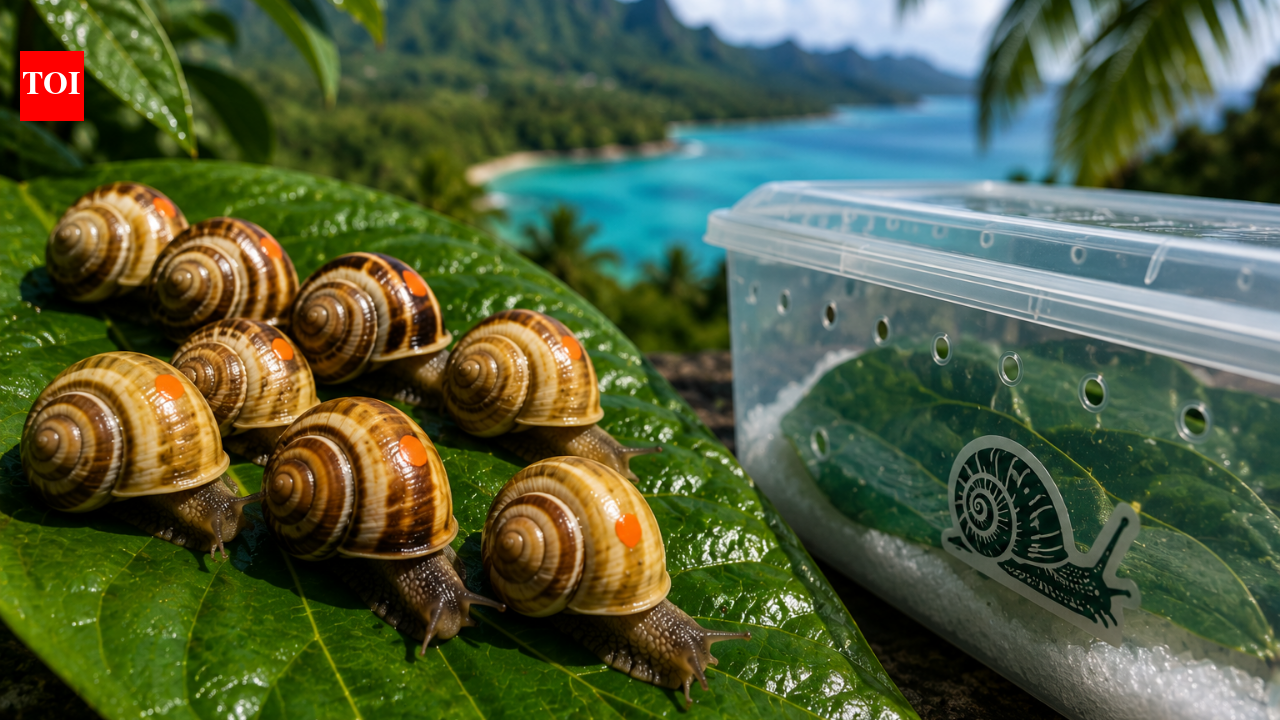
Before leaving, each snail receives a small orange dot of animal-safe paint on its shell. asserted
snail → leave → shell
The marking is designed to glow under ultraviolet light, allowing conservationists in Tahiti to distinguish the 2026 release group from snails released in previous years. asserted
conservationists → design → years
A different paint colour is used for each year's release, giving researchers a practical way to track individual release groups after they enter the wild. asserted
they → use → wild
The species is currently classified as Extinct in the Wild, meaning it survives under human care but does not have a known surviving wild population. asserted
it → classify → population
Conservation breeding provides a way to prevent such species from disappearing completely. asserted
breeding → provide → species
Zoos and other institutions can maintain genetically viable populations while conservationists work to create conditions for their eventual return. asserted
conservationists → maintain → return
According to the Detroit Zoo, its conservation partners have documented wild-born offspring following earlier Partula reintroductions. uncertain
partners → accord → reintroductions
Such reproduction is an important step because simply releasing captive-bred animals is not enough to establish a self-sustaining population. asserted
releasing → release → population
The animals must survive, reproduce and contribute to future generations in their native habitat. asserted
animals → survive → habitat
More than 17,000 returned asserted
17,000 → return → ?
The 500 snails travelling to Tahiti represent only a small part of the broader recovery program. asserted
snails → travel → program
According to the Detroit Zoological Society, more than 17,000 Partula snails have been reintroduced through the collaborative effort. uncertain
snails → accord → effort
The program has also returned 11 Partula species that were once considered extinct in the wild to their native islands. asserted
that → return → islands
That figure illustrates how conservation programs can operate over long periods. asserted
programs → illustrate → periods
Instead of producing an immediate result, captive breeding and reintroduction can require years of animal care, monitoring and repeated releases. asserted
breeding → produce → care
For the Detroit Zoo, the current shipment is another stage in a program that connects its animal-care facilities in Michigan with conservation sites thousands of miles away in French Polynesia. asserted
that → connect → Polynesia
Protecting more than a species asserted
Protecting → protect → species
The importance of Partula recovery also extends beyond biodiversity. asserted
importance → extend → biodiversity
The Detroit Zoological Society notes that Partula snails have cultural significance in Polynesia. asserted
snails → note → Polynesia
Their distinctive shells have been associated with different islands, giving the animals a place in the region's cultural heritage. asserted
shells → associate → heritage
Their return therefore represents more than restoring populations of small forest snails. asserted
return → represent → snails
It also helps reconnect native wildlife with the ecosystems and cultural landscapes where these species evolved. asserted
species → help → ecosystems
After 37 years of captive breeding and conservation work, the latest 500 snails are now taking another step toward that goal. asserted
snails → take → goal
Their journey from Michigan to Tahiti shows how a species that disappeared from the wild can, with sustained international cooperation, begin making its way back. asserted
that → show → way

💬 Give feedback
🕘 History 🎫 Support