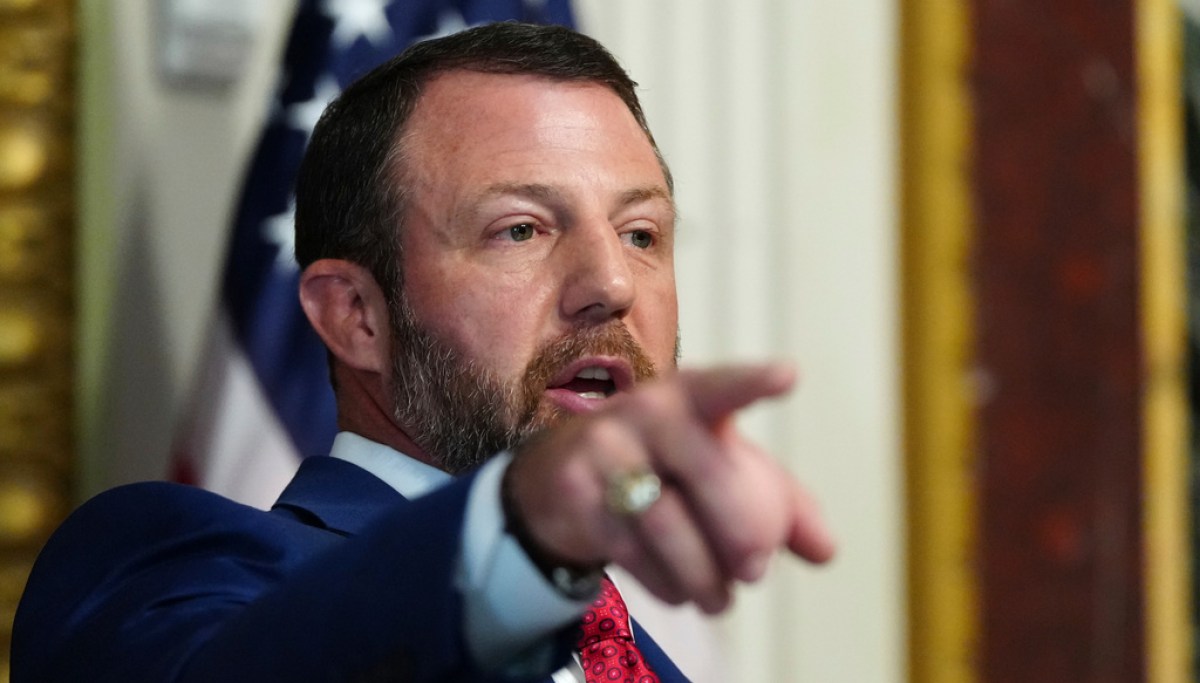
Homeland Security Secretary Markwayne Mullin asked the Justice Department this week to review whether election-related nonprofit groups, some with multimillion-dollar backing from a Mark Zuckerberg-linked nonprofit, improperly received sensitive state motor vehicle and voter-registration data.
asserted
groups → ask → data
In a letter sent Wednesday to Attorney General Todd Blanche, Mullin raised possible violations of the federal Driver’s Privacy Protection Act involving the Electronic Registration Information Center, known as ERIC, and the Center for Election Innovation and Research, or CEIR.
asserted
Mullin → send → Innovation
The Washington Examiner obtained a copy of the four-page letter, which the White House also released on Friday.
asserted
House → obtain → Friday
“Generally, we asked DOJ to review the legality of ongoing sharing of state motor vehicle data and voter registration data with several private non-profit non-governmental organizations,” Mullin wrote in the four-page document addressed to Blanche.
asserted
Mullin → ask → Blanche
Mullin said Department of Homeland Security representatives first raised the data-sharing concerns with DOJ officials last September.
asserted
representatives → say → officials
The letter did not suggest any ongoing DOJ investigation, criminal charge, or legal conclusion.
asserted
letter → suggest → investigation
But it surfaced concerning allegations of potential violations of the Driver’s Privacy Protection Act, which limits the disclosure and use of personal information held by state motor vehicle agencies.
asserted
which → surface → agencies
Mullin accused ERIC of exposing “millions of citizens’ sensitive private data to unknown contractors, subcontractors, and agents,” potentially in violation of the law.
asserted
Mullin → accuse → law
ERIC is a nonprofit membership organization created and governed by state election officials.
asserted
ERIC → create → officials
It uses voter-registration and motor vehicle data to help states identify inaccurate voter rolls, potential duplicate registrations, deceased registrants, and people who may be eligible to vote but are not registered.
uncertain
who → use → rolls
The letter said ERIC’s model agreement required member states to share all licensing or identification records from their motor vehicle agencies at least every 60 days.
asserted
agreement → say → agencies
Mullin wrote that the data fields included Social Security and driver’s license numbers.
asserted
fields → write → numbers
ERIC has not responded to a request for comment, but it states on its website that members submit Social Security and driver’s license information only after it has been cryptographically hashed, meaning the values are not human-readable.
asserted
values → respond → information
The group also said its eligible-but-unregistered reports contain limited contact information, not Social Security, driver’s license, or state identification numbers, and that only ERIC employees process member data.
asserted
employees → say → data
Letter ties ERIC data to CEIR
Mullin wrote that ERIC shared protected motor vehicle data with CEIR before the 2020 election.
asserted
ERIC → tie → election
He said CEIR received more than $70 million from a Chan Zuckerberg 501(c)(3) organization and provided grants to state election officials who agreed to turn over sensitive data.
asserted
who → say → data
The letter cited Pennsylvania’s roughly $13 million 2020 CEIR grant agreement, which required the state to cooperate with CEIR, “including providing data, as CEIR reasonably requests.”
asserted
CEIR → cite → data
Mullin wrote that the requested information included motor vehicle data that Pennsylvania had originally shared with ERIC and that CEIR used to create lists of people eligible but unregistered to vote.
asserted
CEIR → write → people
CEIR said its 2020 voter-education program received support from Priscilla Chan and Zuckerberg and distributed nearly $65 million to states to promote nonpartisan public information about voting options, polling places, voting hours, and pandemic-related election changes.
asserted
program → say → options
Its report listed Pennsylvania’s grant at about $13.26 million.
asserted
report → list → million
Mullin said ERIC officials had argued that the data transfer to CEIR fell under the Driver’s Privacy Protection Act’s research exception.
asserted
transfer → say → exception
That exception permits disclosures for research or statistical reports only if the personal information is not published, publicly disclosed, or used to contact people.
asserted
information → permit → people
He also cited Georgia emails obtained through a public records request that he said showed CEIR was “coordinating ERIC EBU outreach” to contact people identified in motor vehicle files.
asserted
CEIR → cite → files
EBU stands for “eligible but unregistered” to vote.
asserted
EBU → stand → ?
CEIR says DHS ‘did not contact’ it
CEIR Executive Director David Becker disputed Mullin’s account in a statement on Friday, saying the allegation concerned research the group conducted during the 2020 election to measure whether voluntary state outreach to people identified as EBUs increased voter registration.
asserted
outreach → say → registration
CEIR’s 2022 report said it worked with election officials in eight states, which sent the mailers and provided EBU lists and voter files for the study.
asserted
which → say → study
Becker said CEIR does not receive motor vehicle or voter data on an ongoing basis, condition grants on access to sensitive information, or use such information for partisan purposes.
asserted
CEIR → say → purposes
He also said “DHS did not contact CEIR for any information or clarification prior to issuing this letter,” adding CEIR “welcomes any opportunity to further clarify the nature of the research it conducted in partnership with the states.”
asserted
it → say → states
Becker also pointed to a June ruling in which U.S. District Judge William Conley dismissed a Driver’s Privacy Protection Act lawsuit brought by the 1789 Foundation, which does business as Citizen AG, against ERIC and Becker.
asserted
which → point → ERIC
Conley, an appointee of former President Barack Obama, dismissed the case without prejudice for lack of subject matter jurisdiction and granted the defendants’ sanctions motions.
asserted
Conley → dismiss → motions
Colorado list included 30,000 noncitizens
Mullin also said ERIC’s 2022 eligible-but-unregistered list in Colorado included 30,000 noncitizens who received voter-registration invitations from the Colorado secretary of state.
asserted
who → include → state
The letter said Colorado later identified the error and “appli[ed] several efforts to prevent or reject anyone not eligible to vote from registering.”
asserted
Colorado → say → anyone
ERIC’s model agreement barred member states from transmitting records containing information indicating that a person was not a U.S. citizen.
asserted
person → bar → information
Mullin argued that the restriction conflicted with ERIC’s use of motor vehicle records to identify people for voter-registration outreach.
asserted
restriction → argue → outreach
While the letter did not allege that the 30,000 noncitizens registered or cast ballots, it described the episode as one that raised concerns about the possibility of noncitizen registration in other states.
asserted
that → allege → states
Mullin also argued that most people identified as eligible but unregistered had already declined a chance to register when they visited a state motor vehicle agency.
asserted
they → argue → agency
Mullin argued that using protected motor vehicle data to contact people who had already declined voter registration could diminish ERIC’s claim that the practice fit the privacy law’s exemptions for government functions or research.
uncertain
practice → argue → functions
The letter came as DHS began a more aggressive campaign of investigating election-related criminal offenses this week in Washington, Wisconsin, Missouri, Georgia, California, Pennsylvania, Nevada, New York, and Connecticut.
asserted
DHS → come → Washington
The DOJ on Friday announced charges against five individuals for fraudulent registration in the 2022 and 2024 elections.
asserted
DOJ → announce → elections
The Washington Examiner contacted the DOJ and ERIC for comment.
asserted
Examiner → contact → comment
 The Aporia