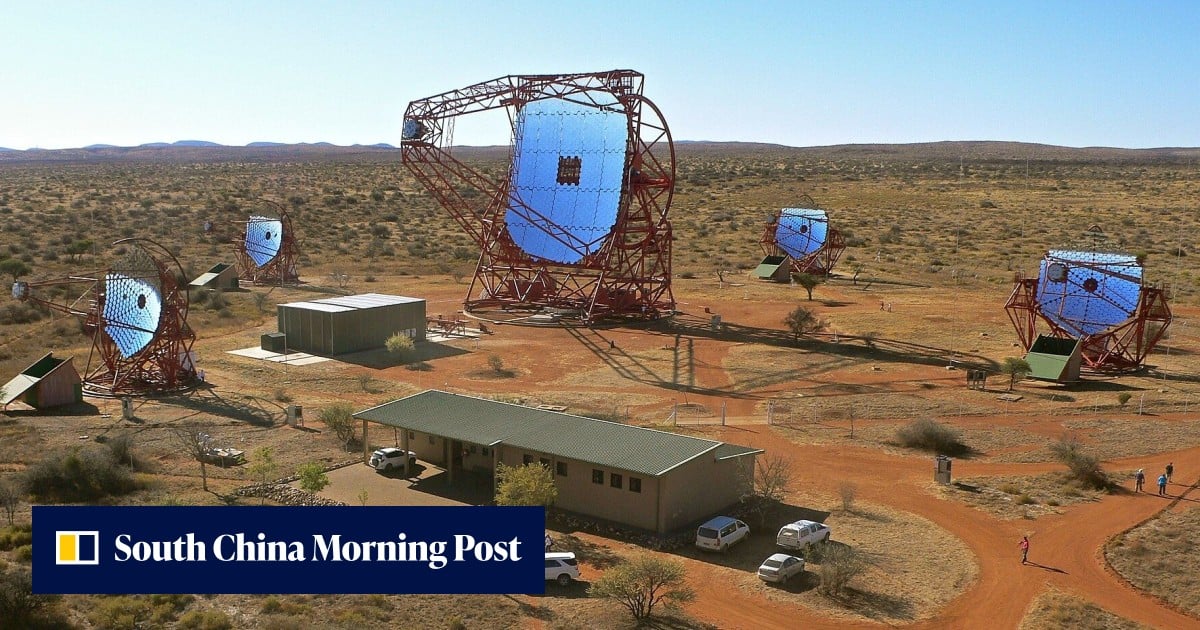
Chinese team extracts uranium from seawater at 8 times the US target rate

News - South China Morning Post · collected 2026-09-04 · by Ling Xin
Read the original at News - South China Morning Post ↗

Summary

A Chinese research team at the Chinese Academy of Sciences in Qingdao has developed a material called PhosCage, which they claim can extract uranium from seawater more efficiently than previously thought possible. The researchers achieved an extraction rate 8 times higher than the US target rate, capturing 22.55mg per gram of uranium over seven cycles of reuse. This breakthrough uses a sponge-like molecular structure that acts as a chemical trap to capture the nuclear fuel. The team believes this novel approach could lay the groundwork for large-scale uranium recovery from seawater.
Written by the local model on 2026-09-04, using this article's own text rather than the other coverage of the same event (that is the story summary below).

Signals How these are calculated →

Claims extracted
5
claim-shaped sentences
Uncertain
0%
0 of 5 hedged
Leaning
not political
takes no side on a contested political question
Publisher trust
94.5
red-flag proxy, not a credibility rating
Outlets on this story
1
Science
Narrative spread
1
articles carrying this framing
Analyzed 2026-09-04 · how these are computed

AI analysis (generated at analysis time, not now)

Story summary

A Chinese research team, affiliated with the *Chinese Academy of Sciences* in *Qingdao*, has developed a material called PhosCage that can extract uranium from seawater at an impressive rate. The team claims their method opens up a new approach to recovering nuclear fuel from oceans worldwide. Using millimeter-sized beads** made from PhosCage, they were able to capture *22.55mg of uranium per gram* and maintain this effectiveness through seven cycles of reuse. This achievement exceeds the target extraction rate set by the US, which is at a much slower pace. The success of PhosCage has potential for large-scale use in the future.

Written for “China's Seawater Uranium Discovery” on 2026-09-05, grounded in this article and the 0 other(s) covering the same event.
Why this leaning score
This article does not take a side on a contested political question, so it has no leaning score. That is an answer rather than a gap: a match report or a rescue can be warmly or critically written without being left or right, and scoring it anyway is how approval of a subject gets recorded as a political position.
No political leaning scored for article 3870 · logged 2026-09-04

Story

📰 China's Seawater Uranium Discovery
Science · 1 article(s) covering the same event. This is the one the site leads with.

How this is being covered How these are calculated →

Article leaning vs. publisher reliability
Source leaning vs. consistency

Compared with similar articles

Nothing to compare against. No article is close enough to this one for the pipeline to have linked or judged the pair.

Publisher

News - South China Morning Post · 124 article(s) · 0 correction(s) detected
SignalValueWeight
Correction rate 0.000 0.4
Uncertainty density 0.110 0.25
Assertive mismatch rate 0.000 0.35
No corrections detected for this publisher. That may mean careful reporting, or simply that nothing has been checked.

Who wrote this

Ling Xin
2 article(s) here · 0 carrying a prediction
🔮 The project will involve partners from at least five other countries as they track the development of space weather China has started an international project to build a three-dimensional satellite network between Earth and the moon that will track solar activity and study some of the universe’s most powerful explosions.
Also by Ling Xin
Nothing else under this byline is closely related to this article, so these are simply their most recent.

Topics

CAS Chinese PhosCage Qingdao the Chinese Academy of Sciences

Subjects

CAS ORG · 1× Chinese NORP · 1× Qingdao GPE · 1× Qingdao Institute of Bioenergy and Bioprocess Technology ORG · 1× the Chinese Academy of Sciences ORG · 1×

Narrative

Researchers developed a material that they say opens up a ‘novel approach’ to recover the nuclear fuel from the world’s oceans The team from the Chinese Academy of Sciences in Qingdao did this using a material they developed called PhosCage – a sponge-like molecular structure filled with phosphate groups that act as chemical traps.
framing: assertive · carried by 1 article(s) · first seen 2026-09-04
2026-09-04 · News - South China Morning Post
Chinese team extracts uranium from seawater at 8 times the US target rate · assertive framing

Claims (5 extracted, 0 hedged)

Chinese team extracts uranium from seawater at 8 times the US target rate asserted
team → extract → rate
Researchers developed a material that they say opens up a ‘novel approach’ to recover the nuclear fuel from the world’s oceans The team from the Chinese Academy of Sciences in Qingdao did this using a material they developed called PhosCage – a sponge-like molecular structure filled with phosphate groups that act as chemical traps. asserted
that → develop → traps
They then turned PhosCage into millimetre-sized beads that are easier to deploy and retrieve in the open ocean. asserted
that → turn → ocean
The beads captured 22.55mg per gram and continued to work through seven cycles of reuse. asserted
beads → capture → reuse
“This work opens up a novel approach to extracting uranium from seawater and lays the groundwork for adsorbents that can capture more uranium and eventually be used on a large scale,” the team from the CAS’ Qingdao Institute of Bioenergy and Bioprocess Technology said in the statement. asserted
team → open → statement
💬 Give feedback
🕘 History 🎫 Support