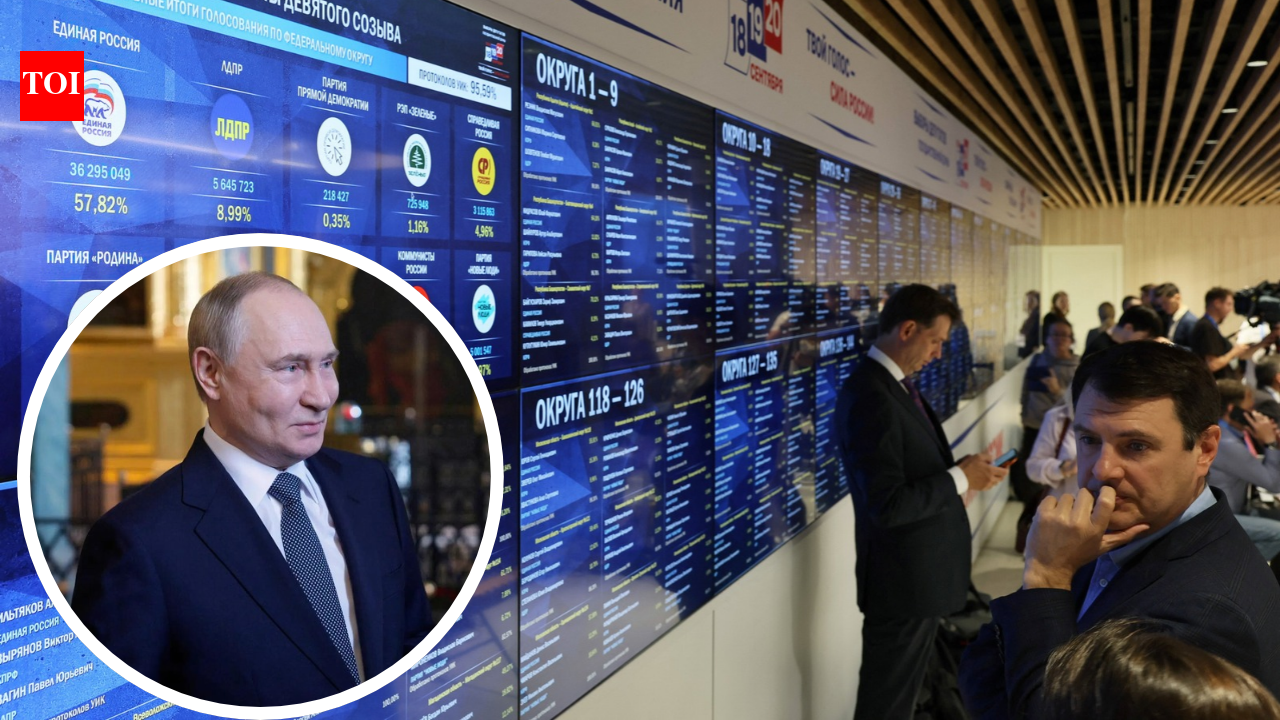
Often during his international engagements, the one question that infuriates Russian President Vladimir Putin the most is if Russia is a “managed democracy”.
asserted
Russia → infuriate → Putin
He has been vehement in saying it’s not.
asserted
it → say → ?
“The road to democracy must be adapted to the realities of Russian life, traditions, and history,” Mr. Putin said in February 2005 at a press conference after the Bratislava Summit, attended also by the then U.S. President, George W. Bush.
asserted
Putin → adapt → President
Mr. Putin’s party, United Russia, is the big bear that wins almost all elections in Russia.
asserted
that → win → Russia
In the just-concluded parliamentary elections, United Russia got 349 out of the 450 seats in the Duma, polling 58% of the vote for the 225 seats apportioned by parties and winning 209 single-seat races that fill the other half of the lower chamber of Parliament.
asserted
that → conclude → Parliament
The vote, western observers said, was flawed.
asserted
observers → say → ?
In August, Russia’s Supreme Court barred Yabloko, the only party running on an anti-war platform, from appearing on the ballot, as polls showed it gaining in popularity and possibly poised to win enough votes to enter Parliament.
uncertain
it → bar → Parliament
The result of Russia’s March 15-17 election was known to everyone even before the first ballot was cast, The Hindu noted in its editorial, as Mr. Putin won nearly 88% of the vote.
asserted
Putin → know → vote
The country saw a record turnout of 77.44%, and the results showed that Russia “is united” under the long-time leader, Ella Pamfilova, Election Commission chief, said.
asserted
Pamfilova → see → leader
Only Kremlin-tolerated candidates, meaning those who could not challenge Mr. Putin and United Russia, were allowed to contest.
uncertain
who → tolerate → Putin
Kremlin party
United Russia, called varyingly as the “party of power” or, for its nebulous ideology, the “big-tent” party, is the Kremlin party, and it’s debatable if the party wants to keep Mr. Putin in power or if it’s the other way.
asserted
it → call → power
In December 2001, Mr. Putin’s Unity party and Fatherland-All Russia, a leading Opposition group, merged to form an entity which became United Russia in 2003, in time for the Parliament elections.
asserted
which → lead → elections
Moscow Mayor Yury Luzhkov, one of Mr. Putin’s fiercest political enemies and strongest potential rivals for the presidency, announced that he and his bloc would side with Unity, which was founded in 1999 by Kremlin strategists to take on Fatherland.
asserted
which → announce → Fatherland
As Acting President after Boris Yeltsin resigned six months before the end of his term on January 1, 2000 and handed over power to him, Mr. Putin, who was Prime Minister before being elevated, went on to consolidate his grip on the state.
asserted
who → resign → state
“Russian democracy now speaks with but one voice.
asserted
democracy → speak → voice
Just 18 months ago, leaders of five ideological factions were waging a pitched public battle to succeed Mr. Yeltsin.
asserted
leaders → wag → Yeltsin
Now there is only Mr. Putin, a man of no classifiable ideology beyond building a strong Russia, his rule endorsed by three of every four Russians, according to polls,” the New York Times reported on January 21, 2001, after Mr. Putin won the presidency in an election.
uncertain
Putin → be → election
A few days later, Parliament introduced a Bill that would drastically reduce the number of registered parties from 57 to just about six.
asserted
that → introduce → six
The news agency Tass, owned by the Russian government, says United Russia “promotes centrist and conservative ideas, stands for strengthening the country’s sovereignty, increasing its defence capabilities, advancing the patriotic education of young people, enhancing investment, introducing innovative technologies, developing democracy and civil society institutions”.
asserted
Russia → own → democracy
In the 2017 article, Tass reported that the party had two million members.
asserted
party → report → members
Under Mr. Putin and United Russia, statism, rooted in Orthodox Christian conservative values, replaced the state-sanctioned communism of the Soviet years, The Hindu editorial noted.
asserted
editorial → root → years
They mastered a complex model of a tightly held state with regular elections and little dissent.
asserted
They → master → elections
Party leaders varyingly call it centrist and conservative, and Russian conservative.
asserted
leaders → call → it
Researchers term it Russian integralism, Eurasianism, and even Putinism.
asserted
Researchers → term → it
Opposition leaders call United Russia a “party of crooks and thieves”, a phrase popularised by Alexei Navalny, an anti-corruption activist who died in prison.
asserted
who → call → prison
Gleb Pavlovsky, Putin’s adviser-turned-critic, is considered the chief architect of the “managed democracy” system in Russia.
asserted
Pavlovsky → turn → Russia
Vladislav Surkov, former Putin aide, called the “grey cardinal” of the Kremlin, rebranded it as “sovereign democracy”.
asserted
Surkov → call → democracy
The Economist described him as the architect of “a system of make-believe”, involving imitation political parties, stage-managed media, and orchestrated social movements.
asserted
Economist → describe → parties
 The Aporia