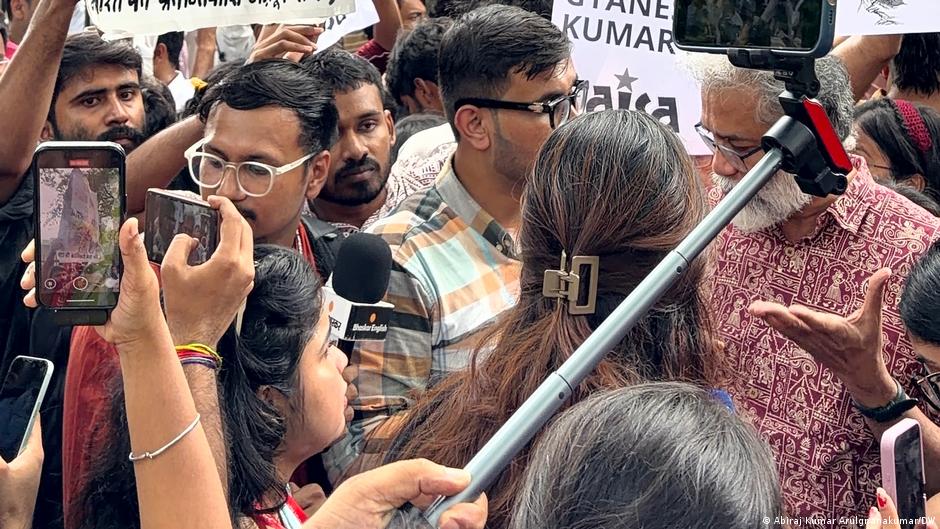
Indian democracy has been shaken by new revelations showing divisions within the body that is in charge of conducting its elections over controversial policies that critics say have disenfranchised tens of millions of people.
asserted
critics → shake → people
India’s Election Commission, a supposedly autonomous constitutional body, is tasked with administering elections in the world’s largest democracy, and in recent decades, had won admirers across the globe for its success in conducting a voting process unmatched in scale and complexity.
asserted
Commission → task → scale
But an investigation by The Indian Express newspaper reported that the current chief of the commission frequently overruled concerns raised by his two other equally ranked commissioners about the integrity of ongoing changes in the voter database.
asserted
chief → report → database
These revelations come after a months-long struggle by India’s opposition parties to bring what they have described as the “sabotaging” conduct of the election commission to the fore, which they say is dictated by Prime Minister Narendra Modi’s party for its electoral benefit.
asserted
they → come → benefit
For decades, India has grappled with deep inequality; divisions along caste, religious and ethnic lines; and the growing role of money in its elections.
asserted
India → grapple → elections
Yet through it all, the actual conduct of its elections was largely viewed as “free” domestically and by global monitors.
asserted
conduct → view → monitors
But leading opposition leaders have, in recent months and years, for the first time, questioned whether elections can be trusted and whether votes are counted accurately, as well as whether rights decide who gets to be a voter or if those in authority take the decision arbitrarily.
asserted
those → lead → decision
Those concerns, say analysts, are likely to only be amplified by the latest revelations.
asserted
analysts → say → revelations
“Today, that faith [in the election process] has shaken.
asserted
faith → shake → process
It is very shocking for the nation,” SY Quraishi, who headed India’s election commission between 2010 and 2012, told Al Jazeera.
asserted
who → head → Jazeera
“The Election Commission used to be a very reputed institution.
asserted
Commission → use → ?
Now, it is totally dysfunctional – and that’s an understatement.
asserted
that → ’ → ?
So, what does this mean for India and its democracy?
asserted
this → mean → India
Earlier this week, the Indian Express newspaper published a series of stories, based on internal documents and interviews, laying bare divisions within the poll panel – consisting of three commissioners, Gyanesh Kumar, Sukhbir Singh Sandhu, and Vivek Joshi.
asserted
newspaper → publish → commissioners
Indian law requires the commission to decide by a majority.
asserted
law → require → majority
Reports revealed that Sandhu and Joshi resisted and questioned the legality of measures Kumar took unilaterally.
asserted
Kumar → reveal → measures
Since June last year, the commission has been revising and updating the voters list state-wise.
asserted
commission → revise → list
It has struck off more than 13 million names during the exercise since then, which the critics say targeted economically weaker sections, minorities, and other vulnerable groups of Indian society disproportionately.
asserted
critics → strike → society
Opposition parties took the matter to the country’s top court, which largely signed off on the process to decide on who gets to vote in India.
asserted
who → take → India
For India’s more than 1.4 billion population, a voting right does not end merely on ballots – rather, several government welfare schemes are tied to voting rights.
asserted
schemes → end → rights
Now, reports reveal that some of the strongest resistance to the three-member commission’s decisions was coming from within.
asserted
some → reveal → within
In fact, Sandhu and Joshi formally objected on record at least 14 times over the last 10 months to measures issued by circumventing them.
asserted
Sandhu → object → them
Sandhu called it “unauthorised and illegal”.
asserted
Sandhu → call → it
Those objections related to the new voter registration mandate; deletion and restoration of voters in the rolls; appeals by people against deletions; and the security of the list.
asserted
objections → relate → list
In short, everything the commission undertook.
asserted
commission → undertake → ?
The opposition has alleged that the additions and deletions of the voters are undertaken as an exercise to disenfranchise a section of voters to benefit Modi’s Bharatiya Janata Party (BJP).
asserted
additions → allege → Party
The commission maintained that access to the voters’ list is highly secured and decentralised, meaning that even in the remotest parts of the country, a local officer made the judgement and decision.
asserted
officer → maintain → judgement
But the latest revelations show that the commission relied on ECINet, a digital platform that logs nearly a billion voters, which was increasingly centralised, giving more control to New Delhi over editing calls.
asserted
which → show → calls
In one instance, the newspaper reported that officials in the coastal state of Goa flagged nearly a hundred voters who were mistakenly taken out.
asserted
who → report → voters
Editing access was limited to New Delhi.
asserted
access → limit → Delhi
So, Goa’s chief electoral officer wrote eight emails to officials in New Delhi in a week before the deadline passed, but got no response and voters were knocked off the list.
asserted
voters → write → list
The Special Intensive Revision (SIR), as the process of revising the list is called, has become controversial mainly because it places an unusually heavy burden on existing voters to prove their eligibility.
asserted
it → revise → eligibility
Such a drive requires people to produce old records, like birth, land, and education certificates – and puts poorer, migrant, and marginalised Indians at a disadvantage, essentially drawing lines on who gets to vote in India.
asserted
who → require → India
A minor mismatch, such as a spelling, in decades-old records could result in being struck from the voters list in India.
uncertain
mismatch → result → India
Opposition parties and civil society groups have argued that mass deletions could significantly alter the electorate before elections.
uncertain
deletions → argue → elections
In some places, the exercise has been reported to disenfranchise minorities, including Muslims.
asserted
exercise → report → Muslims
In the eastern state of West Bengal, Al Jazeera earlier reported that the exercise removed 9 million residents from the electoral rolls just days before the state elections that were held in April and May.
uncertain
that → report → April
Nearly 34 percent of the deleted voters were Muslims in the state, where they only make up 27 percent of the population.
asserted
they → delete → population
Then, Prime Minister Modi’s Hindu majoritarian BJP came to power for the first time in the politically critical state.
asserted
BJP → come → state
The BJP and supporters of the SIR process have argued that it is fundamentally aimed at removing illegal migrants, the deceased or fraudulent voters from the rolls – and have tried to portray many Muslims eliminated from the lists in border states as “illegal Bangladeshi migrants,” despite hard evidence that Indian nationals have been victims of the process.
asserted
nationals → argue → process
…and 38 more, not listed.
 The Aporia