This article is brought to you by American Purpose, the magazine and community founded by Francis Fukuyama in 2020, which is proudly part of the Persuasion family.
asserted
which → bring → family
On August 22, 2025, the U.S. government bought just over 433 million shares of Intel stock for just under $9 billion—meaning they now own nearly 10% of the company. The United States then used the CHIPS Act and Secure Enclave Program funding to crown a national champion in one of its most strategically important industries.
asserted
States → buy → industries
Three days earlier, Commerce Secretary Howard Lutnick had explained the logic simply: the government should get equity for its money.
asserted
government → explain → money
The administration has been on a spree collecting equity ever since.
asserted
administration → collect → equity
Washington acquired: 5% of Lithium Americas (plus 5% of its Thacker Pass lithium project), a 10% stake in Trilogy Metals, and 20% of the future profits of nuclear builder Westinghouse in a deal.
asserted
Washington → acquire → deal
The White House shows no signs of slowing in 2026; the Council on Foreign Relations now counts 37 deals worth $27.6 billion.
asserted
Council → show → deals
Perhaps American leaders are trying to learn from Beijing—but if so they are learning the wrong lessons.
asserted
they → try → lessons
China’s national champions were not state-directed; they were forged by manufactured competition.
asserted
they → direct → competition
Beijing succeeded by funding many firms at the same time, refusing to choose just one, and allowing the market to do the rest.
asserted
market → succeed → rest
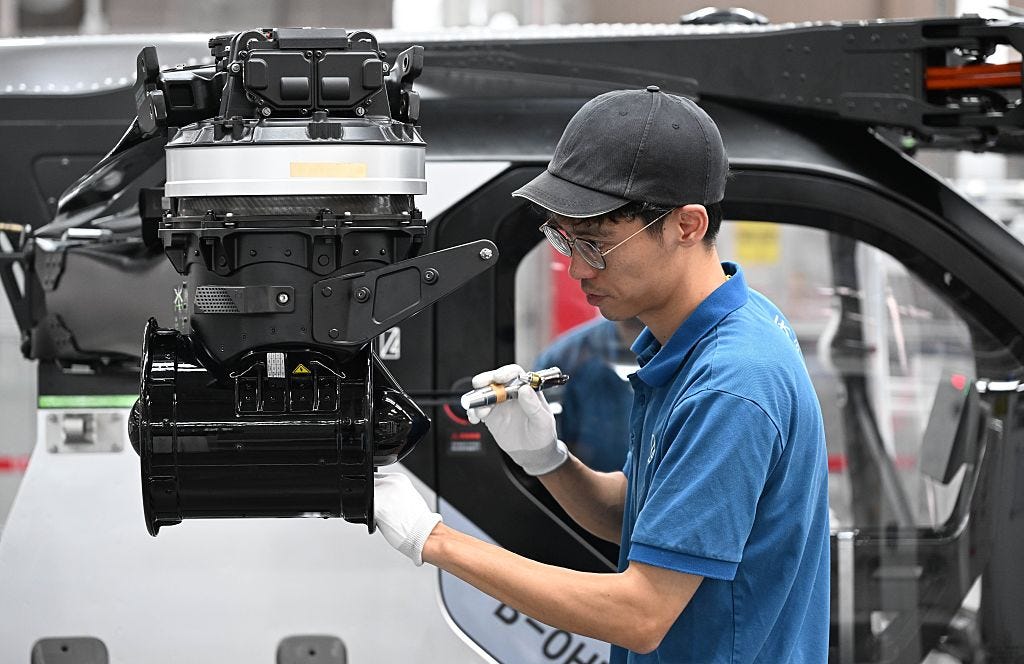
As recently as the mid-2010s, China’s car companies were dependent on joint ventures between foreign carmakers and Chinese state-owned enterprises.
asserted
companies → own → carmakers
Now, the Chinese electric car company BYD outsells Tesla—and every other EV manufacturer on the planet.
asserted
company → outsell → planet
Alongside Xiaomi and Leapmotor, BYD is reshaping the global EV market.
asserted
BYD → reshape → market
Even legacy manufacturer Chery is now earning more than half its revenue overseas for the first time.
asserted
Chery → earn → time
In 2023, China surpassed Japan as the largest exporter of passenger vehicles in the world.
asserted
China → surpass → world
The process of building this new industry was not cheap.
asserted
process → build → industry
CSIS estimated that between 2009 and 2023, Chinese state support for EVs was over $230 billion.
asserted
support → estimate → EVs
In the years before 2017, that support exceeded 40% of EV sales; by 2023, it was just over 11%.
asserted
it → exceed → 2023
By 2023, the government support per vehicle was estimated at $4,800.
asserted
support → estimate → 4,800
This is less than the new electric vehicle tax credit the United States offered from 2023 to 2025.
asserted
States → offer → 2025
China further tightened subsidies earlier this year.
asserted
China → tighten → subsidies
As subsidies and government support continue to wind down, the market will coalesce around a few strong brands.
asserted
market → continue → brands
Over 500 companies were planning new energy vehicles in China in 2018.
asserted
companies → plan → 2018
Only 129 were still selling them by 2024, and AlixPartners expects only 15 to be financially viable by 2030.
asserted
15 → sell → 2030
Neither Xi Jinping nor any other central planner could have predicted the winners of the 21st-century EV brawl: Xiaomi, a phone company; BYD, a battery manufacturer; and Leapmotor, a car company founded in 2015.
uncertain
Jinping → predict → 2015
All three are publicly listed companies rather than state-owned enterprises.
asserted
three → list → enterprises
Now examine what happened when Beijing picked its champion in advance.
asserted
Beijing → examine → advance
COMAC was created in 2008 to rival Boeing and Airbus.
asserted
COMAC → create → Boeing
It is a state-owned enterprise with no rivals and a captive market, as Beijing forces Chinese airlines to buy COMAC’s planes.
asserted
Beijing → own → planes
Nearly 20 years in, COMAC still cannot deliver at the volume or speed that the state has set for it.
asserted
state → deliver → it
It demands more complex systems engineering and stricter safety standards, but China produces the most engineers in the world.
asserted
China → demand → world
The complexity of building a commercial aircraft is all the more reason to try many different things, rather than line up behind one attempt.
asserted
complexity → build → attempt
As it stands, startups have no reason to challenge the state’s chosen champion, and COMAC has no pressure from other companies to improve or innovate.
asserted
COMAC → stand → companies
Beijing bought an aircraft company when it needed an industry.
asserted
it → buy → industry
Washington knows better, because it used to do better.
asserted
it → know → ?
In 1984, the Air Force kicked off the Great Engine War, splitting the award for F-15 and F-16 engines between Pratt & Whitney and General Electric.
asserted
Force → kick → Pratt
This contract was re-competed for every single year for six years.
asserted
contract → re → years
Both engines showed dramatic improvements over the course of the competition.
asserted
engines → show → competition
When Covid-19 emerged and America needed safe and effective vaccines quickly, Washington did not buy 10% of AstraZeneca.
asserted
Washington → emerge → AstraZeneca
Instead, it pumped over $10 billion into eight vaccine candidates, two on each of four platforms.
asserted
it → pump → platforms
Many never made it to the emergency approval stage, but their mere presence in the race made all the other entrants better.
asserted
entrants → make → race
…and 16 more, not listed.
 The Aporia