In 2023, my review of On The Marble Cliffs took second in the ACX book review contest, and Scott offered me the right to pitch him more essays.
asserted
Scott → take → essays
I have worked as a neuroscientist, so in 2024 I pitched a post with my theory of consciousness.
asserted
I → work → consciousness
Later that year, my connection to neuroscience took an unexpected turn, and I wrote about my experience getting diagnosed with brain cancer.
asserted
I → take → cancer
This post is an update on how I’m doing.
asserted
I → do → ?
I’m doing well.
asserted
I → do → ?
So well that the only other person I’ve ever heard of doing as well as I am was Jo Cameron, who was profiled on ACX for her rare genetic mutation that makes her incapable of negative emotion.
asserted
her → hear → emotion
My case can’t be a mutation, so it must be related to my brain cancer and subsequent surgery.
asserted
it → relate → cancer
I write about it here in the hopes of making a novel contribution to the study of low-suffering phenotypes.
asserted
I → write → phenotypes
Content warning: the first part of this review contains medical details that some people might find gruesome; I am bad at judging these things since I can no longer feel disgust or fear myself, and have tried to err on the side of completeness.
uncertain
I → contain → completeness
In summer 2024, I had an open craniotomy.
asserted
I → have → craniotomy
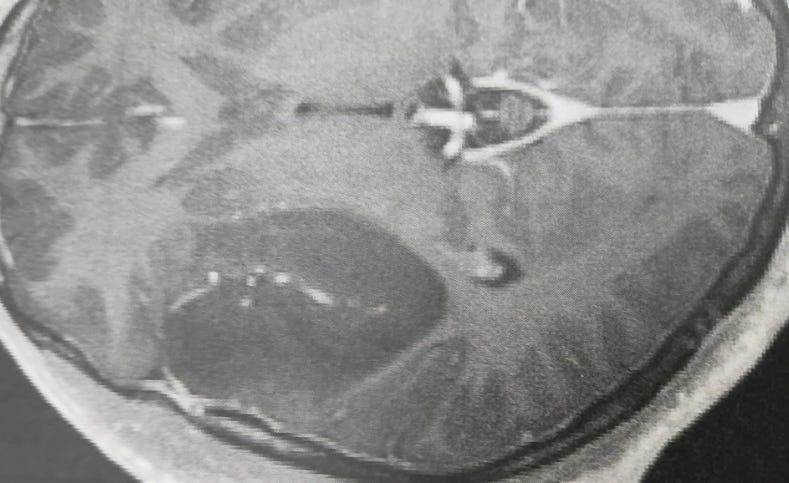
Doctors cut open my skull and took out the part of my brain with the cancer - an astrocytoma2 about the size of my fist.
asserted
Doctors → cut → fist
Collateral damage included my right-side amygdala, the rightmost edge of my hippocampus, and a big chunk of my temporal cortex, including my right-side primary auditory cortex.
asserted
damage → include → cortex
It’s the dark 🫀shape in the middle of this MRI segment:
asserted
It → ’ → segment
The remains of the tumor were then blasted with radiotherapy: high-powered photons at X-ray wavelength.
asserted
remains → blast → wavelength
The doctors were so worried that they made my health insurance pay for taxi rides to return home after the near-daily radiation treatments for weeks, even though it was only a ten minute walk.
asserted
it → make → weeks
I got what passes for good news.
asserted
what → get → news
The oncology center where I was in treatment offered to make me the only experimental subject in a case study to see, for the first time anywhere on the planet, what happens to my kind of brain cancer when attacked simultaneously with both of the most powerful chemotherapy drugs that can cross the blood-brain barrier.
asserted
that → offer → barrier
This combination had previously been tried only on 72 patients with glioblastomas, a type of brain cancer far more dangerous than mine, and had extended patient survival times by about a quarter on average, meaning several months.
asserted
combination → try → months
I immediately accepted the offer, delighted to receive this unique opportunity.
asserted
I → accept → opportunity
I guessed I could reasonably expect my own life expectancy to grow by about a quarter compared to standard care as well, which for my comparatively less aggressive cancer could mean a year or more!
uncertain
which → guess → year
But chemo and major surgery don’t mix, and I ended up needing a long string of follow-up neurosurgeries, each necessary to repair a shortcoming of the previous one.
asserted
each → mix → one
A triangular piece of my skull, which in the craniotomy had been sawed off and screwed back on with three little titanium screws, was found to have a population of bacteria happily growing on the inside; an abscess inside the brain cavity equals an immediate medical emergency.
asserted
abscess → saw → emergency
This necessitated the removal of that bone triangle and its replacement with a customized 3d printed piece of polymethylmethacrylate bone cement, an exciting new implant technology expected to be much better than the old standard-issue titanium implants.
asserted
This → necessitate → implants
Shortly after I had gotten it implanted, I developed a big swelling on my right forehead below the wound that grew enough to squeeze my right eye shut, prompting neurosurgery number three.
asserted
that → get → number
A few weeks after that neurosurgery, while briefly released from stationary care, I developed signs of brain overpressure - from too much CSF, which can cause strokes and death - so I went back for number four.
A particularly low point came in January 2025, when the swelling on my forehead came back; the neurosurgeons told me it was CSF leaking from the cranial cavity, indicating a common post-neurosurgery complication called “postoperative hydrocephalus.”
asserted
it → release → complication
I needed a fifth neurosurgery to receive a shunt, a valve and pipe system that would drain the excess CSF to my gut.
asserted
that → need → gut
I didn’t know physiology, but I did know hydraulics, and the swelling wasn’t growing, which clearly falsified their increasingly exasperated explanations.
asserted
which → know → explanations
I had read the many pages of fine print they pressure you to sign before each surgery and become a minor expert in German medical law, so I knew I didn’t need their permission to refuse the surgery and they needed mine to perform it.
asserted
mine → read → it
I said no.
asserted
I → say → ?
On the morning of February 8, 2025, I awoke while a large fountain of body fluids was erupting from my scalp.
asserted
fountain → awake → scalp
The swelling had opened and was spraying most surfaces4 of the double bedroom with what was obviously too red to be CSF.
asserted
what → open → bedroom
The large rescue team that came running to answer my roommate’s panicked emergency call was finally quiet about their shunt, I smugly noted.
asserted
I → run → shunt
The swelling had instead been an unusually large seroma filled with serosanguineous exudate, and I got to leave, promptly proceed to the chemotherapy experiment5 and skip neurosurgery number five.
asserted
I → fill → number
In the spring, a scab fell off the hole in my skull, revealing that the flesh had failed to close over it.
asserted
flesh → fall → it
I could see the 3D-printed bone cement in the mirror (it was bright green) it was exposed to the open air.
uncertain
it → see → air
Open air contains microbes that could colonize it and give me meningitis, which could kill me rather more suddenly than cancer.
uncertain
which → contain → cancer
I asked if the doctors could just sew the hole together, and they explained why that wouldn’t work.
uncertain
that → ask → hole
I was going to need another major neurosurgery to replace the newfangled implant with a good old titanium mesh.
asserted
I → go → mesh
And in order to get my head properly and permanently closed to microbes again, I was going to need a flap, a handful of my flesh transplanted to the side of my head from someplace else6 with all blood vessels connected exactly right, and the new hole they’d carve to fill the old one would get patched with a skin graft.
asserted
they → get → graft
These are just routine surgeries, but as additions to the implant replacement they would turn this fifth neurosurgery into a six-surgeons-for-six-hours operation, and the first of my surgeries to necessitate blood infusions.
asserted
they → turn → infusions
…and 132 more, not listed.
 The Aporia