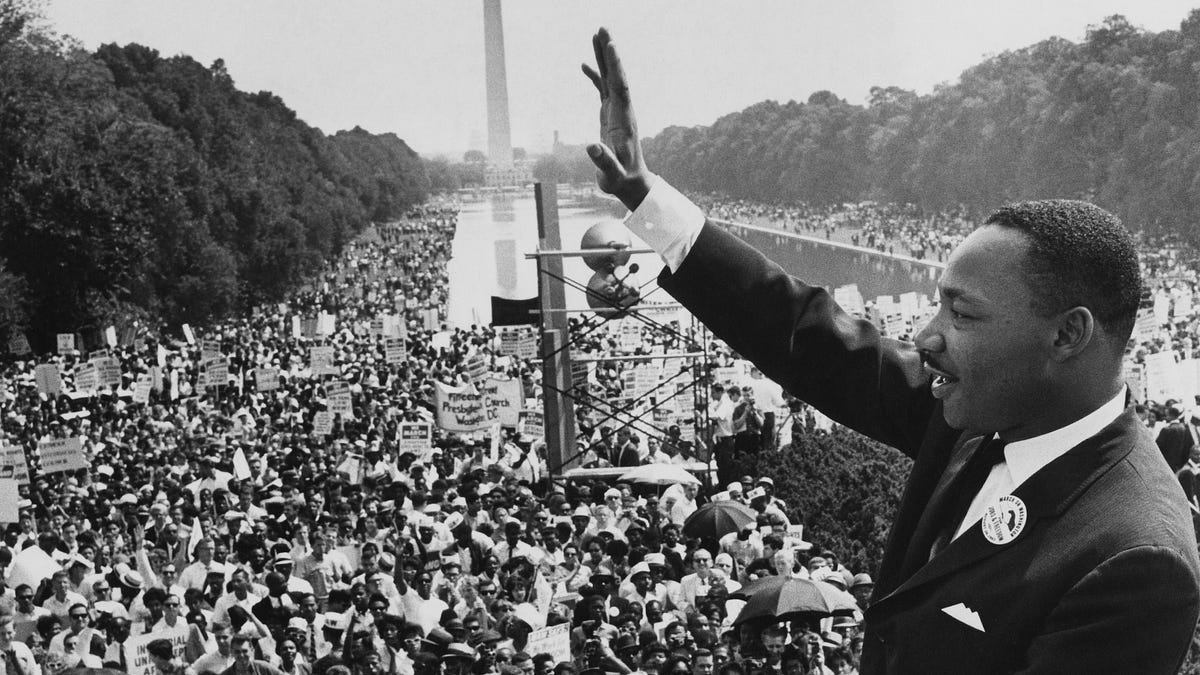
August 28, 2026

Letters from an American · collected 2026-08-31 · by Heather Cox Richardson commentary
Read the original at Letters from an American ↗

Summary

The article discusses the March on Washington for Jobs and Freedom held on August 28, 1963, where Reverend Dr. Martin Luther King Jr. delivered his iconic "I Have a Dream" speech. Key speakers included John Lewis, chair of the Student Nonviolent Coordinating Committee, who emphasized the need for voting rights and peaceful demonstrations to address economic deprivation and racial violence. The march's organizers focused on economic discrimination and decent jobs for Black Americans, with civil rights leader A. Philip Randolph and labor organizer Walter Reuther working together. In 1964-65, Congress passed landmark civil rights legislation, including the Civil Rights Acts and Voting Rights Act, under President Lyndon B. Johnson.
Written by the local model on 2026-08-31, using this article's own text rather than the other coverage of the same event (that is the story summary below).

Signals How these are calculated →

Claims extracted
53
claim-shaped sentences
Uncertain
2%
1 of 53 hedged
Leaning
Leans left
expected in commentary, which argues a position
Publisher trust
not scored
Commentary is not rated for newsroom trust
Outlets on this story
2
Other
Narrative spread
1
articles carrying this framing
Analyzed 2026-08-31 · how these are computed

AI analysis (generated at analysis time, not now)

Story summary

Martin Luther King Jr.'s "I Have a Dream" speech, delivered on August 28, 1963, at the Lincoln Memorial in Washington, D.C., marked a pivotal moment in American history. The speech is often remembered as a call to end racial segregation and discrimination, but its organizers, including Black labor leader A. Philip Randolph and civil rights leader Bayard Rustin, had a broader focus: economic justice for Black Americans. They aimed to address the lack of decent jobs and economic opportunities for African Americans, which was a major contributor to their poverty and disenfranchisement. The March on Washington for Jobs and Freedom, where King delivered his speech, was a culmination of efforts by civil rights leaders and labor organizers to bring attention to these issues. Today, a private effort is underway to make the engraved inscription marking the spot where King stood more visible in time for the 65th anniversary of the speech in 2028, highlighting the ongoing importance of preserving and honoring this moment in American history.

Written for “American Olympic Trials” on 2026-08-31, grounded in this article and the 1 other(s) covering the same event.
Why this leaning score
The article's own words the score was based on. Each is quoted verbatim and was checked against the article text before being stored, so you can find it in the original.
Score -0.35 Confidence high
Leaning score -0.35 for article 3389 (high confidence, 1 verified quote) · logged 2026-08-31

Story

📰 American Olympic Trials
Other · 2 article(s) covering the same event. This is the one the site leads with.

How this is being covered How these are calculated →

Article leaning vs. publisher reliability
Source leaning vs. consistency

Compared with similar articles

This article reads leans left and hedges 2% of its claims. Each row says how that neighbour differs.
Persuasion
⚖️ Leans left 🔴 10% hedged 10 of 105
“Both articles describe the March on Washington for Jobs and Freedom on August 28, 1963, and specifically mention Martin Luther King's 'I Have a Dream' speech at the Lincoln Memorial.”
Top News - UPI.com
⚖️ leaning not scored 🔴 0% hedged 0 of 20 📰 publisher trust 54
“Article B refers to a specific event in 1963, while Article A lists multiple events for August 28, one of which is also about the March on Washington but mentions different dates and context.”
The Straits Times World News
⚖️ Leans strongly left further left than this 🔴 8% hedged 1 of 13 📰 publisher trust 95
“Article A refers to a march happening in the present (2026), while Article B describes a historic event from August 28, 1963”

Publisher

Letters from an American · 14 article(s) · 0 correction(s) detected

Commentary. The three signals behind a trust score all measure a newsroom's record with its own reporting, so they are not computed for this source. How trust is scored.

No corrections detected for this publisher. That may mean careful reporting, or simply that nothing has been checked.

Who wrote this

Heather Cox Richardson
14 article(s) here · 1 carrying a prediction
🔮 “The nonviolent revolution is saying, ‘We will not wait for the courts to act, for we have been waiting for hundreds of years.
2026-08-31 · assertive framing · August 28, 2026
🔮 The push has come in the wake of the rise of New York City mayor Zohran Mamdani and other naturalized U.S. citizens whose policy positions those like South Carolina representative Nancy Mace consider un-American.
2026-08-31 · assertive framing · August 29, 2026
🔮 She is one of the youngest mayors in the city’s history and is the first woman and the first Asian American to be elected to the office.
2026-08-31 · assertive framing · Week Fourteen in 250 to 250
🔮 The book was written not to reflect the facts of Washington’s life—biographies would not focus on facts for almost a century—but to show virtues the nation’s youth should imitate and to establish a set of attributes against which future voters could judge those vying to lead the nation.
2026-08-31 · assertive framing · August 30, 2026
🔮 Still, Smith points out, the apparent proof that Kennedy lied to Congress is a clear opening for hearings into Kennedy’s testimony, history, and conduct in office—including changing the vaccine schedule after promising not to—that would illuminate what has been happening to the U.S. government, information that would likely prove embarrassing to the Trump administration.
2026-08-28 · assertive framing · August 27, 2026
🔮 The antennas of Chicago’s Willis Tower—formerly the Sears Tower—lit up pink, too.
2026-08-27 · assertive framing · August 26, 2026
🔮 In contrast to MAGA’s performative nonsense, Canadian officials announced today that on September 8 they will begin to impose tariffs of up to 50% on about 700 products worth about $20 billion in retaliation for Trump’s tariffs on Canada.
2026-08-26 · assertive framing · August 25, 2026
🔮 Canada and the U.S. have shared military and defense capabilities, with the North American Aerospace Defense Command (NORAD) operating since 1957 to detect aircraft or missiles, especially those coming over the North Pole, that could prove a threat to the United States (NORAD’s Santa Tracker originally was a way to make Americans aware of what NORAD did).
2026-08-25 · assertive framing · August 24, 2026
🔮 McMaster said Trump “thought it was a great idea” for her to replace her brother, and she has indicated her loyalty to Trump and her willingness to pass the SAVE America Act he so badly wants in order to rig the 2026 midterm elections.
2026-08-24 · assertive framing · August 22, 2026
🔮 Mayo Clinic, Narrated by Dr. Stephen Ray Mitchell Dr. Stephen Ray Mitchell is an award-winning medical expert who currently serves as the Joseph Butenas Professor of Medicine and Pediatrics and Dean Emeritus for Medical Education at Georgetown University School of Medicine.
2026-08-24 · assertive framing · Week Thirteen in 250 to 250
Also by Heather Cox Richardson
August 29, 2026
2026-08-31 · Letters from an American
Week Fourteen in 250 to 250
2026-08-31 · Letters from an American
August 30, 2026
2026-08-31 · Letters from an American
Rob Sand | American Conversations
2026-08-28 · Letters from an American
Nothing else under this byline is closely related to this article, so these are simply their most recent.
All 14 articles by Heather Cox Richardson →

Topics

Black Black Americans Congress D.C. Washington

Subjects

Congress ORG · 5× Black Americans NORP · 4× King PERSON · 3× Washington GPE · 3× Black NORP · 2× D.C. GPE · 2× Democrats NORP · 2× Lewis PERSON · 2× A. Philip Randolph PERSON · 1× Martin Luther King Jr. PERSON · 1×

Narrative

At the Washington march, Lewis railed against the systems that kept Black Americans in poverty and permitted white men to commit violence against them, and explained that the remedy for the economic deprivation and racial violence Black Americans suffered was not in the civil rights bill proposed by the administration of President John F. Kennedy, but in the power of peaceful demonstrations and the vote.
framing: assertive · carried by 1 article(s) · first seen 2026-08-31
🔮 “The nonviolent revolution is saying, ‘We will not wait for the courts to act, for we have been waiting for hundreds of years.
2026-08-31 · Letters from an American
August 28, 2026 · assertive framing

Claims (53 extracted, 1 hedged)

The March on Washington for Jobs and Freedom that took place on August 28, 1963, in Washington, D.C., is remembered today primarily because it was the occasion when the final speaker, the Reverend Dr. Martin Luther King Jr., stood on the steps of the Lincoln Memorial and delivered what became known as the “I Have a Dream” speech. asserted
I → take → speech
While that speech is often excerpted to make it sound like King’s concerns were simply about the way individuals thought about race, in fact, the march’s organizers, Black labor leader A. Philip Randolph and civil rights leader Bayard Rustin, focused on economic discrimination and the lack of decent jobs for Black Americans. asserted
organizers → excerpt → Americans
In the process of organizing the march, they brought on board not only civil rights organizers but also white labor organizer Walter Reuther, the head of the United Auto Workers. asserted
they → organize → Workers
King acknowledged the economic focus of the march when he centered his speech around the idea that Black Americans had received “a promissory note” that had become “a bad check, a check which has come back marked ‘insufficient funds.’” asserted
which → acknowledge → note
“But,” he said, “we refuse to believe that the bank of justice is bankrupt.” asserted
bank → say → justice
Dr. King was not the only speaker that day; he anchored the event. asserted
he → anchor → event
Before him spoke the chair of the Student Nonviolent Coordinating Committee, a young John Lewis. asserted
chair → speak → Committee
Just 23 years old, he had been one of the thirteen original Freedom Riders, white and Black students traveling together from Washington, D.C., to New Orleans in 1961 to challenge segregation. asserted
he → travel → segregation
At the Washington march, Lewis railed against the systems that kept Black Americans in poverty and permitted white men to commit violence against them, and explained that the remedy for the economic deprivation and racial violence Black Americans suffered was not in the civil rights bill proposed by the administration of President John F. Kennedy, but in the power of peaceful demonstrations and the vote. asserted
Americans → rail → demonstrations
“‘ONE MAN, ONE VOTE’...must be our [cry],” he told the crowd. asserted
he → tell → crowd
“The revolution is at hand, and we must free ourselves of the chains of political and economic slavery,” Lewis said. asserted
Lewis → free → slavery
“The nonviolent revolution is saying, ‘We will not wait for the courts to act, for we have been waiting for hundreds of years. asserted
we → say → years
We will not wait for the President, nor the Justice Department, nor Congress, but we will take matters into our own hands and create a great source of power, outside of any national structure, that could and would assure us a victory.’ uncertain
that → wait → victory
In 1964, Congress passed the Civil Rights Acts to protect voting rights. asserted
Congress → pass → rights
That year, when Republicans ran Arizona senator Barry Goldwater for president, calling for a rollback of business regulation and civil rights to the years before the New Deal, voters gave Democrats such a strong majority in Congress that President Lyndon Baines Johnson and the Democrats were able to pass 84 new laws to put what Johnson called the Great Society into place. asserted
Johnson → run → place
They cemented civil rights with the 1965 Voting Rights Act protecting minority voting, created jobs in Appalachia, and established job-training and community development programs. asserted
They → cement → programs
The Elementary and Secondary Education Act of 1965 gave federal aid to public schools and established the Head Start program to provide comprehensive early education for low-income children. asserted
Act → give → children
The Higher Education Act of 1965 increased federal investment in universities and provided scholarships and low-interest loans to students. asserted
Act → increase → students
The Social Security Act of 1965 created Medicare, which provided health insurance for Americans over 65, and Medicaid, which helped cover healthcare costs for folks with limited incomes. asserted
which → create → incomes
Congress advanced the war on poverty by increasing welfare payments and subsidizing rent for low-income families. asserted
Congress → advance → families
Congress took on the rights of consumers with new protective legislation that required cigarettes and other dangerous products to carry warning labels, required products to carry labels identifying the manufacturer, and required lenders to disclose the full cost of finance charges in loans. asserted
products → take → loans
Congress also passed legislation protecting the environment, including the Water Quality Act of 1965 that established federal standards for water quality. asserted
that → pass → quality
But the government did not simply address poverty and safety. asserted
government → address → poverty
Congress also spoke to Johnson’s aspirations for beauty and purpose when it created the National Foundation on the Arts and Humanities. asserted
it → speak → Arts
This law created both the National Endowment for the Arts and the National Endowment for the Humanities to make sure the era’s emphasis on science didn’t endanger the humanities. asserted
emphasis → create → humanities
In 1967 it would also establish the Corporation for Public Broadcasting, followed in 1969 by National Public Radio. asserted
it → establish → Radio
In 1968, former vice president Richard M. Nixon won the presidency after promising that he would not continue to use the federal government to protect Black rights in the South. asserted
he → win → South
With that promise, racists made a permanent move from the Democrats to the Republicans, joining forces with businessmen who wanted an end to regulation and to taxes and the social welfare programs they funded. asserted
they → make → taxes
The race to tear apart the postwar government that helped all Americans by appealing to racism was on. asserted
that → tear → racism
Yesterday the Department of Homeland Security under Trump served up straight racism and cruelty to its wavering base in a post about Haitians. asserted
Department → serve → Haitians
About 350,000 Haitians came to the United States after a catastrophic earthquake hit their country in 2010, destabilizing both the economy and the government. asserted
earthquake → come → economy
As the country became overrun with violent gangs, the U.S. granted Haitians Temporary Protected Status, allowing them to stay in the U.S. because it was too dangerous to go home. asserted
it → overrun → U.S.
Former secretary of homeland security Kristi Noem, who described Haitians as “entitlement junkies” and “foreign invaders,” refused to extend TPS for those immigrants, despite the fact that the State Department warns travelers not to visit Haiti “due to the risk of crime, kidnapping, terrorism, unrest and limited health care.” asserted
Department → describe → crime
In June the Supreme Court ruled that the administration had the power to make that determination, and the administration promptly warned Haitian immigrants, many of whom have deep roots in the U.S. now, that they no longer have legal status and would be deported. asserted
they → rule → status
Yesterday the Department of Homeland Security posted on social media: “Haiti TPS has been TERMINATED. asserted
TPS → post → media
They have two options: LEAVE IMMEDIATELY or be DEPORTED.” asserted
They → have → options
Attached was a video of chained Black men and women being moved through the rain toward a waiting plane. asserted
video → attach → plane
Officials at DHS chose to publish a video of Black people in chains that evoked the slave coffles of the Old South. asserted
that → choose → South
Today Theodore Schelifer and Matt Zdun of the New York Times reported on the top 20 megadonors, who have already poured $1.2 billion into the midterm elections. asserted
who → report → elections
Elon Musk alone has put in more than $90 million to keep Republicans in office as they dismantle a government that worked for the people and replace it with one that continues to funnel money upward. asserted
that → put → money
…and 13 more, not listed.

💬 Give feedback
🕘 History 🎫 Support