This article is brought to you by American Purpose, the magazine and community founded by Francis Fukuyama in 2020, which is proudly part of the Persuasion family.
asserted
which → bring → family
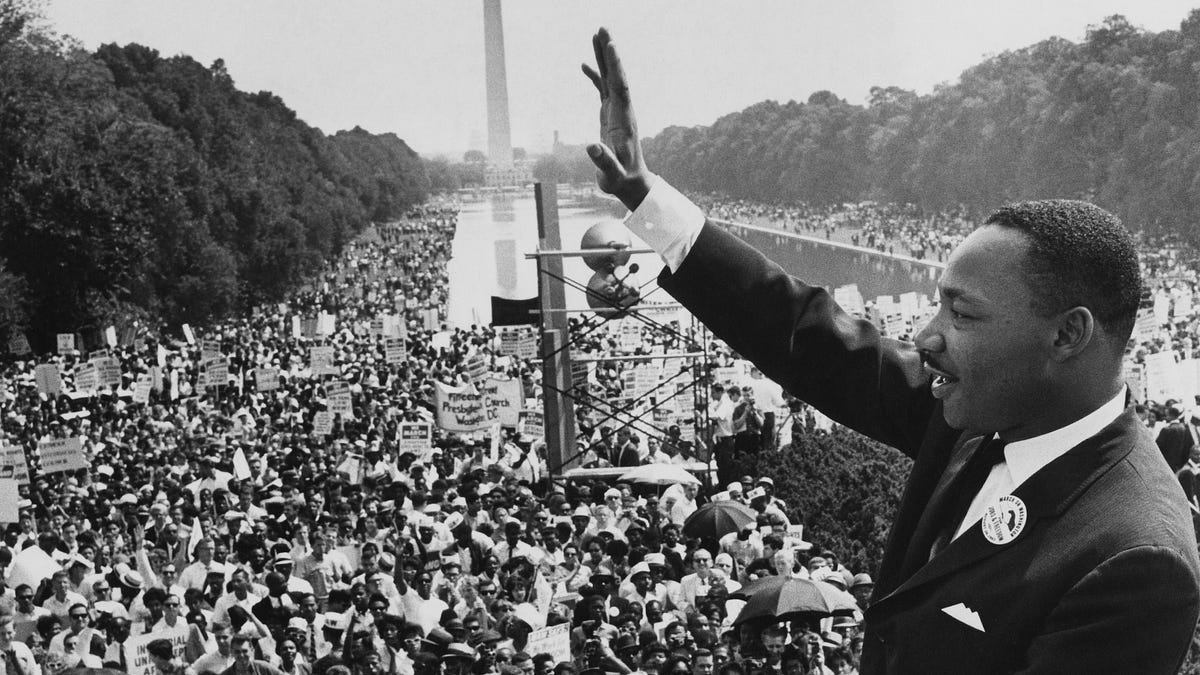
The spot at the Lincoln Memorial where Martin Luther King, Jr. delivered “I Have a Dream” is easy to step over without noticing.
asserted
I → deliver → Dream
The engraved inscription is nearly invisible in the granite, beneath the giant, looming statue of Abraham Lincoln.
asserted
inscription → loom → Lincoln
But it marks the place where King stood on August 28, 1963—63 years ago today—and spoke one of the last pieces of moral language Americans across the political spectrum can still quote without irony.
asserted
Americans → mark → irony
That marker was installed in 2003 with broad bipartisan support and spearheaded by a Republican congresswoman from Kentucky, Rep. Anne Northup, whose constituent wrote to her noting the absence of any indicator of hallowed ground.
asserted
constituent → instal → ground
Today, there is a private effort to make the marker more visible in time for the 65th anniversary of the speech in 2028.
asserted
marker → be → 2028
This sounds like the kind of everyday campaign no one could reasonably oppose—perhaps brass footprints on the step, a resonant visual to evoke public memory.
uncertain
one → sound → memory
But shared memory is more complicated in America than it used to be—for both good reasons and bad.
asserted
it → share → reasons
We invite many more perspectives into our national story than in the past, which is good.
asserted
which → invite → past
Institutions are also frequently mistaking the loudest voices as public consensus, which is not.
asserted
which → mistake → consensus
In recent years, we have seen statues toppled and names removed from buildings.
asserted
names → see → buildings
Our founders are being reassessed in parks and museums across the country.
asserted
founders → reassess → country
While activists on the left treat the past like a crime scene, some on the right treat any widening of the historical lens as a betrayal of America.
asserted
some → treat → America
Caught in the fray, our institutions have grown skittish, citizens suspicious of each other’s motives, and the act of honoring anyone has begun to feel less like gratitude than divorce proceedings.
asserted
act → catch → proceedings
Which raises the question that the granite step may soon force on us: When we mark the place where King spoke, what exactly are we honoring?
uncertain
we → raise → what
The flesh and blood man who left a family behind when he was assassinated?
asserted
he → leave → family
The greater movement he symbolized?
asserted
he → symbolize → ?
The dream he projected?
asserted
he → project → ?
America’s aspiration to become what the speech demanded?
asserted
speech → become → what
The question of the step’s meaning is about to become less theoretical.
asserted
question → become → meaning
In January 2027, the court seal on King’s still-sealed FBI surveillance recordings and transcripts will expire.
asserted
seal → seal → recordings
While a large cache of FBI and other agency documents relating to King’s assassination were made public on July 21, 2025, the FBI’s electronic surveillance recordings of King, along with related transcripts and logs, were not.
asserted
recordings → relate → transcripts
These particular materials were gathered as part of one of the ugliest campaigns of state surveillance and harassment in modern American history.
asserted
materials → gather → history
J. Edgar Hoover’s FBI wiretapped King, bugged his hotel rooms, spread allegations about his private life, and sent him an anonymous threat to reveal what they knew in an attempt to push him to suicide.
asserted
they → wiretappe → suicide
The allegations described in Pulitzer Prize-winning King biographer David Garrow’s 2019 Standpoint article—mostly of libertine sexual activities but also of King’s entanglements with Communist Party members—are grave, lurid, and, crucially, based on evidence not yet fully reviewable by the public.
asserted
allegations → describe → public
Garrow’s telling draws from then-newly available Bureau summaries of still-sealed recordings, related investigative material, and a 1977 Justice Department review that found the FBI transcripts it examined to be accurate.
asserted
it → draw → recordings
Garrow writes these materials “slipped into public view on the [National] Archives’ lightly annotated and difficult-to-explore web site,” due to the provisions of the President John F. Kennedy Assassination Records Collection Act of 1992.
The original FBI tapes and documents still under seal were created between 1963 and 1968.
asserted
tapes → write → 1963
They were ordered into the custody of the National Archives after litigation brought by the Southern Christian Leadership Conference (SCLC) and King aide Bernard Lee, and sealed in 1977 for fifty years.
asserted
They → order → years
In 2025, the government tried to bring them into the declassification process early, arguing they were relevant to President Trump’s order to fully disclose files related to the assassinations of King, John F. Kennedy, and Robert F. Kennedy.
asserted
they → try → King
The SCLC and King family have objected, arguing that records born of illegal surveillance should not be rushed into public view as spectacle and should, in fact, be destroyed.
asserted
records → object → fact
A federal judge ultimately declined to lift the seal ahead of its January 31, 2027 expiration.
asserted
judge → decline → expiration
As Garrow notes, neither he nor the public has heard the original tapes or seen the full transcripts.
asserted
he → note → transcripts
The most explosive claim—that King was present during an alleged rape perpetrated by a friend, and reacted with laughter while offering advice—appears, according to Garrow, as a handwritten annotation on an FBI document.
uncertain
King → perpetrate → document
Until the underlying recordings and full transcripts can be independently examined, the accuracy of the allegations is impossible to judge.
asserted
accuracy → underlie → allegations
So today they sit like Schrödinger’s cat, both alive and dead, subject to a morbid anticipation of what will be revealed once they are opened to public view.
asserted
they → sit → view
To be sure, it remains entirely possible that, once the recordings are no longer under court seal, the allegations related to the rape will not be supported.
asserted
allegations → remain → rape
The FBI report and handwritten note will remain in the record.
asserted
report → remain → record
Some will shout “coverup,” and enough will believe them to disrupt a legacy as the attempt to augment the Lincoln Memorial marker stirs the waters and asks for votes from the glorified group of social media trolls that Congress has become.
asserted
Congress → shout → trolls
In 2019, Garrow wrote that “Some of us now ageing King scholars ‘may not get there with you’ come 2027, but there is no question that a profoundly painful historical reckoning and reconsideration inescapably awaits.”
uncertain
reckoning → write → you
They are power struggles over what stories we will allow one another to tell about ourselves and our culture—about our past as it implicates our present and future.
asserted
it → allow → present
…and 65 more, not listed.
 The Aporia