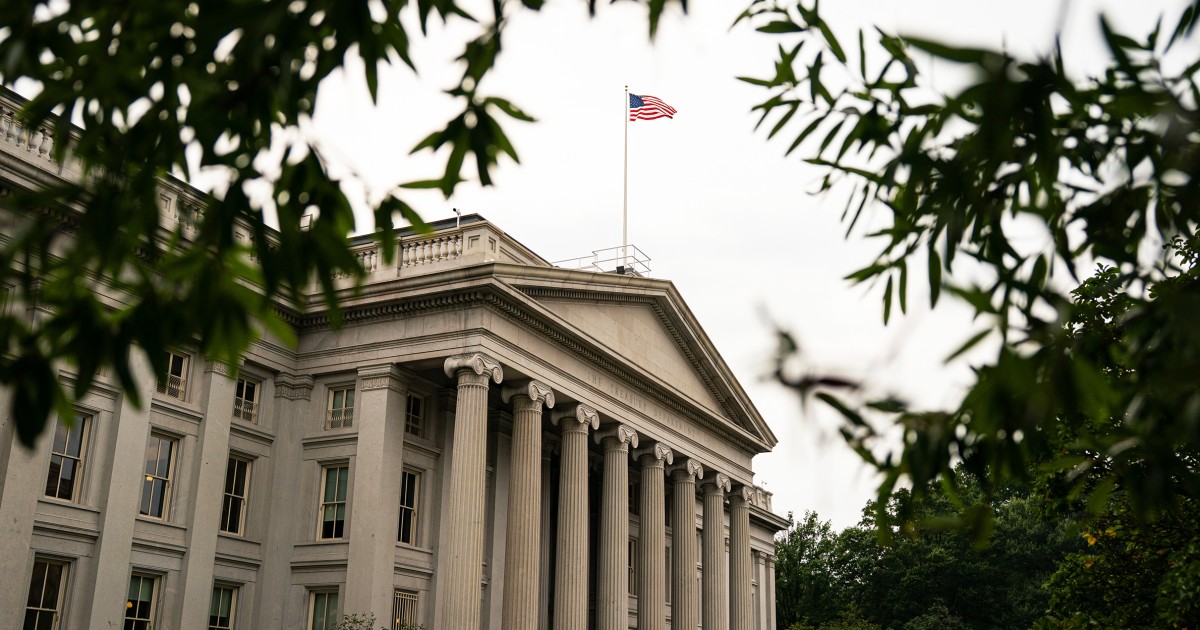
Bond yields continue to rise worldwide, and with the U.S. 10-year Treasury yield now hovering above the five per cent threshold for the first time in nearly two decades, experts say Canadian consumers should take note.
asserted
consumers → continue → note
Bonds are essentially loans, where governments or companies look to borrow money from the general public, and those bond purchasers expect a return or interest on that borrowed money, which is known as the yield on those bonds.
asserted
which → look → bonds
Those yields fluctuate regularly, based on various economic factors as well as supply and demand for those bonds, and yields have been spiking in recent months amid economic uncertainty and geopolitical conflicts, rising inflation and government debt, and expectations of higher interest rates.
The 10-year U.S. Treasury bond yield was 5.12 per cent as of publication — the highest since 2007, and a nearly four per cent increase since Wednesday.
asserted
yield → fluctuate → Wednesday
“An increase in U.S. bond yields means that borrowers are demanding more compensation to lend money to the government,” says economics professor Michael Boutros at the University of Toronto.
asserted
Boutros → mean → Toronto
“This signals that there is increased risk in lending to the U.S. government.
asserted
This → signal → government
This risk is still quite small, but has increased, as reflected in yields.”
asserted
risk → increase → yields
“Although most individuals do not directly hold U.S. bonds, nearly everyone is exposed to U.S. bonds in some way.
asserted
everyone → hold → way
”
Why are bond yields rising now?
asserted
yields → rise → ?
It isn’t always clear why bond yields change when they do, but the spikes since Wednesday align with the news that the Trump administration is considering a 90-day ban on U.S. exports of diesel fuel in order to tamp down inflation and U.S. gas prices ahead of the mid-term elections.
asserted
administration → change → elections
The idea has been widely criticized for posing massive long-term economic risks in the U.S. and worldwide.
asserted
idea → criticize → U.S.
Get daily National news
The U.S. government has also reportedly spent over $25 billion so far on its war against Iran, as U.S. Defense Secretary Pete Hegseth said last month, and the war has no clear end in sight.
uncertain
war → get → sight
At the same time, global oil prices have skyrocketed because the conflict has led to a near-complete closure of the Strait of Hormuz shipping channel, which the Bank of Canada warned could lead to higher inflation the longer it persists.
uncertain
it → skyrocket → inflation
Higher inflation not only makes goods and services more expensive, but it can also force central banks to raise their benchmark interest rates to help bring inflation down, which means higher borrowing costs for many consumers and businesses.
asserted
which → make → consumers
Expectations of rate hikes from central banks can also influence bond yields.
asserted
Expectations → influence → yields
The U.S. Federal Reserve raised interest rates earlier this month for the first time in three years.
asserted
Reserve → raise → years
For years, five per cent on the benchmark U.S. 10-year Treasury yield was viewed as the point at which global financial markets would start hitting turbulence.
asserted
markets → view → turbulence
That threshold is beginning to look less like a ceiling and more like a waypoint.
asserted
threshold → begin → waypoint
The latest move above five per cent has not lasted long enough yet to properly test that theory.
asserted
move → last → theory
But it has always been a psychological marker rather than an automatic tripwire, according to BlueBay Asset Management’s head of market strategy, Mike Bell.
uncertain
it → accord → strategy
“People think of it as if there’s a magic number for Treasury yields at which it becomes a problem, (but) it’s a relative number, not an absolute number,” Bell explained.
asserted
Bell → think → which
Many bond yields worldwide are also on the rise, because when U.S. bond yields rise, others usually will too because of the market’s ripple effects.
asserted
others → rise → effects
For an investor, if the U.S. bond yield pays more to a buyer than Canada’s bond yield, for example, then the U.S. option may be more attractive.
uncertain
option → pay → example
The Canadian example would then need to rise in order to stay competitive with the U.S. yield in this scenario.
asserted
example → need → scenario
The 10-year Canadian government bond yield increased from about 3.95 per cent Wednesday to 3.97 per cent as of publication, up 1.3 per cent.
“In the last few days, we’ve seen a confluence of factors here take yields significantly higher and we’ve been on an uptrend in yields for months since the Iran-U.S. war began,” says mortgage strategist Robert McLister.
asserted
McLister → increase → months
“We have yields going up because of higher inflation risk, and that’s coming from all kinds of things.
asserted
that → go → things
And that’s bad enough, but we also have uncertainty premiums being built into bond yields from reckless fiscal policy.”
asserted
we → ’ → policy
“The U.S. is not going bankrupt anytime soon, but there are concerns about the U.S. credit, given the fiscal situation, and that gets priced in incrementally to yields.”
asserted
that → go → yields
What this means for Canadian borrowers
For investors, rising bond yields can be an attractive place to park money and watch it grow, but for regular consumers, that can mean it’s going to get more expensive to take out a mortgage, line of credit, a car or student loan.
asserted
it → mean → credit
That’s because long-term fixed interest rate loans mostly follow changes in government bonds.
asserted
loans → ’ → bonds
“The U.S. Treasuries, especially the short-terms ones, some would say they are the lowest risk security you can buy,” says McLister.
asserted
McLister → say → ?
“But in the mortgage market, we’re more tied to the medium or longer-term bonds in the U.S., and they’re tied heavily to the 10-year Treasury.
asserted
they → tie → Treasury
In the U.S., the average rate for a 30-year fixed mortgage hit 7.03 per cent this week, up from 6.95 per cent last week, according to the Federal Home Loan Mortgage Corporation.
uncertain
rate → fix → Corporation
The Bank of Canada, and other central banks, can also influence borrowing costs, but that’s more related to short-term or variable rate loans.
asserted
that → influence → loans
In either scenario, Canadians should expect higher mortgage rates, which can also come as a shock to those that are about to renew their mortgages.
asserted
that → expect → mortgages
“People are getting really stressed.
asserted
People → get → ?
We’re talking 20, 30, 40 per cent payment increases at mortgage renewal for some folks,” says McLister.
asserted
McLister → talk → folks
“We had a big batch of folks getting mortgages five years ago.
asserted
We → have → mortgages
They’re in that case now where they have additional risk that people didn’t expect.”
asserted
people → ’re → that
 The Aporia