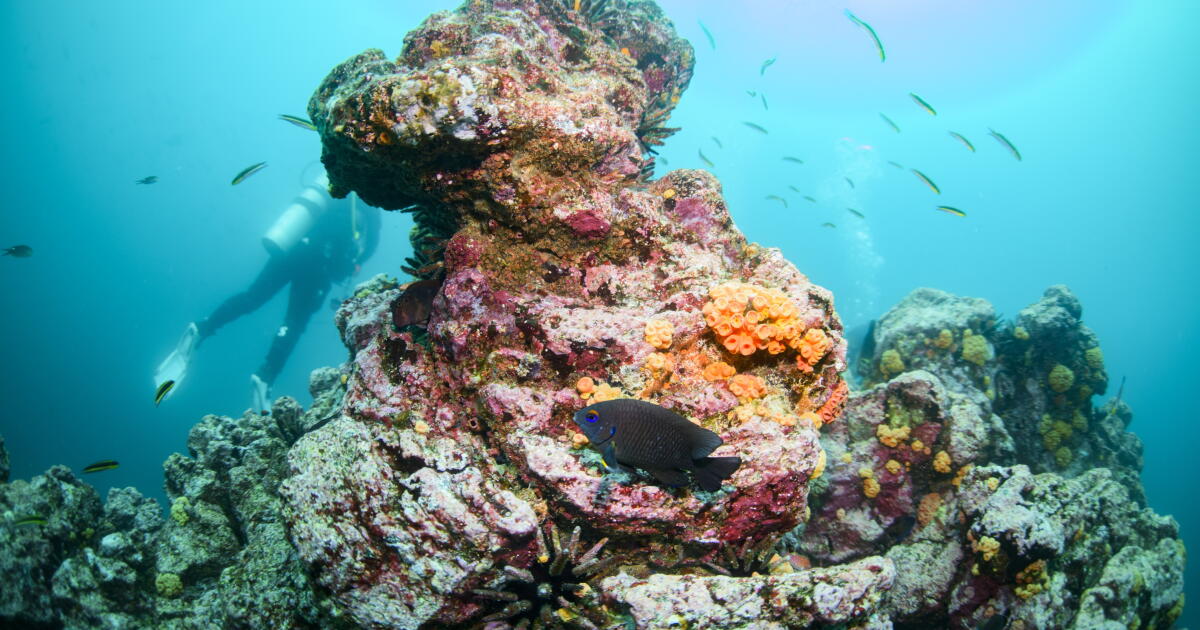
Corals in decline globally, nearly half a century of data shows
A record El Niño may make things a whole lot worse
The proportion of the world's reefs with living, stony stalks of hard corals is down significantly, according to a new global report on these vital ecosystems.
uncertain
proportion → show → ecosystems
And as these reefs stare down a potentially record-breaking El Niño peak just months away, new research suggests the naturally-occurring warming phenomenon might be more intense than it used to be — a trend captured in coral skeletons.
uncertain
it → stare → skeletons
The Status of Coral Reefs of the World 2025 says marine heatwaves and global bleaching events have taken a repetitive toll on the world's corals.
asserted
heatwaves → say → corals
This climate change-fuelled heat stress has driven hard coral coverage globally to roughly 25 per cent.
asserted
stress → fuel → cent
"Coral cover around the world used to be above 30 or 40 per cent back in the '80s," said Manuel González Rivero, lead author with the Australian Institute of Marine Science and global co-ordinator of the Global Coral Reef Monitoring Network.
asserted
Rivero → use → Network
But he adds that the main takeaway is "not only that we're seeing a loss in coral cover, but that the window of recovery is getting shorter and shorter," given extreme ocean heat events have been occurring more frequently.
asserted
events → add → recovery
Which is why the rate of recent coral cover decline relative to previous decades is also worrying at 9.5 per cent.
asserted
rate → worry → cent
"This decline … is showing that we're losing big chunks of coral from the majority of the world's coral reefs — and it's associated with climate change,” said Emily Darling, director of Coral Reefs at the Wildlife Conservation Society, who was not involved in the report.
asserted
who → show → report
This status report is the seventh by the Global Coral Reef Monitoring Network, using data from close to 37,000 reef sites.
asserted
report → use → sites
Hard coral cover shows a clear downward trend of loss and recovery stretching back to 1980.
asserted
cover → show → 1980
The declines, notably, come after a global bleaching event, or GBE — where hotter ocean temperatures cause corals to expel the symbiotic microscopic algae inside, turning them a ghostly white.
asserted
corals → come → them
While bleaching itself is not a death sentence, it leaves the corals weak and susceptible to disease and death, starting a domino effect for all the microorganisms and larger marine species that depend on them as a source of food and shelter.
asserted
that → bleach → food
Corals can recover, if given time.
asserted
Corals → recover → time
However, of the four recorded GBEs, three have happened in just the last 15 years — with the latest only recently declared over.
asserted
latest → record → years
"Corals have had nine months, just over a year, to try to recover," said Darling, "and now they're facing down the strongest 'super' El Niño on record and the hottest ocean temperatures ever recorded."
asserted
they → try → record
The lack of a decent recovery window means even resilient species, which Darling's recent research focused on, are getting hit repeatedly.
asserted
research → mean → which
Of the 10 regions monitored in this report, Rivero says, the declines are seen in four — Australia, the eastern Pacific, the Caribbean and the area from the Persian Gulf out to the Arabian Sea.
asserted
declines → monitor → Sea
Other regions are stable, if not growing.
asserted
regions → grow → ?
Corals in growth areas, however, are not immune to the added heat of the oceans.
asserted
Corals → add → oceans
As humans burn fossil fuels, oceans absorb 90 per cent of the excess heat trapped by those greenhouse gases, leading to more intense and frequent marine heatwaves.
asserted
oceans → burn → heatwaves
In the western Indian Ocean, which saw a significant increase in coral cover, the report notes "data sparsity prior to 1998 and uneven monitoring efforts" can "limit the accuracy of estimates of hard coral cover," adding that it and other regions may have actually experienced a decline.
Darling says confidence in the data has improved, because the number of people doing the diving, measuring and counting has gone up.
uncertain
number → see → diving
But she also echoes the report's call for sustained funding and standardizing monitoring methods in order to better understand the global picture of reefs.
asserted
she → echo → reefs
"There's still hope for increasing resilience to coral reefs," Darling said, but warned that ocean temperatures are getting hotter.
"
asserted
temperatures → be → reefs
And we are slowly boiling corals to death."
Action on a global and regional level
While the report's data brings the decline of corals into focus, the calls to action are also clear.
asserted
calls → boil → action
Given reefs support an estimated 25 per cent of marine life and contribute to the economy and coastal protection of more than 100 countries, the authors advocate for global and local action.
asserted
authors → give → action
On a regional level, "second-stage interventions" such as limiting overfishing, pollution and coastal development can "increase the resilience of coral reefs and their likelihood of surviving and recovering from extreme events," according to the report.
uncertain
interventions → limit → report
But on a global level, Rivero says, we need to stop emitting greenhouse gases by burning fossil fuels.
asserted
we → say → fuels
"Climate change is driving the warming of the oceans and that warming of oceans is driving the decline that we've seen on coral reefs.
asserted
we → drive → reefs
There's no doubt about it," Rivero told CBC News from Townsville, Australia.
asserted
Rivero → be → Townsville
El Niño may be getting worse
The current danger is more heat ahead with El Niño gaining strength on top of a baseline raised by climate change.
uncertain
Niño → get → change
But new research published in Science says recent El Niño events have been stronger — and corals themselves are a calendar of proof.
asserted
corals → publish → proof
"Corals can live for decades to centuries, and in the chemistry of their skeleton, they preserve a history of the conditions that they grow under," said Julia Cole, paleoclimatologist and chair of the department of earth and environmental sciences at the University of Michigan.
asserted
Cole → live → Michigan
"In warm conditions, corals are building their skeleton with a different chemistry than during cold conditions.
asserted
corals → build → conditions
"
Oceans dangerously acidic from carbon emissions, report warns
El Niño is here, and it’s already looking like it could be 'mind-blowing'
By studying the geochemistry of corals in the Galápagos — what Cole refers to as the heart of El Niño country — the study was able to go effectively back in time.
uncertain
study → warn → time
It found evidence of stronger El Niño events in the last 40 years compared to a time before 1850.
asserted
It → find → 1850
Cole cautions that El Niño is complex and this is not predictive of future events, but there is a shift in the last few decades as the world has gotten warmer from the burning of fossil fuels.
asserted
world → caution → fuels
"It really adds to this urgency and also a deep concern....
asserted
It → add → urgency
If this is where we are now, where are we going in the next 10 years?" Darling told CBC News.
asserted
Darling → go → News
"Because we know that a lot of this warming is committed and even if we turn things around today we still have a ways to go before the ecological systems on our planet start to respond to that."
asserted
systems → know → that
 The Aporia