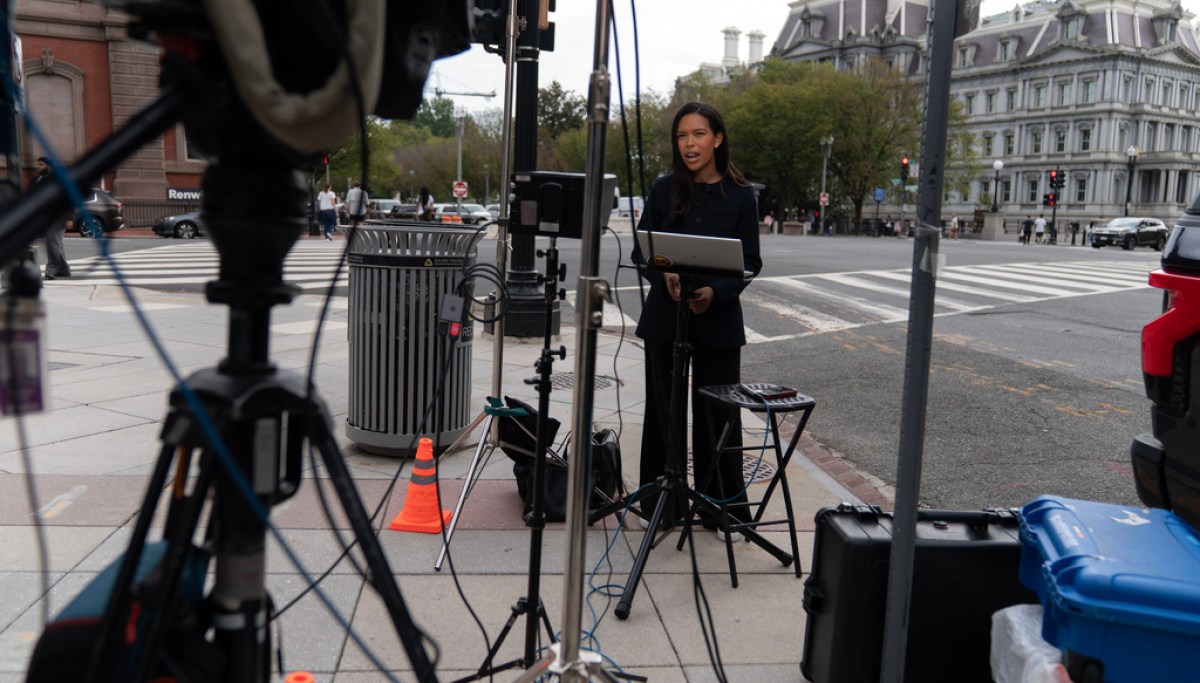
On the afternoon of September 18, 2026, President Trump announced in a social media post that, "effective immediately," he was "banning" the news organizations CNN, MS NOW, and POLITICO "from the White House."
asserted
he → announce → House
And those news organizations allege that over the weekend their reporters were denied access to the White House and had their "hard pass" press credentials deactivated.
asserted
credentials → allege → House
Plaintiffs—the three news organizations and three individual reporters—sue the President and several White House officials and move for a temporary restraining order, asking the Court to order the immediate reinstatement of their hard passes pending further proceedings.
asserted
Plaintiffs → sue → proceedings
The Court's resolution of their Motion is dictated by the application of well-known D.C. Circuit precedent that this Court must faithfully apply.
asserted
Court → dictate → that
For the reasons explained below, the Court will grant the Motion….
asserted
Court → explain → Motion
Plaintiffs have shown a likelihood of success, at least on their Fifth Amendment procedural due process claim.
uncertain
Plaintiffs → show → claim
The merits of this claim are assessed in two steps: "the first asks whether there exists a liberty or property interest which has been interfered with by the State; the second examines whether the procedures attendant upon that deprivation were constitutionally sufficient."
uncertain
procedures → assess → deprivation
Plaintiffs have shown they are likely to succeed at both steps.
asserted
they → show → steps
As for the first, the D.C. Circuit held in Sherrill v. Knight (D.C. Cir. 1977) that "the interest of a bona fide Washington correspondent in obtaining a White House press pass … undoubtedly qualifies as [a] liberty [interest] which may not be denied with-out due process of law under the fifth amendment."
uncertain
which → hold → amendment
And if there were any doubt about what Sherill meant, the D.C. Circuit more recently reaffirmed this conclusion in Karem v. Trump (D.C. Cir. 2020), holding that "a duly issued hard pass may not be suspended without due process."
uncertain
pass → be → process
Plaintiffs are also likely to succeed in showing that their hard passes were revoked without constitutionally adequate due process.
asserted
passes → succeed → process
The "general rule" is that "individuals must receive notice and an opportunity to be heard before the Government deprives them" of a constitutionally protected interest.
asserted
Government → receive → interest
Indeed, the Supreme Court has "described the root requirement of the Due Process Clause as being that an individual be given an opportunity for a hearing before he is deprived of any significant property interest."
asserted
he → describe → interest
Karem also holds that, because of the substantial interests at stake, before the Government can revoke the White House-issued hard pass of a reporter it must promulgate rules or standards governing the conduct that would lead to such revocation.
asserted
that → hold → revocation
And the reporter must "receive fair notice not only of the conduct that would subject him to punishment, but also of the magnitude of the sanction that the White House might impose."
uncertain
House → receive → that
Defendants do not dispute that Plaintiffs did not receive notice and an opportunity to be heard before their hard passes were revoked.
asserted
passes → dispute → notice
And, as in Karem, the record is bereft of any relevant "formally articulated standards" in place before any of the conduct for which Defendants revoked their hard passes.
asserted
Defendants → articulate → passes
One standard Defendants appear to offer—reflected in letters they sent to Plaintiffs on September 22, 2026, identifying their objectionable reporting—is so vague it hardly does the trick.
asserted
it → appear → trick
See, e.g., ECF No. 16-1 ("[Y]our organization has exhibited behavior in violation of the standards of professionalism and decorum expected of those given access to the White House Complex.").
asserted
organization → see → Complex
Moreover, Defendants renewed Plaintiff Betsy Klein's hard pass several months after she published some of the identified reporting, undercutting any argument that she or her employer, for example, had the requisite notice that the conduct at issue violated a relevant standard.
asserted
conduct → renew → standard
Finally, nothing put Plaintiffs on notice of the magnitude of the sanction Defendants imposed.
asserted
Defendants → put → sanction
None of Defendants' arguments convince the Court that Plaintiffs are not likely to succeed on their due process claim.
uncertain
Plaintiffs → convince → claim
Defendants say that Sherrill and Karem were wrongly decided.
asserted
Sherrill → say → ?
Maybe—but this Court is bound by D.C. Circuit precedent, full stop.
asserted
Court → bind → precedent
Defendants also point to the letters referenced above, which they assert afford Plaintiffs post-deprivation notice of the revocations and an opportunity to be heard.
asserted
they → point → revocations
And Defendants cite cases that suggest that such a post-deprivation process suffices in "extraordinary circumstances."
asserted
process → cite → circumstances
These are such circumstances, Defendants argue, because Plaintiffs have endangered national security through their reporting.
asserted
Plaintiffs → argue → reporting
But the circumstances here are not so "extraordinary" as to permit deviation from the "essential principle of due process" that a deprivation of liberty "be preceded by notice and opportunity for hearing."
asserted
deprivation → permit → hearing
Zevallos holds that post-deprivation due process may suffice in unusual situations, such as when "providing notice before blocking the assets of international narcotics traffickers would create a substantial risk of asset flight."
uncertain
providing → hold → flight
But nothing in the record suggests the need for such urgency here.
uncertain
nothing → suggest → urgency
Indeed, some of the reporting identified by Defendants in the letters to Plaintiffs stretches back months or years.
asserted
some → identify → Plaintiffs
The sorts of stories Defendants identify in the letters to Plaintiffs are routine.
asserted
Defendants → identify → Plaintiffs
And as discussed further below, the Court is skeptical—at least on this record—that Defendants' interest in safeguarding national security is the actual motivation for, or is even advanced by, the revocation of Plaintiffs' hard passes.
asserted
interest → discuss → passes
Finally, even if the circum-stances here allowed for post-deprivation process, Defendants are still left with the problem that, before the reporting at issue, Plaintiffs still did not "receive fair notice" of either the "conduct" that would lead to a sanction or of "the magnitude of the sanction that the White House might impose."
uncertain
House → allow → that
{At the hearing on the Motion, Defendants argued that an adequate standard relating to the revocation of Plaintiffs' hard passes had been promulgated because the public is generally on notice that disclosure of classified information is unlawful.
asserted
disclosure → argue → information
The Court is doubtful that the laws governing the retention, sharing, or mishandling of classified information provided Plaintiffs the sort of notice that satisfies Karem for several reasons, but especially given the lack of precedent for applying those laws to reporters.
asserted
that → govern → reporters
Moreover, just as the record lacks factual support for Defendants' contention that the revocation of Plaintiffs' hard passes will in fact protect national security (as discussed below), the record also lacks factual support for Defendants' contention that Plaintiffs violated these statutes, at least at this stage.}
asserted
Plaintiffs → lack → stage
[And] nothing in the record that predates this suit suggests that the revocation of Plaintiffs' hard passes was motivated by national security concerns.
uncertain
revocation → predate → concerns
Certainly, that is not what President Trump said when he announced that he was "banning" Plaintiffs from the White House—instead, he focused on the alleged lack of truthfulness and negativity of Plaintiffs' reporting.
asserted
he → say → reporting
And even the justifications provided to Plaintiffs after this case was filed are ambiguous about the true purpose of the revocations: while Defendants' letters to Plaintiffs mention national security concerns, they purport to identify reporting that "threatened national security and/or spread falsehoods," leaving open the possibility that all the stories fall into the later bucket, rather than the former….
[T]he record [also] lacks factual support for Defendants' contention that the revocation of Plaintiffs' hard passes will in fact protect national security or that national security will be endangered if the Court orders their passes reinstated while this litigation proceeds.
asserted
litigation → provide → security
…and 5 more, not listed.
 The Aporia