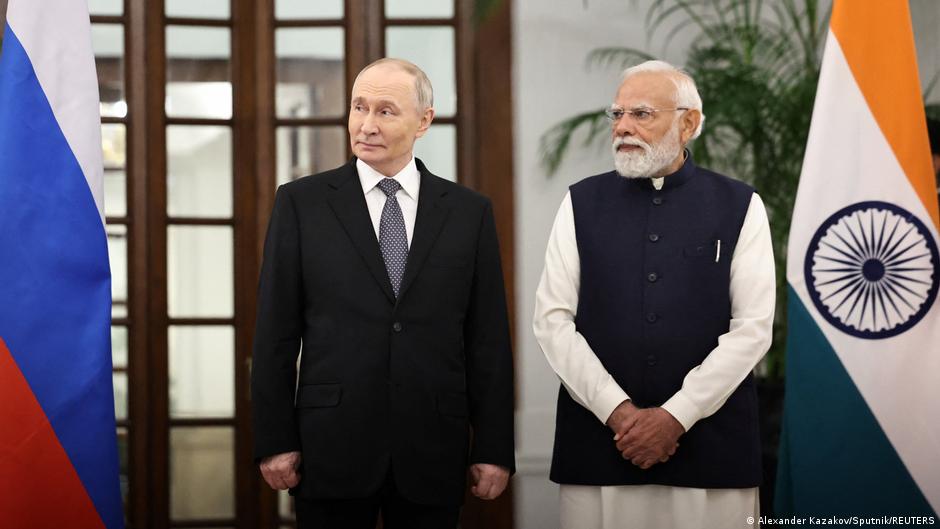
Indian Prime Minister Narendra Modi meets Russian President Vladimir Putin in Kyrgyzstan's capital Bishkek on Monday on the sidelines of the Shanghai Cooperation Organization (SCO) summit — a bloc often seen as a counterweight to US influence.
asserted
Modi → meet → influence
The meeting comes against the backdrop of the fallout from the US-Israel war on Iran, which has disrupted global energy markets, and Russia's war in Ukraine, which is in its fifth year.
asserted
which → come → year
India has remained engaged with the SCO while resisting efforts to turn it into an anti-Western bloc.
asserted
India → remain → bloc
Its position reflects a broader effort to maintain relationships with competing powers.
asserted
position → reflect → powers
Russia remains under Western sanctions over the war in Ukraine.
asserted
Russia → remain → Ukraine
Meanwhile, India has faced US pressure over its purchases of Russian oil, alongside wider trade tensions.
asserted
India → face → tensions
Former Indian ambassador to the US Meera Shankar told DW that India's relationship with Moscow should not be seen as directed against Washington.
asserted
relationship → tell → Washington
"India has a long-standing strategic relationship with Russia.
asserted
India → have → Russia
This is not directed against any country but intended to help India meet its national goals," said Shankar.
asserted
Shankar → direct → goals
Energy ties deepen
asserted
ties → deepen → ?
Energy has become the most visible change in the India-Russia relationship since the Ukraine war.
asserted
Energy → become → war
Before 2022, when Moscow launched a full-scale invasion of Ukraine, Russia supplied only a small share of India's crude imports.
asserted
Russia → launch → imports
Discounted Russian oil rapidly changed that, making Moscow one of India's biggest suppliers.
asserted
Moscow → change → suppliers
It has also become the most contentious part of India's relationship with Washington.
asserted
It → become → Washington
The US has pressed New Delhi to reduce its purchases from Russia, while India has maintained that securing affordable and reliable energy is a national interest.
asserted
securing → press → energy
The disruption to traditional energy supplies has made that calculation more complicated.
asserted
calculation → make → supplies
The US-Israel war on Iran and disruption of traffic through the Strait of Hormuz have affected India's purchases from the Gulf and pushed up prices.
asserted
war → affect → prices
Shankar says India is responding by diversifying its sources of supply, including Russia and the US.
asserted
India → say → Russia
"In the long run, a transition to a non-fossil fuel economy would strengthen India's energy independence.
asserted
transition → strengthen → independence
But this will not happen overnight," she added.
asserted
she → happen → ?
Until then, Shankar says, India will take steps it considers necessary to stabilize supplies and protect its people.
asserted
it → say → people
The future of India-Russia defense cooperation
Defense remains the other major pillar, but here the direction of travel is clearer: India's dependence on Russian equipment has been declining.
asserted
dependence → remain → equipment
The Ukraine war has raised questions over Russia's production capacity, delivery schedules and ability to supply spare parts after decades as a major supplier of India's military hardware.
asserted
war → raise → hardware
"India remains one of Russia's oldest and largest arms buyers, and perhaps the last major one," Aravind Yelery, associate professor at Jawaharlal Nehru University, told DW.
asserted
Yelery → remain → DW
"New Delhi is increasingly reluctant to commit to Russia's fifth-generation fighter program and has little appetite for new Russian hardware unless it can be incorporated into India's indigenous production plans," added Yelery.
asserted
Yelery → commit → plans
While New Delhi has diversified its purchases, that does not mean the defense relationship is disappearing.
asserted
relationship → diversify → purchases
However, the terms are changing, with India looking for a relationship that contributes to its own defense production, rather than simply buying finished systems.
asserted
that → change → systems
The China question
Russia's growing dependence on China has become an unavoidable part of the India-Russia equation.
asserted
dependence → grow → equation
Since the Ukraine war, China has become indispensable to Russia as a market, supplier and economic partner.
asserted
China → become → market
That has reduced Moscow's ability to serve as a counterweight to Beijing.
asserted
That → reduce → Beijing
Yelery sees an important distinction in the two relationships.
asserted
Yelery → see → relationships
"Strategically, Russia's relationship with China remains structurally transactional, a dependence it can ill afford to compromise, whereas its relationship with India rests on partnership," he said.
asserted
he → remain → partnership
India still has reasons to keep Moscow close: energy, defense, access to the Russian market and a longstanding political relationship across Eurasia.
asserted
India → have → Eurasia
But the strategic calculation has changed.
asserted
calculation → change → ?
India's 'America plus' strategy
Strategic affairs expert C Raja Mohan said that Russia's growing dependence on China has changed its strategic value for India.
asserted
dependence → say → India
"Russia is no longer in a position to help India balance China," Mohan, a professor of American Studies at Jindal Global University, told DW.
asserted
Mohan → help → DW
This changes what New Delhi expects from the relationship with Russia.
asserted
Delhi → change → Russia
The emphasis is increasingly on specific interests — energy security, defense supplies, trade, and access to technology — while India's larger strategic weight increasingly rests on relationships with the US and its allies.
asserted
weight → rest → US
India has expanded defense and technology cooperation with Washington, while deepening ties with partners such as France and Israel.
asserted
India → expand → France
Mohan describes this approach as an "America plus" strategy whereby India maintains the US partnership while widening its engagement with other major powers.
asserted
India → describe → powers
…and 12 more, not listed.
 The Aporia