Anyone who was an adult 25 years ago can remember where they were when they heard news that Muslim terrorists had flown two passenger planes into the World Trade Center.
asserted
terrorists → remember → Center
It was one of those cataclysmic events that marks one’s mind indelibly and creates a permanent refraction, from before to after, like B.C. and A.D., or before COVID and after COVID.
asserted
that → mark → COVID
I was driving to work in Toronto that morning, listening to a news show hosted by a Vietnam War draft dodger who had fled America when his country needed him and had, in the decades since, achieved a degree of media stardom in Canada.
asserted
country → drive → Canada
If I recall correctly, he speculated, reasonably enough in those earliest seconds of the all-consuming news cycle, that a small plane carrying tourists to see the skyscrapers close up had met with disaster.
asserted
skyscrapers → recall → disaster
Shortly after I reached the office, the second plane hit.
asserted
plane → reach → office
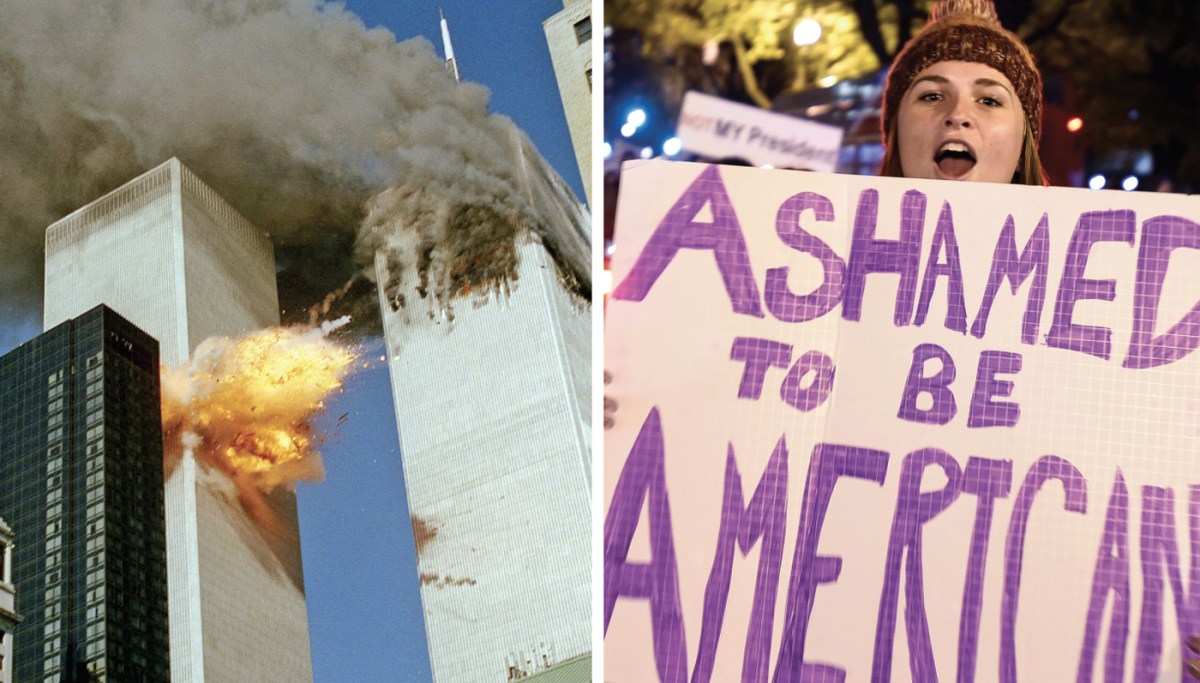
Reporters and editors who had been watching on TV as the first tower belched smoke into the blue sky, gasped in shock and horror when the second plane flashed across the screen and exploded in a ball of flame before a live worldwide audience.
asserted
plane → watch → audience
Global revulsion at the attack was instantaneous, and there was an emotional understanding among people everywhere, particularly in the West, that this was an act of war against our civilization.
asserted
this → be → civilization
Yes, there was Article 5 of the NATO agreement, which states that an attack on one member will be treated as an attack on all members.
asserted
attack → be → members
Foreign leaders and pundits declared, “We are all Americans.”
asserted
We → declare → ?
Some dissenting voices took the side of our enemies, and there were one or two utterly cynical responses, such as that of a British civil servant who advised colleagues to release any bad news while the world was distracted by the enormity perpetrated by Osama bin Laden and al Qaeda.
asserted
world → dissent → Laden
Mostly, however, and overwhelmingly, there was a sense of reeling disbelief combined with genuine sympathy for America, and a nearly universal understanding that a great evil was abroad in the world.
asserted
evil → be → world
Like so many others, I lost a friend murdered that day; she was on the plane that the hijackers smashed into the Pentagon.
asserted
hijackers → lose → Pentagon
Men and women stopped what they were doing, collected their children early from school, and rearranged their lives long term.
asserted
they → stop → lives
Men and women quit their jobs to do whatever they could to help.
uncertain
they → quit → whatever
Young men abandoned their careers to join the armed forces, stand with their country, and go to war with the newly declared and terrible enemy.
asserted
men → abandon → enemy
President George W. Bush stirred and emboldened the nation when he stood on the apocalyptic rubble of southern Manhattan and told workers doing the grim work of retrieving bodies, “I can hear you. …
asserted
I → stir → you
The rest of the world hears you … and the people who knocked these buildings down will hear all of us soon.”
asserted
who → hear → us
It was a rallying cry for just retribution and seemed also to contain a new clear-sightedness.
asserted
It → seem → sightedness
In the aftermath of the attack, watching the national and international reaction, I wrote that the passion released on 9/11 might bring epochal change and initiate a new age of revived American patriotism, a restoration of understanding in the West that some cultures are better than others, and ours is worth fighting for.
uncertain
ours → watch → others
I expressed hope and some confidence that, galvanized by the atrocity just visited upon it, our society would get up off its knees, end its cultural cringe, and finally see that tolerance of cultural difference should not be allowed to slump into self-abasement and retreat.
asserted
tolerance → express → abasement
The resurgence of patriotism did not last.
asserted
resurgence → last → patriotism
Bush himself stressed that the murder of 3,000 people should not taint America’s view of Muslims.
asserted
murder → stress → Muslims
As we went to war in Afghanistan, the Left found its voice and, furrowing its brow, suggested that the most important thing was to avoid “Islamophobia.”
uncertain
thing → go → Islamophobia
Its adherents recovered their composure after the patriotic setback and started wearing badges declaring, “War is not the answer.”
asserted
War → recover → badges
(That depends on the question.
asserted
That → depend → question
If it is “how can we make sure America defeats its foes?” then war may be very much the answer).
uncertain
war → make → foes
As our armed forces went into action on foreign battlefields, skeptics and naysayers lectured us on the home front that we must not act or think ill of Islam.
asserted
we → go → Islam
“Islamophobia” was then, and today remains, a lie.
asserted
Islamophobia → remain → ?
It is a term intended to denigrate as bigots those who rationally dislike Muslim culture, values, and deadly aggression.
asserted
who → intend → culture
It attempts to reframe a reasonable antipathy as gut prejudice that should be shunned by civilized people.
asserted
that → attempt → people
Thus began a process, still with us today, by which America’s enemies, foreign and domestic, seek to shut down discussion of the obvious problems that Islam poses to the way of life and security of the West.
asserted
Islam → begin → West
Some months after 9/11, my newspaper was approached by the Council on American-Islamic Relations, which was unhappy with what we’d write about Islam’s incompatibility with the preservation of the West as we know it.
asserted
we → approach → it
The organization did not like our advocacy of military action against jihadis.
asserted
organization → like → jihadis
It objected to our labeling the killers and devotees of their creed as “Islamofascists.”
asserted
our → object → Islamofascists
Just this month, prosecutor Lara Burns testified to Congress about evidence from a 1993 wiretap in which members of the Palestine Committee, a body which, naturally, was established by the United Nations, discussed their Islamist conspiracy against the West.
asserted
which → testify → West
Burns said it “included supporting Hamas abroad and infiltrating universities, media, and politics here in the U.S. … to begin normalizing Hamas and Muslim Brotherhood extremist ideology in American society.
asserted
it → say → society
They stated, ‘War is deception’ when plotting to lie to Americans.
asserted
War → state → Americans
They also noted their intent to cleanse the curriculum in K-12 schools because ‘we don’t want our children growing up surrendering to the idea of peace with Jews.’ …
asserted
children → note → Jews
They agreed to continue to pursue their agenda by cloaking themselves under the cover of legitimacy. …
asserted
They → agree → legitimacy
It was out of this conspiratorial meeting that CAIR was created to protect the other elements of the Hamas support network.”
asserted
CAIR → create → network
…and 55 more, not listed.
 The Aporia