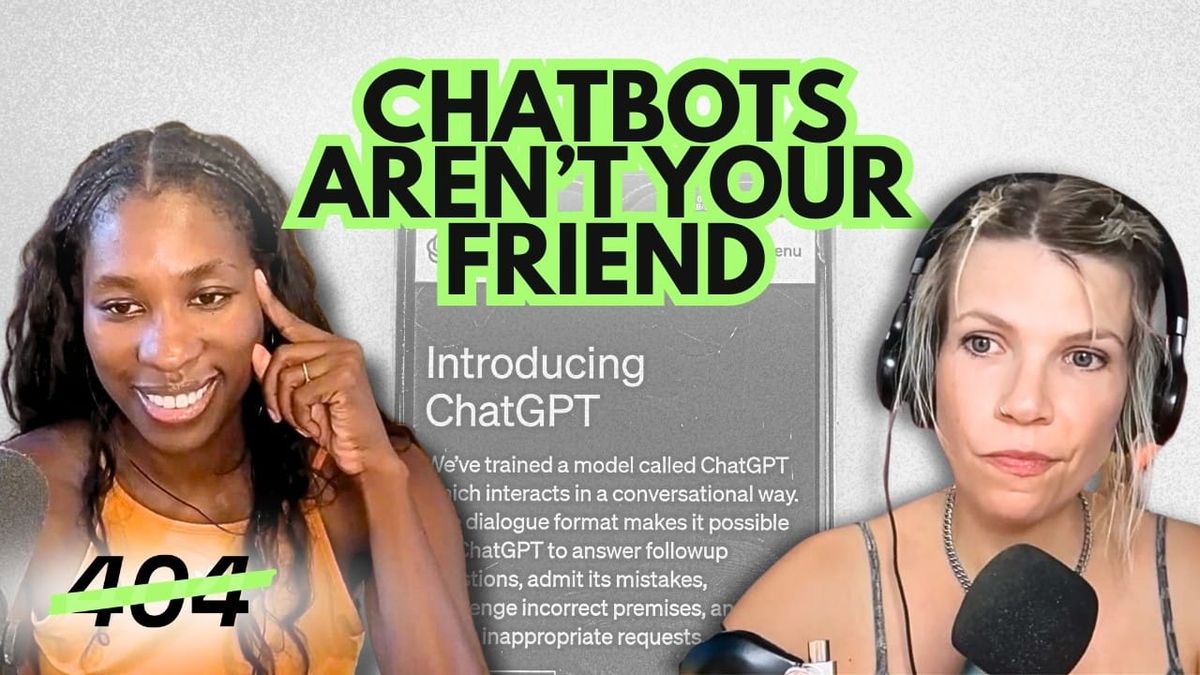
Tech companies want you to believe that the chatbots they profit from are the always ready, never judgmental, constantly affirming friend in our pockets.
asserted
they → want → pockets
But are the people using them as companions under some kind of deep self-delusion?
asserted
people → use → delusion
Or are they seeking something else?
asserted
they → seek → something
In this week’s interview episode, I was joined by journalist Bridget Todd.
asserted
I → join → Todd
Among many other projects and accomplishments, Bridget is the creator and host of the award winning podcast There Are No Girls on the Internet, is a Fellow at the MacArthur Foundation, and an affiliate at Harvard University's Berkman Klein Center for Internet & Society.
asserted
There → win → Internet
Her new audiobook, Love at First Prompt: AI and the Future of Intimacy, launched in July with coauthor Michael Amato.
asserted
audiobook → launch → Amato
We talk about her work interviewing people who use chatbots to fill an emotional need, how people who engage in romantic, intimate and erotic roleplay with LLMs are mocked for it, and how tech companies are implicated in all of this.
asserted
companies → talk → this
In her new book, you’ll hear from experts in the field of AI companionship, but also from people who have nuanced, interesting interactions with chatbots every day.
asserted
who → hear → chatbots
For Bridget, Love at First Prompt was inspired in large part by her own use of LLMs in the face of extreme stress and tragedy after her parents died – her dad after a long illness, and her mom more suddenly after.
asserted
parents → inspire → illness
“It was like having to relearn how I fit into my existing social dynamic,” she told me.
asserted
she → have → me
I wasn't really talking to my friends.
asserted
I → talk → friends
I wasn't really talking to anybody.
asserted
I → talk → anybody
I wasn't really returning any emails.
asserted
I → return → emails
She’d been using ChatGPT to keep track of medical notes, but soon that changed, almost without her realizing it.
asserted
her → use → it
“My use of ChatGPT had gone from just looking up things that my dad's doctor would say, or researching how to get care and how to pay for care – it was a lot of that because I was getting hit with a lot of complex medical jargon that I never heard – to then, I found myself late at night telling ChatGPT, ‘I'm so overwhelmed.
asserted
I → go → ChatGPT
And so there wasn't any particular black and white light switch that flipped where [I thought] now I'm going to start speaking emotionally to ChatGPT.
asserted
I → be → ChatGPT
It happened without me really even noticing it.”
asserted
me → happen → it
This made her curious about other people’s usage of chatbots, especially in a time when so many tech companies are pushing “AI companions” as the frontier of connection.
asserted
companies → make → connection
In the book, she breaks down how real people use LLMs to fill an emotional need, and connects their experiences to how tech executives are cashing in.
asserted
executives → break → experiences
“All of these things that we used to think of as sacrosanct are now just up for grabs by these tech companies.
asserted
we → use → companies
And so the question that I asked people who were experiencing intimacy with AI was, are you comfortable with something as intimate as these connections that are romantic or sexual being owned and controlled by companies who don't give a shit about you, who we know cannot be trusted, who do horrible things without even thinking about it?
asserted
who → ask → it
Even beyond that, who will change as the wind blows?” Bridget said in our conversation.
asserted
Bridget → change → conversation
“Like Sam Altman saying, ‘We're gonna start doing erotic role play.
asserted
We → say → play
The whiplash with which [execs] say things and then take it back and then operate as if they never said that, it's almost like gaslighting.
asserted
it → say → gaslighting
Do you want your most intimate human connections being mediated by an unreliable gaslighter?
asserted
connections → want → gaslighter
And that's what we have in these tech companies.”
Bridget’s book is her most vulnerable work yet.
asserted
book → have → companies
She unpacks and critiques her own use of ChatGPT during a crisis, and reveals what she learned about herself, her friendships and real-life relationships, and what it means to maintain human connections in an era tech companies are constantly trying to exploit our innermost worlds.
asserted
companies → unpack → worlds
 The Aporia