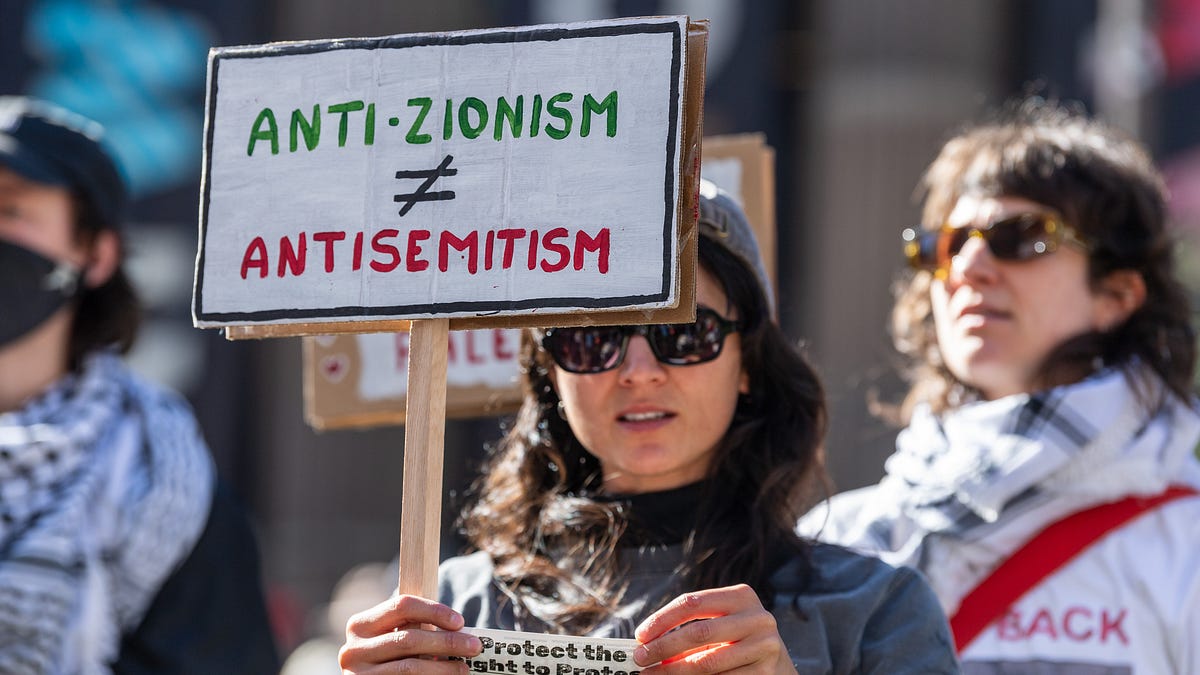
Last week, a federal judge weighed in on whether an alleged assault involving an Israeli flag was antisemitic.
asserted
assault → weigh → flag
The case stemmed from an incident in November 2024, at a CodePink demonstration outside the Dirksen Senate Office Building in Washington, D.C., when a pro-Palestinian protester, Janine Ali, a then-73-year-old Palestinian-American grandmother, allegedly grabbed the Israeli flag that a pro-Israel counterprotester, Kimmara Sumrall, was wearing tied around her neck as a cape.
uncertain
counterprotester → stem → cape
Ali was found not guilty of assault in a criminal trial in May, so Sumrall, with the support of the National Jewish Advocacy Center, then filed a complaint in federal court alleging antisemitic discrimination under civil rights law.
uncertain
Sumrall → find → law
In his ruling, U.S. District Judge Trevor McFadden, a Trump appointee, noted that lawyers for Ali argued that “the Israeli flag represents the state of Israel rather than the Jewish race, so her action is merely anti-Israel, not antisemitic.”
asserted
action → note → race
McFadden, however, rejected the argument that the Israeli flag did not represent Jewish identity, writing, “The Star of David, emblazoned upon the Israeli flag, symbolizes the Jewish race.”
asserted
Star → reject → race
The six-pointed star, called the “Star of David” (Magen David in Hebrew, literally “shield of David”), has been a Jewish symbol since long before the establishment of the State of Israel.
asserted
star → call → Israel
It first became widely used as a distinctive Jewish symbol by European Jews in the 19th century.
asserted
It → use → century
It came to represent Judaism in the same way that the cross represents Christianity.
asserted
cross → come → Christianity
To this day, just as many Christians wear necklaces with a cross, many Jews wear a Star of David on necklaces as a symbol of their Jewish identity.
asserted
Jews → wear → identity
Some Jews even have tattoos of it (disregarding the fact that Jewish law prohibits getting a tattoo).
asserted
law → have → tattoo
The Zionist movement adopted the Star of David at the first Zionist Congress in Basel in 1897 because it had become a popular Jewish symbol by then, and for the mostly secular early Zionists, it had the merit of not being seen solely as a religious symbol (as the late Israeli Jewish scholar Gershon Scholem noted in a 1949 essay in Commentary magazine titled, “The Curious History of the Six-Pointed Star: How the ‘Magen David’ Became the Jewish Symbol”).
asserted
David → adopt → Star
It was subsequently incorporated into the flag of the State of Israel a few months after Israel’s founding in 1948.
asserted
It → incorporate → 1948
When the Star of David is emblazoned in blue between two horizontal blue stripes on the flag of Israel, it ceases to be just a Jewish symbol.
asserted
it → emblazon → Israel
The Israeli flag symbolizes the State of Israel.
asserted
flag → symbolize → Israel
It has a Jewish symbol on it, but the flag itself is not a Jewish symbol.
asserted
flag → have → it
More than a dozen Muslim-majority countries have the Islamic crescent on their flags, but that does not make these flags Islamic symbols.
asserted
flags → have → flags
For example, Pakistan, officially named the Islamic Republic of Pakistan, has a national flag with a white crescent moon – the symbol associated with Islam – on a dark green background, which is the color associated with Islam.
asserted
which → name → Islam
If someone burned that flag at a demonstration against Pakistan, it would surely be offensive to Pakistanis, but it would not be Islamophobic.
asserted
it → burn → Pakistanis
The same logic applies to the Israeli flag.
asserted
logic → apply → flag
Both Israel and Pakistan, as well as many other countries, have appropriated religious symbols for nationalist purposes.
asserted
Israel → appropriate → purposes
Thus, wearing an Israeli flag at a demonstration is not the same as wearing a Magen David necklace.
asserted
wearing → wear → necklace
Grabbing an Israeli flag worn as a cape during a demonstration may be considered an act of political violence, but it is not an act of antisemitic violence or discrimination.
uncertain
it → grab → violence
It is not the same as grabbing a Magen David necklace or knocking a kippa off someone’s head – actions that are equivalent to pulling a hijab off a Muslim woman or a turban off the head of a Sikh man.
asserted
that → grab → man
Although Israel’s flag is prominently displayed in many synagogues outside Israel, this does not make the flag itself a religious object (nor does the presence of an Israeli flag in a synagogue, typically alongside an American flag, make the synagogue an Israeli institution).
asserted
synagogue → display → flag
To characterize the flag of Israel as a Jewish object because it has a Star of David on it conflates Judaism with Zionism and the Jewish people with the Israeli state.
asserted
it → characterize → state
Unfortunately, such conflation has become all too common.
asserted
conflation → become → ?
This is one reason, though it is of course not the only reason, why Jews are harassed and attacked by people who hate Israel.
asserted
who → harass → Israel
In some people’s minds, Jews are proxies for Israel; therefore, they hate Jews because they hate Israel, and they attack Jews because they cannot attack Israel.
asserted
they → hate → Israel
This is antisemitic and morally reprehensible because innocent people are being collectively blamed and harmed for the actions of a state.
asserted
people → blame → state
The same is true when all Muslims or Arabs are blamed for the actions of terrorist groups such as ISIS and al-Qaeda, which happened frequently in the aftermath of the 9/11 terrorist attacks.
asserted
which → blame → attacks
It is bigoted to hold all Muslims or Arabs accountable for the behavior of terrorist groups, and it is equally bigoted to hold all Jews accountable for Israel’s behavior.
asserted
Jews → hold → behavior
However, it is important to acknowledge that prejudice is not the only factor at play here.
asserted
prejudice → acknowledge → play
Another factor is that people mistakenly believe that Muslims support Jihadist groups and that Jews support Israel.
asserted
Jews → believe → Israel
Some do, but many do not.
asserted
many → do → ?
Although the Islamic State claims to act on behalf of all Muslims, surveys show that most Muslims do not support the Islamic State terrorist group.
uncertain
Muslims → claim → group
Similarly, Israel claims to act on behalf of all Jews, but surveys show that most American Jews do not support the actions and policies of the Israeli government and army, particularly towards Palestinians in the West Bank and Gaza Strip
uncertain
Jews → claim → Bank
(to be clear, I am not equating these actions with those of the Islamic State).
asserted
I → equate → State
For example, in a 2025 Washington Post survey, 61% of American Jews said that Israel committed war crimes against Palestinians in Gaza, and 40% thought that Israel had committed genocide.
asserted
Israel → say → genocide
What complicates matters in the case of Jews and Israel is that most American Jews have an emotional attachment to Israel (around six in 10 in surveys express such an attachment), and this attachment is a product of their Jewish identity.
asserted
attachment → complicate → identity
They care about Israel, which, it must be stressed, is not the same as supporting everything it does.
asserted
it → care → everything
…and 18 more, not listed.
 The Aporia