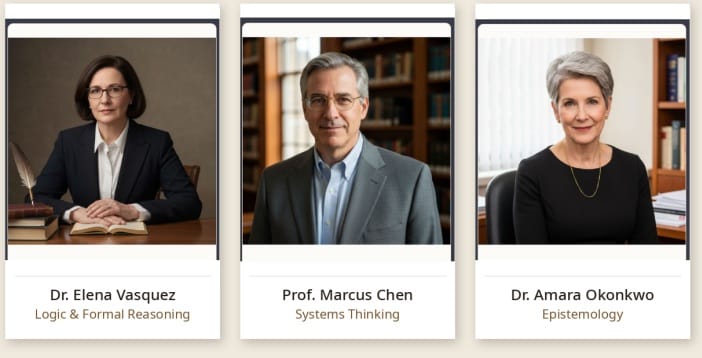
“Elena Vasquez and Marcus Chen have appeared as volcano experts, astronauts, thriller protagonists, podcast hosts, and academic co-authors across hundreds of independently produced AI-generated documents, never having lived,” a new preprint research paper from Samsung and the University of Warsaw said.
asserted
paper → appear → Warsaw
The paper identified a number of names that co-authored hundreds of AI-generated academic papers, articles, and books.
asserted
that → identify → papers
The authors don’t actually exist, but are instead names that large language models repeatedly produce when tasked with generating experts in certain fields.
asserted
models → exist → fields
The paper, titled “The Ghost Couple: Correlated LLM Name Priors and Their Haunting of the Web and Academic Publishing,” utilized a known phenomenon where certain LLMs will keep coming up with the same names in certain contexts.
asserted
LLMs → title → contexts
For example, In June, Sam wrote about how ChatGPT, Gemini, and Claude were likely to use the name Elias Thorne in fiction they generated, and that the character was often a lighthouse keeper.
asserted
character → write → fiction
Similarly, users noticed that if they ask ChatGPT to generate a software developer, their name will often be Marcus Chen.
asserted
name → notice → developer
The researchers were able to show not only that LLMs often default to the same names, but that they produce “correlated character ensembles,” meaning some names were more likely to appear together.
asserted
names → show → ensembles
Other names that were consistently generated by AI models include Elena Amara Okafor from Claude, Aris Thorne and Lena Petrova from Gemini, and Elara Voss from ChatGPT.
asserted
that → generate → ChatGPT
Earlier this month, I reported a story about Research Gold, a company that offered what it claimed was human medical research, but that was in fact entirely AI generated.
asserted
that → report → fact
The founder and lead methodologist for that company was named Elena Vasquez.
asserted
founder → name → company
Research Gold removed Elena Vasquez from its site after I published the story.
asserted
I → remove → story
Michał Brzozowski, the lead author of the paper, told me that searching for these names on Google turned up other instances of AI generated personalties.
asserted
searching → tell → personalties
For example, following the killing of Alex Pretti at the hands of U.S. Border Patrol agents in January, a rumor spread on Facebook that he was fired from his nursing job for misconduct allegations.
asserted
he → follow → allegations
Snopes reported that the false statement was attributed to “executive director Dr. Elena Vasquez,” who does not exist.
asserted
who → report → Vasquez
Brzozowski was able to search databases of academic papers for the names they knew LLMs often generated.
asserted
LLMs → search → names
“On Zenodo, a CERN operated repository that mints real DataCite DOIs, we identify 1,655 ghost-authored records claiming nonexistent journals with fabricated publication dates.”
asserted
we → operate → dates
A DOI, or a Digital Object Identifier, is a string of characters and numbers used to identify academic papers.
asserted
DOI → use → papers
The researchers saw that many of the papers authored by these AI names were backdated, meaning their publication dates were different from the date they were uploaded to Zenodo.
asserted
they → see → Zenodo
Anyone with a free account can create a DOI on Zenodo, but the existence of AI generated papers with DOIs has impacts on other parts of the web and academic publishing.
asserted
existence → create → web
“These [AI generated papers] carry real DOIs harvestable by any scholarly aggregator; the infrastructure for large-scale scholarly record contamination is already in place.
asserted
infrastructure → generate → place
Ghost names additionally appear on ResearchGate, forming synthetic research groups with collaborators drawn from multiple model families, and are indexed without verification by Google Scholar and Semantic Scholar [...] The academic record is being quietly haunted.”
asserted
record → appear → Scholar
Research Gate and Google Scholar are both aggregators of academic publishing that are likely to come up in search results.
asserted
that → come → results
The researchers say that different LLMs and versions of those LLMs generate certain names so consistently, they think they can use them to determine the provenance of AI slop.
asserted
they → say → slop
For example, the name Elena Vasquez was particularly common in content generated by Claude Sonnet 4, so papers that list her as an author were likely generated by that LLM.
asserted
that → generate → LLM
However, Brzozowski said that this level of accuracy might not hold for long now that AI generated content with these names is flooding the internet and feeding back into all AI models that are scraping the internet for training data.
uncertain
that → say → data
The fact that AI academic publishing is struggling to deal with the load of AI generated content isn’t new.
asserted
publishing → struggle → content
We’ve previously reported that scientific journals have published AI generated text, that AI is impacting the peer review process, and that the open-access repository for preprint academic research Arxiv will now ban authors for a year if they are caught submitting AI generated work.
asserted
they → report → work
The potential upside of this research is that these names might allow us to detect this AI generated content more easily.
uncertain
us → allow → content
 The Aporia