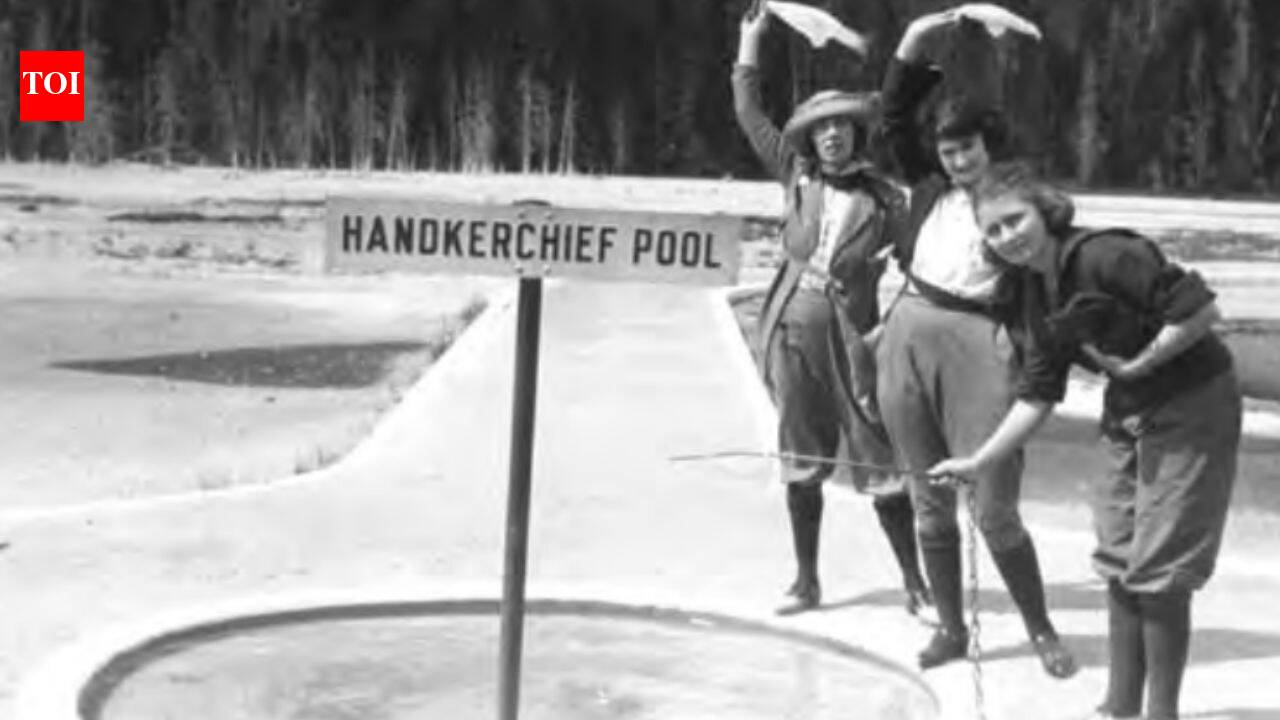
Long before Yellowstone National Park became known for strict rules around its hot springs and geysers, visitors were encouraged to marvel at some of the park’s unusual thermal features.
asserted
visitors → know → features
According to National Park Service, visitors could put a handkerchief into it and watch it disappear into the water.
uncertain
it → accord → water
The item would then come back to the surface after being moved through the pool’s water currents.
asserted
item → come → currents
Vistors believed the items came back scrubed and clean.
asserted
items → believe → ?
But visitors did not limit themselves to handkerchiefs.
asserted
visitors → limit → handkerchiefs
Over time, people began putting other objects into the pool.
asserted
people → begin → pool
This gradually turned a natural thermal feature into a collection point for rubbish and other items and started to interfere with the pool’s natural activity.
asserted
This → turn → activity
Handkerchief Pool’s activity eventually stopped in 1926.
asserted
activity → stop → 1926
According to Yellowstone Science, a log was shoved into the pool’s vent, blocking the feature and stopping the movement of water that produced its unusual effect.
uncertain
that → accord → effect
Visitors, however, continued to throw objects into the pool even after it stopped working properly.
asserted
it → continue → pool
The problem was not limited to the log.
asserted
problem → limit → log
The pool had accumulated a large amount of material over the years.
asserted
pool → accumulate → years
Objects that visitors had thrown into the water remained inside the feature, adding to the blockage and making it harder for the pool to function normally.
asserted
pool → throw → blockage
Also, the park contains geothermal systems that depend on underground water movement, heat and narrow openings.
asserted
that → contain → movement
Blocking those openings with foreign material can change or stop the natural activity of a spring.
asserted
Blocking → block → spring
The damage was eventually investigated and a major cleanup was carried out in 1929.
asserted
cleanup → investigate → 1929
When Ranger Carlos Davis cleaned the pool in 1929, the amount and variety of material removed was astounding.
asserted
amount → clean → material
More than one and a half bushels of debris were taken out of the spring.
asserted
bushels → take → spring
Morning Glory Pool in the Upper Geyser Basin was another heavily affected thermal feature.
asserted
Pool → affect → Basin
The debris included coins, more than 100 hairpins, nails, bolts, a horseshoe, a broken bottle, part of a spark plug, badges, nuts and about a dozen handkerchiefs.
asserted
debris → include → plug
The 1929 cleanup helped improve the convection currents in the pool, but the work did not completely solve the problem.
asserted
work → help → problem
Records indicated that further work would be needed.
asserted
work → indicate → ?
Other springs and geysers were also affected when visitors threw rocks, coins, bottles and other objects into them.
asserted
visitors → affect → them
Minute Geyser in Norris Geyser Basin was among the most vandalised.
asserted
Geyser → vandalise → vandalised
It once erupted about once a minute, sometimes reaching 40 feet, but rocks and other material were repeatedly thrown into its vent.
asserted
rocks → erupt → vent
By 1969, the vent was clogged with rocks cemented together by mineral-rich spring water, causing the geyser’s activity to shift to a side vent.
asserted
activity → clog → vent
Its eruptions then became irregular and reached only a few feet.
Morning Glory Pool in the Upper Geyser Basin was another heavily affected thermal feature.
asserted
Pool → become → Basin
Before the road near it was diverted in 1971, visitors threw coins, rocks, logs, bottles and clothing into the spring.
asserted
visitors → divert → spring
Repeated cleanups removed some of the material, but continued additions clogged the vent.
asserted
additions → remove → vent
The pool’s temperature may have fallen, allowing algae to grow, although Yellowstone geologists noted that natural causes may also have contributed to the change.
uncertain
causes → fall → change
The story of Handkerchief Pool did not end with the 1929 cleanup.
asserted
story → end → cleanup
In 1950, park geologist George Marler cleaned the spring again, removing the log and gravel that had washed into it.
asserted
that → clean → it
Water flowed into the pool once more, but the feature had been permanently changed by its long period of inactivity, with algae mats spreading onto its rims.
asserted
feature → flow → rims
Many geysers around the world have been altered or lost because of geothermal energy development and tourism.
asserted
geysers → alter → development
Yellowstone was protected as the world’s first national park largely because of its geyser basins.
asserted
Yellowstone → protect → basins
 The Aporia