Singapore has to keep reinventing itself as global environment changes: SM Lee
asserted
environment → have → itself
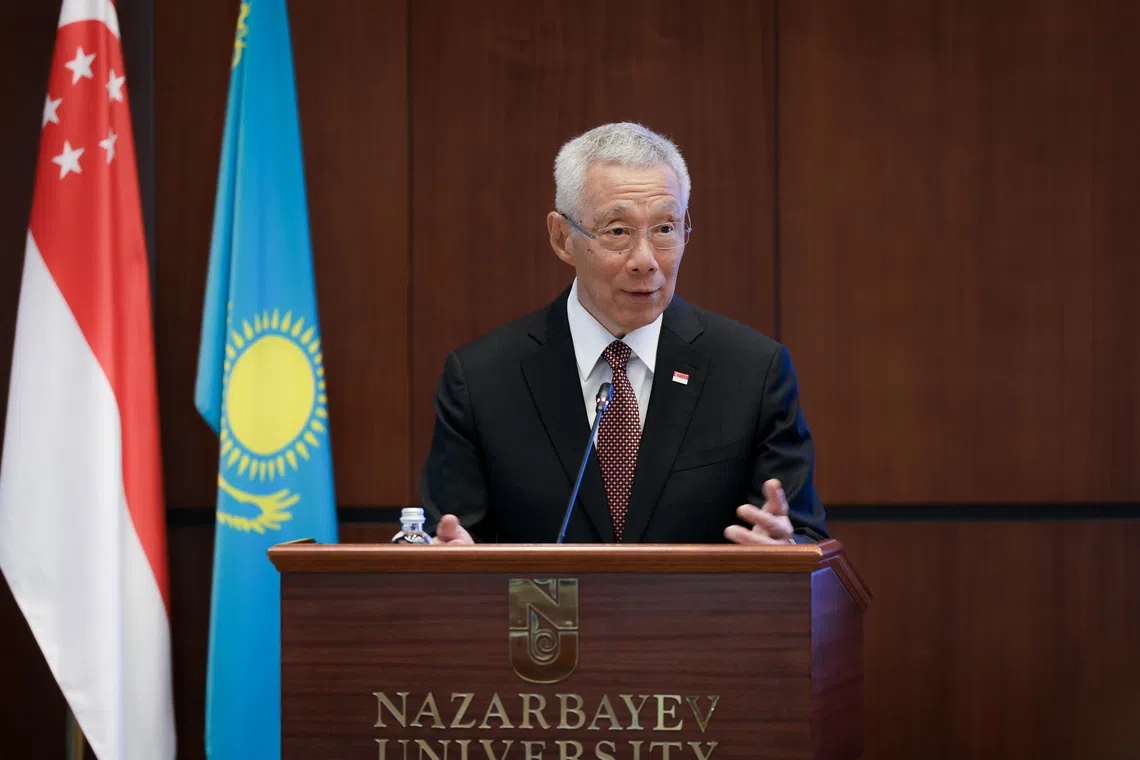
Singapore has had to reinvent itself from time to time when circumstances changed, and must continue to adapt as it navigates an increasingly uncertain global environment, Senior Minister Lee Hsien Loong said on Aug 27.
asserted
Loong → have → Aug
The Republic’s progress has not been a straight line, and policies have sometimes had to be adjusted when they did not work as intended, he said in a lecture at Nazarbayev University in Kazakhstan’s capital, where he was conferred an Honorary Professorship.
asserted
he → have → Professorship
“We have repeatedly had to reinvent ourselves, in order to overcome setbacks and changed circumstances, and resume our journey forward,” SM Lee said.
asserted
Lee → have → journey
“In the current uncertain and troubled world, we have to respond with equal resourcefulness and resolve.”
asserted
we → have → resourcefulness
SM Lee noted that Singapore and Kazakhstan faced different circumstances and might make different policy choices, but said the broader lesson was the need to build systems capable of “continuously adapting and readapting”.
uncertain
lesson → note → systems
These have to rest on strong fundamentals such as state capacity, market discipline and inclusive policies, allowing for adjustments when circumstances change or policies fail to work as intended.
“That is what Singapore has had to do, again and again,” he said.
asserted
he → have → what
SM Lee said Singapore was now at “another turning point”, after benefiting - for much of the six decades since independence - from a rules-based global trading system and a broad push towards economic integration and mutual prosperity.
asserted
Singapore → say → integration
In the Asia-Pacific, the United States provided the security that allowed countries to grow in peace, while China re-entered the world economy in the 1980s and grew rapidly within the same framework, creating what Lee called “the best of both worlds” for Asian countries.
asserted
Lee → provide → countries
But the strategic environment has changed significantly, he said.
asserted
he → change → ?
Major power rivalry is now intense, with the US reassessing its approach to the world, national security and resilience taking precedence over economic well-being, and trade dependencies being weaponised.
asserted
dependencies → reassess → being
“Multilateralism is breaking down,” SM Lee said.
asserted
Lee → break → ?
“This is a much less conducive environment for countries to grow and develop.”
asserted
countries → grow → ?
It was against this changed backdrop that Singapore embarked on an Economic Strategies Review to rethink its position and chart the way forward, SM Lee said.
asserted
Lee → change → way
Launched in August 2025, the review brought together government, business and union representatives to chart Singapore’s longer-term economic strategy.
asserted
review → launch → strategy
Its final recommendations, released in May, focused on keeping Singapore competitive and adaptable, while building greater resilience against global shocks
As it had done at previous major turning points, Singapore formed a tripartite committee bringing together government ministers, business leaders and union representatives for the review.
uncertain
Singapore → release → review
“They are invaluable not just for generating new ideas, but also to build consensus and commitment amongst businesses, unions and the population on the way forward,” he said.
asserted
he → generate → way
Staying open, remaking the economy
SM Lee laid out five areas Singapore must focus on as it adapts to the new environment.
asserted
it → stay → environment
While bigger countries might be able to promote self-sufficiency by erecting trade barriers, this was not an option for Singapore.
uncertain
this → promote → Singapore
“Closing ourselves off and turning inwards is simply impossible,” he said.
asserted
he → close → ourselves
“We will always have to do business with the world, even as we diversify and secure our own supply chains.”
asserted
we → have → chains
This was why Singapore was growing ties with non-traditional partners such as Kazakhstan and other Central Asian economies.
asserted
Singapore → grow → Kazakhstan
Where consensus among all World Trade Organization members is not possible, SM Lee said “coalitions of the willing” could pursue shared interests while remaining within the framework.
uncertain
coalitions → say → framework
This means the Government creating the conditions for enterprise to thrive, actively investing in infrastructure and skills, developing capabilities and opening new markets.
asserted
enterprise → mean → markets
Fourth, Singapore must remake its economy “again and again”.
asserted
Singapore → remake → economy
This includes encouraging firms to embrace artificial intelligence and preparing workers for ensuing changes and disruptions.
asserted
This → include → changes
It must also continue to invest in areas where Singapore is strong, such as its air hub, container port and financial sector.
asserted
Singapore → continue → hub
Finally, and “most critically”, Singaporeans have to remain united.
asserted
Singaporeans → have → ?
SM Lee said society had to guard against racial and religious divisions, frictions between old and new citizens, and divides between rich and poor.
asserted
society → say → rich
“For us to stay united, growth has to be inclusive, and has to benefit everyone.
asserted
growth → stay → everyone
“No one should be left behind,” he said.
asserted
he → leave → ?
Speaking to an audience of more than 120 students, academics, government officials and business representatives, SM Lee shared how Singapore had repeatedly changed its economic strategy since the 1950s.
asserted
Singapore → speak → 1950s
Faced with a young and growing population and stagnating entrepot trade after World War II, Singapore initially pursued industrialisation and merger with Malaysia to gain a larger domestic market.
asserted
Singapore → face → market
After separation in 1965, Singapore had to manufacture for export instead.
asserted
Singapore → have → export
It sought investments from multinational corporations, decided to build an international financial centre and invested in its port.
asserted
It → seek → port
But wages had been restrained, and by the late 1970s, companies had little incentive to raise productivity or invest in workers.
asserted
companies → restrain → workers
So the Government changed course and launched a “corrective wage policy”.
asserted
Government → change → policy
It changed course again following the first post-independence recession in 1985, after high wage costs made Singapore uncompetitive.
asserted
Singapore → change → 1985
It subsequently pushed towards higher-value and more technology-intensive activities and invested heavily in reskilling workers.
asserted
It → push → workers
During the 1997 Asian Financial Crisis, Singapore took advantage of a flight to safety to transform its financial sector, while from the 2000s it developed a knowledge-based economy by investing in research and development, education and infrastructure.
asserted
it → take → research
…and 10 more, not listed.
 The Aporia