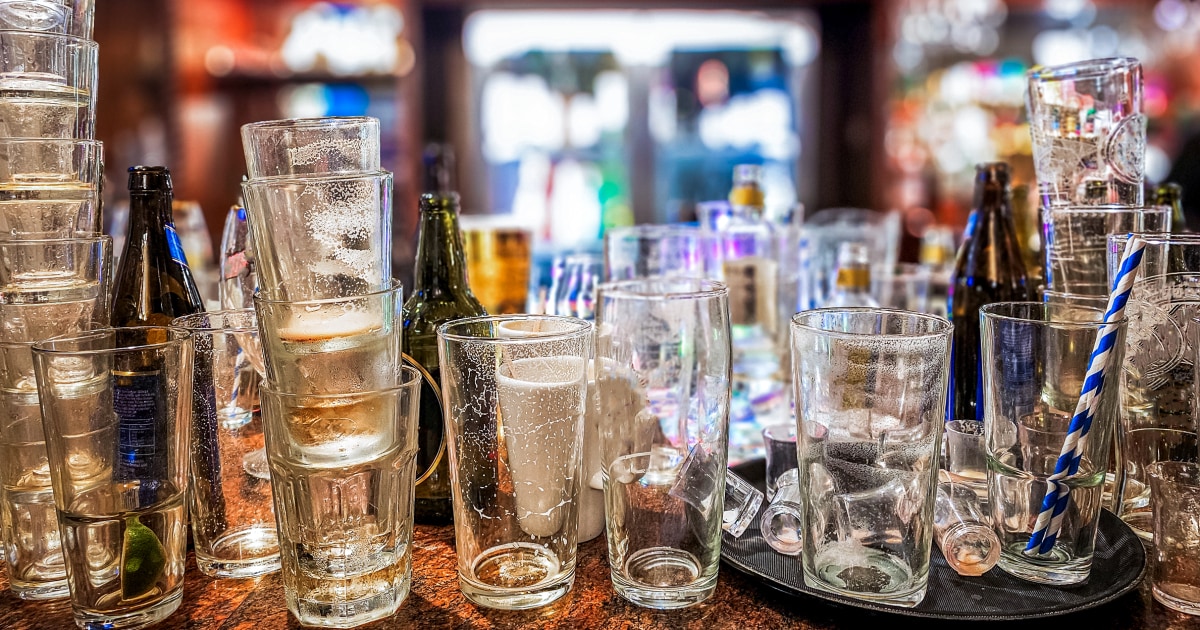
Photo via New York Post

Fewer Americans are boozing after a massive COVID-19 spike — and a surprising generation is leading the way

Read the original at New York Post ↗
Cite

Oliveira, A. (2026, September 22). Fewer Americans are boozing after a massive COVID-19 spike — and a surprising generation is leading the way. New York Post. https://nypost.com/2026/09/22/us-news/fewer-americans-are-boozing-after-a-massive-covid-19-spike-and-a-surprising-generation-is-leading-the-way/

Dated when The Aporia collected the article, usually within hours of publication. Check the original for its exact date and byline.

New York Post · collected 2026-09-22 · by Alex Oliveira

Quick Summary

A new study from USC Los Angeles shows that alcohol consumption in America dropped for the first time since the start of the COVID-19 pandemic, with heavy drinking decreasing by 8% and overall drinking dropping by 2% from 2022 to 2024. However, this trend is not uniform across age groups; while Millennials report a significant decrease in heavy drinking and Gen Z shows an overall decline in alcohol use, Boomers and Generation X continue to drink at or above pre-pandemic levels. Dr. Brian P. Lee, who conducted the study, noted that younger generations are quitting alcohol at higher rates than older ones, which could be due to changes in societal norms around drinking during the pandemic.
Written by AI on 2026-09-22, from this article's own text only (the story summary below draws on all the coverage).
See how they differ ↓

AI analysis

Story summary

Americans are drinking less for the first time since the pandemic, according to a study published in the Annals of Internal Medicine by researchers at Keck Medicine of USC in Los Angeles. The decline is modest, around 1%, after heavy alcohol use spiked sharply during the pandemic years 2020-2024. However, drinking habits have not declined evenly across all age groups: while both heavy and occasional drinking decreased among Gen Z and millennials from 2022 to 2024, it increased in people ages 50 to 64. Specifically, heavy drinking rose by 36% between 2018 and 2024 for Boomers and Generation X, with the number of drinkers climbing 4%. Dr. Brian P. Lee noted that older generations are most at risk for liver conditions starting in their 50s, emphasizing the health risks associated with sustained heavy drinking in these age groups. Despite this decline, overall alcohol use remains higher than pre-pandemic levels, indicating ongoing public health concerns.

Written for “Alcohol Consumption Trends Post Pandemic” on 2026-11-18, grounded in this article and the 1 other(s) covering the same event.

How they differ

2 outlets covered “Alcohol Consumption Trends Post Pandemic”.

What each outlet says

One AI summary per outlet of its latest article on this story, written from that article alone and checked against it. Open the article for the outlet's own words.

New York PostThis outlet22 Sep

A new study from USC Los Angeles shows that alcohol consumption in America dropped for the first time since the start of the COVID-19 pandemic, with heavy drinking decreasing by 8% and overall drinking dropping by 2% from 2022 to 2024. However, this trend is not uniform across age groups; while Millennials report a significant decrease in heavy drinking and Gen Z shows an overall decline in alcohol use, Boomers and…

Fewer Americans are boozing after a massive COVID-19 spike — and a surprising generation is leading the way (this article)
NBC News21 Sep

A study published in the Annals of Internal Medicine reports that American drinking rates are decreasing for the first time since the pandemic began, though overall levels remain higher than pre-2020 figures. The decline is modest at around 1%, but significant differences exist across age groups: while Gen Z and millennials show reductions, people aged 50 to 64 report increasing heavy drinking habits. Since 2018…

Drinking finally slows after pandemic spike, but not for every age group →

Compared with similar articles

This article reads unscored and hedges 0% of its claims. Each row says how that neighbour differs.
NBC News
Hedges 2 of 20 claims Outlet record 78/100
TIME
Hedges 8 of 29 claims Outlet record 60/100
“The articles describe overall trends in alcohol consumption but refer to different time periods and studies, indicating they are discussing related but distinct events.”

Story

Alcohol Consumption Trends Post Pandemic
Health · 2 article(s) covering the same event. See how they differ ↑
How this article was measured signals, leaning charts, publisher record, byline, topics and claims

Signals How these are calculated →

Claims extracted
19
sentences that state something as happening or true
Uncertain
0%
0 of 19 hedged ("reportedly", "may", "according to")
Leaning
not political
takes no side on a contested political question
Publisher signals
66/100
New York Post's corrections and hedging, across everything collected from it. Not a measure of accuracy.
Outlets on this story
2
Health
Same framing elsewhere
1
articles that frame the event the way this one does
Analyzed 2026-09-22 · how these are computed

How this is being covered How these are calculated →

Article leaning vs. publisher reliability
Source leaning vs. consistency

Publisher

New York Post · 21098 article(s) · 41 correction(s) detected
Running correction rate · 41 correction(s)

Who wrote this

Alex Oliveira
60 article(s) here · 1 carrying a prediction
The three-story Flatbush apartment building caved into the adjacent lot Wednesday afternoon as the excavation work was underway — prompting Mayor Zohran Mamdani to order a review of about 100 properties across the city linked to “five entities” involved in the construction. “A tragedy of this magnitude demands a comprehensive and thorough investigation that includes both the construction site and the building which collapsed.
Exactly how Marrone ended up hours away in Montauk remains unclear but investigators suspect she may have fallen victim to Biegenwald, who was known as the “Thrill Killer” and murdered at least six victims across the Jersey Shore before his 1983 arrest.
“I remember being in and out of consciousness thinking I was going to die,” she said in Bronx Supreme Court during Wednesday’s sentencing hearing, according to a transcript obtained by The Post. “One of the things I was most afraid of is what would happen if I did not survive for my daughter.” Her neighbors heard her screaming and came to check on her, she recalled in the interview Friday.
Bystanders were mercifully able to flag down police and stop trains from barreling into the station until they could free her from the roadbed, but she was severly injured.
“No rational adult would show up to a job with proximity to kids in a skimpy costume and a reference to a novel about the sexual abuse of a child by a middle-aged man … and then revive the controversy by engaging in lawfare,” she added.
The attorneys — state AG Letitia James, and city District Attorneys Melinda Katz and Eric Gonzalez — stared blank-faced when asked by The Post about the damning report at a Thursday gun-safety press conference. “Did any of you order prosecutors to downgrade gun charges to keep illegal immigrants in the US, per the Judiciary Committee report the recent house judiciary report?” a reporter asked, explaining the report could clearly indicate a gun-safety issue.
One ex even said that he claimed he would rape a male intruder breaking into his apartment — to show dominance.
Mayor Zohran Mamdani should be investigated for using $1.6 million in taxpayer funds to push New Yorkers to back ballot proposals with messaging that plastered his face on buses and kiosks, a city lawmaker said.
“This is a situation you created and that you could have completely avoided.”
Republican gubernatorial candidate Bruce Blakeman warned New York voters that congestion pricing could come to a “community near you” if Gov. Kathy Hochul wins reelection Blakeman, the Nassau County executive, vowed to kill the program outright if he beats the Democratic incumbent in the Nov. 3 election as he claimed Hochul could have a menu of new taxes she could unleash if she secures another term. “Doesn’t matter whether it’s New York City, Buffalo, Rochester, Syracuse, Albany, Binghamton or any town in between,” Blakeman claimed while speaking on Fifth Avenue in Manhattan Tuesday.
Also by Alex Oliveira
Nothing else under this byline is closely related to this article, so these are simply their most recent.
All 60 articles by Alex Oliveira →

Topics

America Americans CNN Millennials USC Los Angeles’

Subjects

Lee PERSON · 5× Americans NORP · 3× America GPE · 1× Boomers NORP · 1× Brian P. Lee PERSON · 1× CNN ORG · 1× Jagpreet Chhatwal PERSON · 1× Millennial NORP · 1× Millennials ORG · 1× USC Los Angeles’ ORG · 1×

Narrative

But both Boomers and Generation X continued to drink at pre-pandemic levels — with heavy drinking rising 36% between 2018 and 2024 while the number of drinkers climbed 4%. “We’re seeing the biggest increases in heavy drinking in exactly the group that we’re worried the most about in terms of their health related to alcohol,” Lee said, noting people are most at risk for liver conditions beginning in their 50s.
framing: assertive · carried by 1 article(s) · first seen 2026-09-22
“Overall, I would not see this as a big victory in any way because the rates have been so high, even before the pandemic.”

Claims (19 extracted, 0 hedged)

Americans are finally starting to feel the boozy hangover from COVID-19. asserted
Americans → start → COVID-19
Alcohol consumption in America dropped for the first time since the pandemic, a new study found — but older generations are still boozing at elevated rates. asserted
generations → drop → rates
Instead, it’s Millennials who are reporting less heavy drinking. asserted
who → ’ → drinking
Gen Z, meanwhile, is quitting altogether. asserted
Z → quit → ?
Alcohol drinkers — anybody who had even a single drink over a year — fell by 2% from 2022 to 2024, a recently published study from USC Los Angeles’ Dr. Brian P. Lee found. asserted
study → have → Lee
Heavy drinking — five drinks daily or 15 weekly for men, and four daily or eight weekly for women — dropped even more, slipping by 8% during that time. asserted
drinking → drop → time
“Seeing this first decline gives you something to hope for as a doctor, but you have to be appropriately cautious too,” Lee told CNN. asserted
Lee → see → CNN
“One change doesn’t necessarily mean a sustained trend.” asserted
change → mean → trend
Lee’s study supported his caution — despite the recent declines, people were still drinking at higher rates in 2024 than they were in 2018. asserted
they → support → 2024
He first identified a spike in pandemic drinking in a 2024 study which found the portion of Americans who drink increased about 3% between 2018 and 2022 — rising from 66.34% before the pandemic and 69.3% after. asserted
who → identify → pandemic
And while drinking overall was now creeping down overall, that wasn’t the case for everybody — younger people were quitting the sauce at higher rates than older folks, who continued to imbibe above pre-pandemic levels. asserted
who → creep → levels
Gen Zers — people 18 to 29 — saw all alcohol use drop 5% from 2022 to 2024, while Millennial — aged 30 to 49 — heavy drinking fell 17%. asserted
drinking → see → 2024
But both Boomers and Generation X continued to drink at pre-pandemic levels — with heavy drinking rising 36% between 2018 and 2024 while the number of drinkers climbed 4%. “We’re seeing the biggest increases in heavy drinking in exactly the group that we’re worried the most about in terms of their health related to alcohol,” Lee said, noting people are most at risk for liver conditions beginning in their 50s. asserted
people → continue → 50s
“This is a generation that really learned to drink when a few drinks a night was just what adults did,” he added. asserted
he → learn → what
“That’s something that we need to continue, with messaging, to informing people what they’re really putting into their body.” asserted
they → ’ → body
Start your day with all you need to know Morning Report delivers the latest news, videos, photos and more. asserted
Report → start → news
Those fears are real — Lee reported a noticeable increase in patients with liver conditions at his own office since the pandemic. asserted
Lee → report → pandemic
And while the declines found in Lee’s study were promising, experts cautioned it was too early to know whether Americans were really improving their habits on the whole. “This is an encouraging trend — at least there’s a change in direction,” said Dr. Jagpreet Chhatwal of Massachusetts General Hospital. asserted
Chhatwal → find → Hospital
“Overall, I would not see this as a big victory in any way because the rates have been so high, even before the pandemic.” asserted
rates → see → pandemic
Give feedback · no sign-in needed

No sign-in needed for now. Your note is sent without a name, so it cannot be answered.

History Support