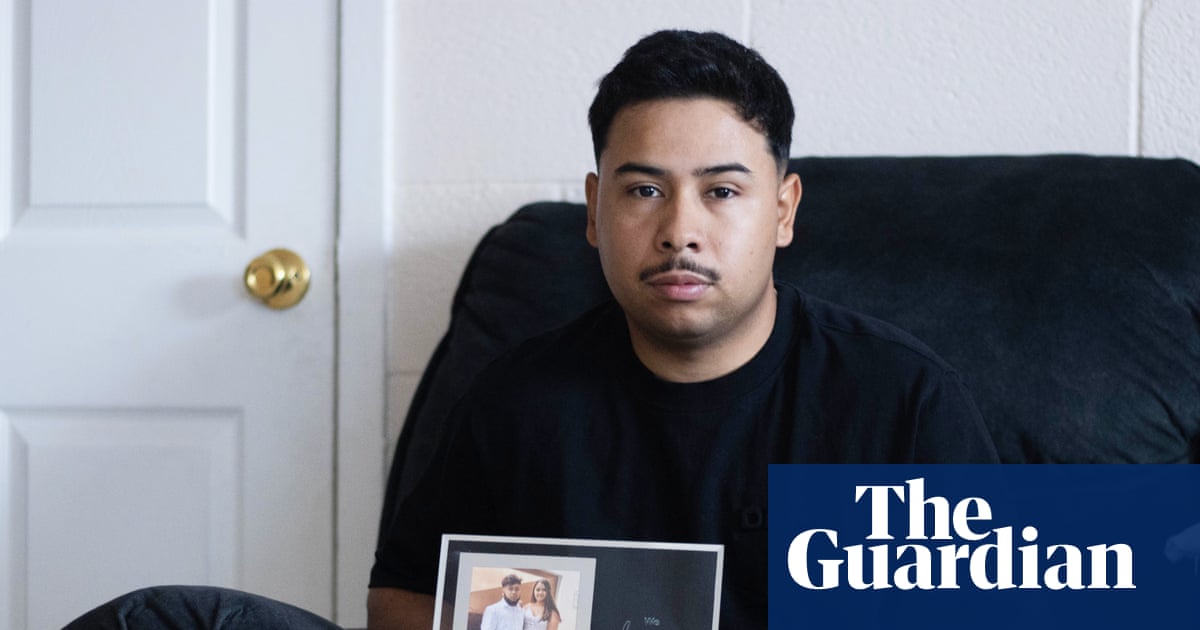
The wife of an active-duty US soldier was deported on Monday to her native Honduras, according to her family and the federal Department of Homeland Security (DHS).
uncertain
wife → deport → Security
Cristy Maryori Villafranca-Trejo is at least the seventh spouse or parent of an active-duty US soldier to be deported under the immigration crackdown during Donald Trump’s second presidency.
asserted
Trejo → deport → presidency
The Associated Press has found more than 50 cases in which immediate family members of US troops were placed in federal immigration detention after the Trump administration rolled back protections for military families.
asserted
administration → find → families
In some instances, the DHS has released military spouses after media attention and advocacy by congressional leaders.
asserted
DHS → release → leaders
Villafranca-Trejo’s husband, army Sgt Hedar Leonel Turcios Juarez, said he has been struggling to manage his military duties since she was detained on 11 July outside a Walmart near Fort Bliss, Texas, where he is stationed.
asserted
he → say → Bliss
Since then, he’s had to care for their six-year-old daughter without his wife’s help.
asserted
he → have → help
Instead of training in the mornings, he takes his daughter to first grade – and he said he has already had to postpone a planned assignment at another base.
asserted
he → train → base
“I don’t know if I will be able to continue with this,” Turcios Juarez said of his army career.
asserted
Juarez → know → career
“I have to make a plan to make sure I can still fulfill my military responsibilities – but also take care of my family.”
asserted
I → have → family
The DHS confirmed Villafranca-Trejo’s deportation, saying she had “received due process”.
asserted
she → confirm → process
Villafranca-Trejo, who has no known criminal record and entered the US in 2016 at age 18, was issued a final order of removal by an immigration judge in 2017 after failing to appear at a hearing, according to the DHS.
uncertain
who → have → DHS
Villafranca-Trejo’s husband said she had not received a notice for the hearing she missed and did not realize she had been ordered deported until they went to apply for her green card after marrying in 2022.
asserted
they → say → 2022
Originally from Honduras, Turcios Juarez became a US citizen in 2024 after enlisting two years earlier.
asserted
Juarez → become → 2024
Villafranca-Trejo’s motion to reopen her case was denied last May and an appeal before the Board of Immigration Appeals remained pending, according to her attorney.
uncertain
appeal → reopen → attorney
She had also been waiting for about a year for a decision on her application for military parole-in-place, a program that allows the immediate family of US troops to remain in the country to apply for a green card.
asserted
family → wait → card
“We were following the rules,” Turcios Juarez said.
asserted
Juarez → follow → rules
“We did everything we could on our side to fix this problem.”
uncertain
we → do → problem
Prior to Trump’s second administration, US Immigration and Customs Enforcement (ICE) would typically allow immediate family members of US troops to adjust their legal status even if they had been issued a final order of removal, according to Dan Gividen, who served as ICE deputy chief counsel from 2016 to 2019 under Trump.
“If you’ve got an active-duty military member that’s married to someone now, and that’s going to give her the opportunity to get a green card, you wouldn’t detain them, much less execute the removal order,” Gividen said.
uncertain
Gividen → allow → order
JP Caballero, a spokesperson for congresswoman Veronica Escobar, a Democrat representing El Paso, said Escobar had opened a congressional inquiry into Villafranca-Trejo’s case and visited her at the Camp East Montana detention facility in Texas earlier this month.
asserted
Escobar → represent → Texas
“My heart breaks for her, her children and the soldier who must feel so betrayed by the country he is sacrificing for,” Escobar said in a statement.
asserted
Escobar → break → statement
“There are far too many families like theirs who are being targeted instead of supported.”
asserted
who → be → theirs
Turcios Juarez said he was unsure how he would care for his daughter without his wife.
asserted
he → say → wife
He still hasn’t figured out how to tell his daughter what has happened.
asserted
what → figure → daughter
But he says he still wants to keep serving his country.
asserted
he → say → country
“I love what I do, I want to keep doing this,” he said of the army.
asserted
he → love → army
“I just don’t know how I am going to keep doing this.”
asserted
I → know → this
 The Aporia