New podcast, “Still Counting”, coming soon!
asserted
podcast → come → ?
Hey readers, some big news: I’m launching a podcast, “Still Counting”, with my former FiveThirtyEight colleagues Galen Druke and Clare Malone.
asserted
I → launch → colleagues
The podcast, produced by Crooked Media, will officially debut in September.
asserted
podcast → produce → September
Look for a more official announcement post about this later, but we’ve been holding off on saying anything about this publicly, so I wanted to share.
asserted
I → look → this
I don’t donate to political campaigns.1
asserted
I → donate → campaigns.1
But the algorithms correctly determine that I’m a high-propensity political news consumer, and so I still get served my share of campaign ads when staying up late watching hockey fight videos or whatever.
asserted
I → determine → videos
In these ads, Talarico frequently complains that he’s fallen short of his fundraising goals — buddy, could you spare 5 bucks? — a bit implausibly given that he’d already raised almost $69 million4 as of the last FEC fundraising deadline in June.
uncertain
he → complain → June
As a grammar pedant, though, I’ve been struck by the language that Talarico has frequently used in these ads as well as elsewhere in his campaign rhetoric5: he’s going to take Texas back.
asserted
he → strike → Texas
But this is a bit like the Cleveland Browns claiming that they’ve finally found the formula to return the franchise back to its former glory.
asserted
they → claim → glory
Almost nobody remembers their former glory because the Browns’ last NFL title came in 1964, two seasons before the first Super Bowl.
asserted
title → remember → Bowl
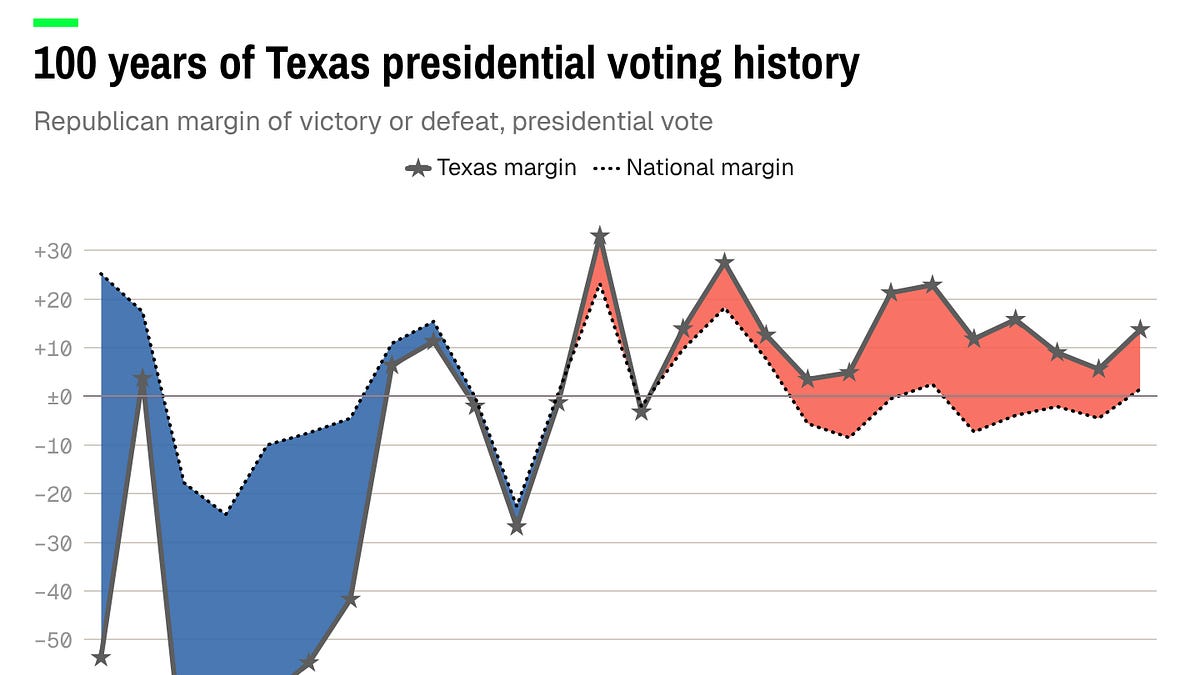
That year, 1964, was also the last time Democrats won the presidential race decisively in Texas — with native-son LBJ prevailing by 27 points — though Hubert H. Humphrey and Jimmy Carter would later sneak out narrow wins in 1968 and 1976.
asserted
Humphrey → win → 1968
Like the Browns, though — one of the most dominant franchises of the pre-Super Bowl NFL — Democrats in Texas did once have a glorious history.
asserted
Democrats → have → history
Between 1924 and 1948, Democrats won presidential elections in Texas by an average of 51 points, failing only in 1928 as part of Al Smith’s landslide defeat to Herbert Hoover, though FDR more than made up for it by winning by 77 points in 1932.
asserted
FDR → win → 1932
From 1952 through 1980, Texas was perhaps the preeminent swing state; it was vital to JFK’s win over Richard Nixon in 1960, for instance, a year when Kennedy’s selection of Lyndon B. Johnson as his running mate was the exception to the rule that vice presidential picks don’t matter much.6
asserted
picks → matter → rule
In all but one year during that period, Texas’s margin was within 5 points of the national popular vote, making it a strong candidate for being the tipping-point state when combined with its hefty electoral vote total.
asserted
it → make → total
The exception came in 1972, and it was telling: Richard Nixon won by 33 points against George McGovern, considerably larger than his gargantuan 23-point national margin.
asserted
Nixon → come → margin
Democrats also haven’t won a gubernatorial race in Texas since 1990 (Ann Richards, of course) or a U.S. Senate race there since 1988 (Lloyd Bentsen, who also doubled as Michael Dukakis’s running mate).
asserted
who → win → mate
So it’s understandable that people are skeptical Talarico can bring the state back to the D column this year.
asserted
Talarico → ’ → column
Why our model nevertheless says Talarico has a pretty good shot
asserted
Talarico → say → shot
Depending on the day, our midterms model, FLIPR, characterizes the Texas Senate race this year either as “toss-up” or as “leans Democratic”.
asserted
model → depend → Democratic
We employ these buckets because some of our readers seem more comfortable with them than with percentages, but they are defined mathematically.
asserted
they → employ → percentages
We describe a race as a “toss-up” when neither party has greater than a 60 percent chance of winning.
asserted
party → describe → chance
Texas has been teetering right around that threshold, with Talarico bouncing around within the 59 to 61 percent range since model launch.
asserted
Talarico → teeter → launch
 The Aporia