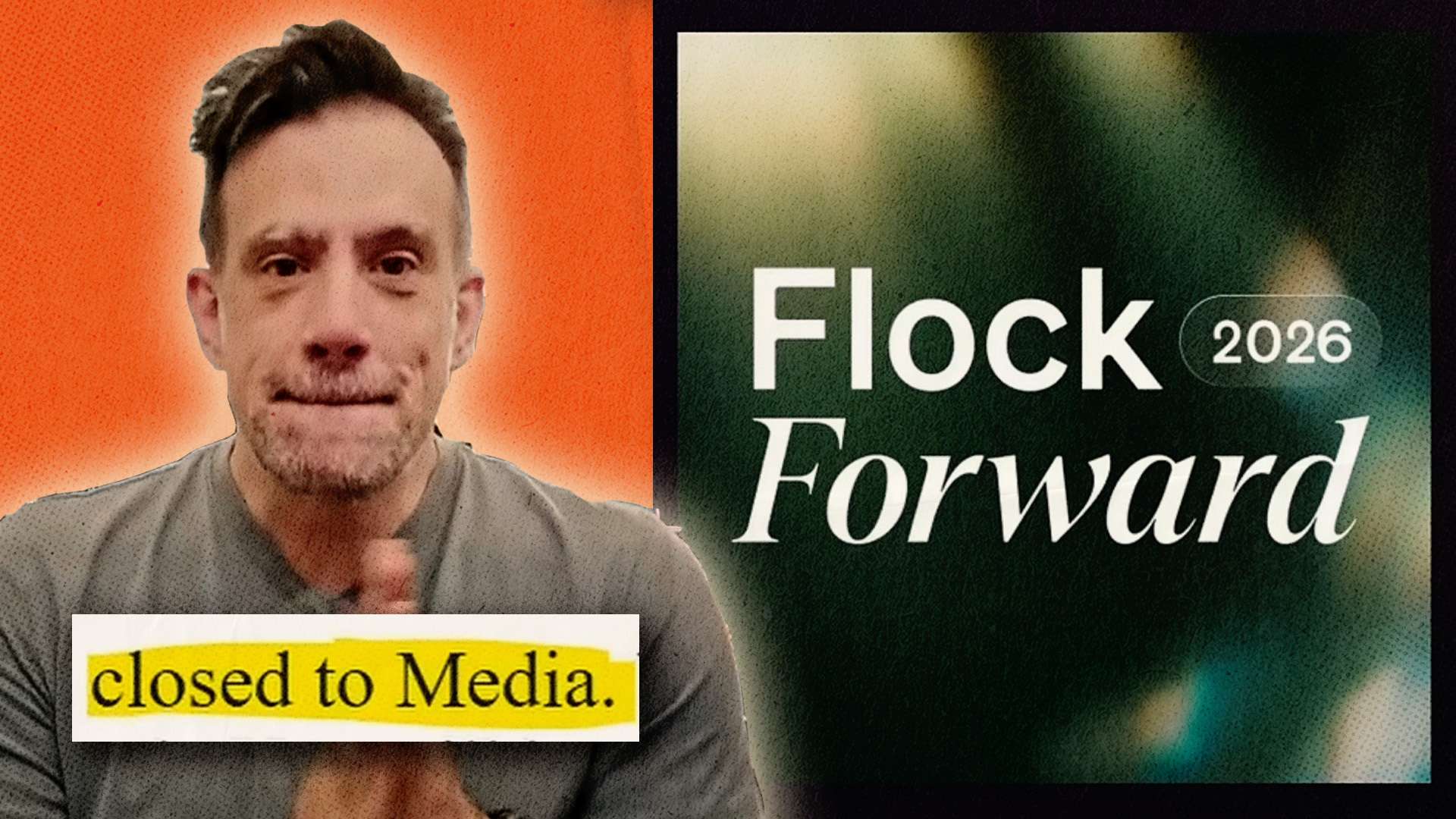
This YouTuber Got Kicked Out of the Flock Convention. So He Ran His Own Surveillance.

Read the original at Reason ↗
Cite

Petti, M. (2026, August 25). This YouTuber Got Kicked Out of the Flock Convention. So He Ran His Own Surveillance. Reason. https://reason.com/2026/08/24/this-youtuber-got-kicked-out-of-the-flock-convention-so-he-ran-his-own-surveillance/

Dated when The Aporia collected the article, usually within hours of publication. Check the original for its exact date and byline.

Reason · collected 2026-08-25 · by Matthew Petti

Quick Summary

YouTube host Benn Jordan, an outspoken critic of Flock Safety's automated license plate reading cameras, attended the company's recent police convention in Atlanta without permission. He used radio equipment and a drone to gather surveillance on attendees, including listening to microphones inside the convention hall and photographing their faces for facial recognition. Over 100 rooms at the hotel where the convention was held were booked under Flock's name, but Jordan still managed to find a public parking spot within view of the hotel. The incident highlights what Jordan sees as hypocrisy in Flock's stance on surveillance and privacy.
Written locally by qwen2.5:14b on 2026-08-25, using this article's own text rather than the other coverage of the same event (that is the story summary below).

AI analysis runs on qwen2.5:14b, locally

Story summary

Benn Jordan, a YouTube host, wanted to attend the Flock Safety convention in Atlanta to investigate the company's relationship with law enforcement. However, after discovering that Flock had canceled his ticket and was trying to keep him out, he decided to set up radio equipment and a drone outside the convention center to unmask attendees and even listen to microphones inside. Jordan's actions were in response to Flock's claims that police customers don't need a warrant to track drivers with its automated license plate reading cameras because drivers have "no reasonable expectation of privacy" on public roads.

Flock Safety has 120,000 cameras across 49 states and works with over 5,000 law enforcement agencies, capturing more than 20 billion license plate scans every month. The company's CEO, Garrett Langley, appeared on Fox News to plead for a national "compromise" to save the company from efforts to ban its technology outright.

Meanwhile, some law enforcement agencies are asking Axon to redesign their automatic license plate readers (ALPRs) to look different from Flock cameras due to widespread vandalism of Flock's devices. Axon has reported that some towns and cities are switching from Flock to Axon's cameras after discovering abuses of access to stalk ex-spouses, among other concerns.

The controversy surrounding Flock Safety highlights the need for strong legal protections against mass surveillance technology, rather than simply banning a single company or product.

Written for “Flock Camera Controversy” on 2026-10-16, grounded in this article and the 4 other(s) covering the same event.

Story

📰 Flock Camera Controversy
Crime & Law · 5 article(s) covering the same event. Compare every outlet's account →

Compared with similar articles

This article reads unscored and hedges 7% of its claims. Each row says how that neighbour differs.
Washington Examiner
⚖️ Leans strongly right 🔴 15% hedged 4 of 27 📰 publisher trust 68
“Both articles report on the same police convention in Atlanta where attendees were tracked by a YouTube host using surveillance equipment, happening at the exact same time according to their timestamps.”
Reason
⚖️ Leans left 🔴 29% hedged 7 of 24 📰 publisher trust 94
“Both articles describe the same police convention in Atlanta where Flock Safety was being protested by Benn Jordan and others, although from different perspectives”
Brickbat: What the Flock different event · 90%
Reason
⚖️ leaning not scored 🔴 0% hedged 0 of 4 📰 publisher trust 94
“Article B refers to a different incident where a YouTuber surveilled Flock's convention, whereas Article A describes a high-risk traffic stop in Wisconsin”
NPR
⚖️ Leans strongly left 🔴 12% hedged 7 of 56 📰 publisher trust 60
“Article A describes a single instance of vandalism, while Article B is about a YouTube host's action at Flock's police convention in Atlanta”
404 Media
⚖️ leaning not scored 🔴 7% hedged 3 of 43 📰 publisher trust 95
“Article A reports on a YouTuber's actions at Flock's police convention in Atlanta, while Article B reports on a separate incident involving fake decoy cameras in Florida”
404 Media
⚖️ leaning not scored 🔴 0% hedged 0 of 7 📰 publisher trust 95
“Article A describes a YouTuber attending a police convention in Atlanta and running his own surveillance, while Article B mentions a cop making a fake Flock camera to catch a vandal, but does not mention the same specific event or location”
How this article was measured signals, leaning charts, publisher record, byline, topics and claims

Signals How these are calculated →

Claims extracted
43
sentences that state something as happening or true
Uncertain
7%
3 of 43 hedged ("reportedly", "may", "according to")
Leaning
withheld
no quote in the article backed the model's score
Publisher signals
94/100
Reason's corrections and hedging, across everything collected from it. Not a measure of accuracy.
Outlets on this story
5
Crime & Law
Same framing elsewhere
1
articles that frame the event the way this one does
Analyzed 2026-08-25 · how these are computed

How this is being covered How these are calculated →

Article leaning vs. publisher reliability
Source leaning vs. consistency

Publisher

Reason · 43 article(s) · 0 correction(s) detected
No corrections detected for this publisher. That may mean careful reporting, or simply that nothing has been checked.

Who wrote this

Matthew Petti
11 article(s) here · 1 carrying a prediction
🔮 It's a sign of how Congress could approach foreign policy if Democrats win a majority in the upcoming midterms.
🔮 The lawsuit alleges that HSI agents "will engage in coercive confrontations with American citizens in a manner that intimidates voters.
🔮 "We expect anti-technology violence, and violence leveraging technology," NYPD Deputy Commissioner for Intelligence and Counterterrorism Rebecca Ulam Weiner wrote in an article for Police Chief Magazine reflecting on the 25th anniversary of 9/11, adding that "2027 will be no different" when it comes to anticipating and counteracting new threats. But as widespread resistance to mass surveillance builds across the country, it seems that the threat category "anti-technology extremism" fails to capture activists groups like SparrowMap, which are set on utilizing technology to oppose and counteract mass surveillance.
🔮 After Anthropic employee Jacob Coxon resigned over fears that its product could destroy humanity itself earlier this month, the company's alignment science lead, Evan Hubinger, publicly agreed that his product has a 10 percent chance of causing human extinction in the next decade.
2026-09-22 · assertive framing · The 'AI Safety' Movement Is Making AI Less Safe
🔮 In February 2026, when he chose to start the war, President Donald Trump promised the public that it would last only "four or five weeks" and promised other leaders that it would be won in three to four days.
2026-09-18 · assertive framing · Trump's 4-Week War With Iran Approaches Month 7
🔮 Last week, Anthropic researcher Jacob Coxon publicly resigned out of his worry that computers will become "smart enough to kill us."
🔮 Some readers reached out asking exactly how they could do the same.
2026-09-15 · assertive framing · How To Get Your Government File
🔮 But the administration of George W. Bush did not hand them over to law enforcement professionals who could secure swift convictions.
🔮 In 2017 and 2018, members of Congress from both parties unsuccessfully pushed a bill that would use export control laws to make encouraging boycotts of Israel punishable by 20 years in prison.
2026-09-06 · assertive framing · Congress Is Trying (Again) To Ban Boycotting Israel
🔮 Before the war, hawkish pundits such as CNN host Fareed Zakaria and New York Times columnist Thomas L. Friedman promised that it would bring reform to the Arab world.
Also by Matthew Petti
Nothing else under this byline is closely related to this article, so these are simply their most recent.
All 11 articles by Matthew Petti →

Topics

Atlanta Flock Flock Safety Reason YouTube

Subjects

Flock ORG · 12× Jordan PERSON · 12× Reason ORG · 3× American NORP · 1× Atlanta GPE · 1× Benn Jordan PERSON · 1× Flock Safety ORG · 1× Georgia GPE · 1× YouTube ORG · 1× the Federal Communications Commission ORG · 1×

Narrative

In response to Jordan's video, Flock CEO Garrett Langley sent officials around the country a letter in December 2025 claiming that "Flock has never been hacked" and is "under coordinated attack…from the same activist groups who want to defund the police, weaken public safety, and normalize lawlessness."
framing: assertive · carried by 1 article(s) · first seen 2026-08-25
🔮 Indeed, Jordan is careful not to reveal anything he picked up from his radio surveillance, telling Reason that the point was simply to show that it could be done.

Claims (43 extracted, 3 hedged)

The surveillance contractor Flock Safety argues that police customers don't need a warrant to track drivers with its automated license plate reading cameras because drivers have "no reasonable expectation of privacy" on public roads. asserted
drivers → argue → roads
So YouTube host Benn Jordan applied the same logic back on Flock. asserted
Jordan → apply → Flock
He sat outside Flock's recent police convention in Atlanta with radio equipment and a drone, which he used to unmask attendees and even listen to microphones inside the convention hall. asserted
he → sit → hall
"Flock values their privacy. asserted
Flock → value → privacy
Oh well," Jordan wrote in the title of his video on the convention. asserted
Jordan → write → convention
His plans didn't quite start out that way. asserted
plans → start → ?
Jordan, an early and outspoken critic of Flock, wanted to visit the convention to see what the relationship between police and the company was like after a string of cases in Georgia involving police misusing Flock products, he tells Reason. asserted
he → want → Reason
After downloading the conference app, he looked inside the source code and found that it revealed the entire guest list. asserted
it → download → list
Jordan alerted Flock to the data breach. asserted
Jordan → alert → breach
Once the company caught wind that Jordan was coming, it canceled his tickets. asserted
it → catch → tickets
But the attempts to keep Jordan out went further than that. asserted
attempts → keep → that
An employee from Flock called the hotel to cancel Jordan's room reservation, which he had booked himself, according to a video Jordan posted of a call with the hotel. uncertain
Jordan → call → hotel
(Flock did not respond to Reason's request for comment.) asserted
Flock → respond → comment
Jordan even found out that all of the rest of the rooms and even the parking lots surrounding the hotel had been booked. asserted
all → find → hotel
Still, he was able to find a public parking spot within view of the hotel, where he parked a van with dozens of WiFi adapters, a parabolic dish antenna, and a dipole array. asserted
he → find → adapters
This equipment picked up the signal from the convention hall's wireless microphones, allowing Jordan to hear attendees' conversations. asserted
Jordan → pick → conversations
"Everything was on public channels," he says. asserted
he → say → channels
Then he used a drone to photograph attendees walking out and used facial recognition to figure out their identities. asserted
he → use → identities
Ironically, government regulations helped Jordan with his surveillance, because the Federal Communications Commission limits wireless microphones to broadcast on very specific frequencies. asserted
Commission → help → frequencies
Although it's within a private company's right to choose who can and can't come to its conference—and Jordan acknowledges that keeping outsiders away from the hotel can be a reasonable security measure—many of the attendees were police officials, presumably attending on the taxpayer dime. asserted
many → choose → dime
While Flock and its police customers are happy to erode the expectation of privacy in everyday life, they carve out ultra-private spaces for themselves. asserted
they → erode → themselves
Indeed, Jordan is careful not to reveal anything he picked up from his radio surveillance, telling Reason that the point was simply to show that it could be done. uncertain
it → reveal → Reason
"Public officials should know that you can't go to a private thing where journalists aren't allowed and not expect anybody to fly a drone from public view. asserted
anybody → know → view
You should be a little unsettled about going to something like that," Jordan adds. asserted
Jordan → go → that
He says that he's ultimately happy that his stunt drew attention to the lack of transparency. asserted
stunt → say → transparency
Although automatic license plate readers have been raising privacy concerns for years, the growth of Flock is particularly alarming because the company plugs police departments around the country into a central database that isn't subject to court orders or the Fourth Amendment to the Constitution. asserted
that → raise → Constitution
Police officers have been caught using Flock data to stalk romantic interests. asserted
officers → catch → interests
One woman spent two weeks in jail, and another was detained at gunpoint because of mistaken identifications from Flock cameras. asserted
another → spend → cameras
The American public is becoming increasingly hostile to these cameras. asserted
public → become → cameras
At least 56 cities and towns have ended their Flock contracts in 2026 over privacy concerns. asserted
cities → end → concerns
Ring, a doorbell camera company owned by Amazon, also canceled its planned partnership with Flock over public backlash. asserted
Ring → own → backlash
More alarmingly, citizens have started vandalizing the cameras. asserted
citizens → start → cameras
Jordan, whose YouTube channel covers eclectic science topics from animal hearing to modern train synthesizers, accidentally found himself at the forefront of the movement against Flock. asserted
channel → cover → Flock
He saw mysterious new cameras in his neighborhood early last year, followed his instincts to reverse engineer everything, and found security vulnerabilities allowing anyone to access Flock footage without a password. asserted
anyone → see → password
In response to Jordan's video, Flock CEO Garrett Langley sent officials around the country a letter in December 2025 claiming that "Flock has never been hacked" and is "under coordinated attack…from the same activist groups who want to defund the police, weaken public safety, and normalize lawlessness." asserted
who → send → lawlessness
The city of Staunton, Virginia, published the letter in its announcement that it was ending its relationship with Flock. asserted
it → publish → Flock
Although he hasn't gotten any response for his surveillance of the Flock conference, Jordan tells Reason that he's had police show up outside his house "and just blast their siren" in the past. asserted
police → get → past
He claims he also spotted a private investigator (who is unlicensed and a convicted felon) hanging around his house, but couldn't figure out who hired them. uncertain
who → claim → them
Despite the unwanted attention, Jordan has continued speaking to city councils and police departments around the country. asserted
Jordan → continue → country
While he says that he would prefer no license plate tracking to begin with, he has been pitching a solution to cities that are going to do it anyway: locally owned cameras feeding into locally owned databases that police need a warrant from a judge to access. asserted
police → say → judge
…and 3 more, not listed.

💬Give feedback
🕘History 🎫Support