A gold mine in South Dakota once produced millions of ounces of precious metal.
asserted
mine → produce → metal
Today, the same site is being used to study some of the biggest mysteries in the universe.
asserted
site → use → universe
The Homestake Gold Mine in Lead, South Dakota, operated for 125 years before it closed in 2001.
asserted
it → operate → 2001
According to Sanford lab, during its lifetime, the mine produced about 41 million ounces of gold and 9 million ounces of silver, making it the largest and deepest gold mine in North America at the time.
uncertain
it → accord → time
The mine later took on a completely different when in 2006, businessman T Denny Sanford pledged $70 million to help revive plans for an underground research laboratory.
asserted
Sanford → take → laboratory
Barrick Gold Corporation, which owned the Homestake property, donated land, while South Dakota committed more than $40 million to the project.
asserted
Dakota → own → project
The efforts led to the creation of the Deep Underground Science and Engineering Laboratory, now known as the Sanford Underground Research Facility (SURF), in 2007.
asserted
efforts → lead → 2007
Today, SURF is the deepest underground laboratory in the United States, reaching 4,850 feet below the surface.
asserted
SURF → reach → surface
Scientists from dozens of countries work there to study questions about the universe and Earth.
asserted
Scientists → work → universe
How mine became lab
asserted
mine → become → ?
The idea of using the mine for science was not new at that time.
asserted
idea → use → time
Research had already begun there decades before mining even ended.
asserted
mining → begin → ?
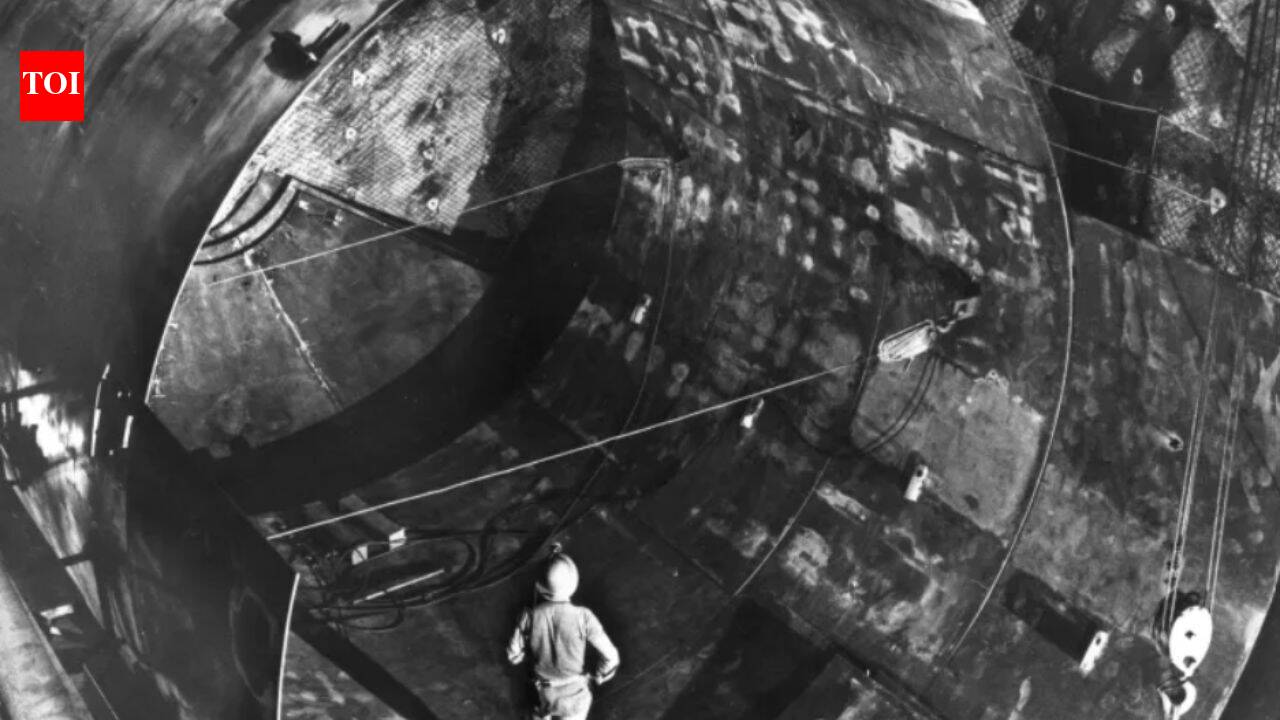
In the mid-1960s, physicist Raymond Davis Jr built the Brookhaven Solar Neutrino Experiment deep inside the Homestake Mine.
asserted
Jr → build → Mine
His experiment used a 100,000-gallon tank filled with perchloroethylene, a chlorine-containing dry-cleaning fluid, to detect neutrinos coming from the Sun.
asserted
experiment → use → Sun
He later recieved the Nobel Prize in Physics in 2022 for detecting cosmic neutrinos.
asserted
He → recieve → neutrinos
Neutrinos are extremely difficult to detect because they interact very weakly with matter.
asserted
they → detect → matter
The experiment therefore needed protection from unwanted signals that could interfere with the measurements.
uncertain
that → need → measurements
The mine's great depth provided an environment suited to this type of research.
asserted
depth → provide → research
Davis continued his work for nearly three decades in an underground area that later became known as the Davis Cavern.
asserted
that → continue → Cavern
Scientists then began pushing for the site to be converted into a permanent underground research laboratory.
asserted
site → begin → laboratory
Search for dark matter
Once the site was developed as a modern research facility, scientists began installing major physics experiments deep underground.
asserted
scientists → search → experiments
It was installed on the 4,850-foot level and was designed to search for dark matter.
asserted
It → instal → matter
Dark matter is a mysterious form of matter that scientists believe exists, but it has not been directly detected.
asserted
it → believe → matter
It does not interact with light in the way ordinary matter does, making it difficult to study.
asserted
it → interact → way
In October 2013, after an initial 80-day run, LUX was found to be the most sensitive dark matter detector in the world.
asserted
LUX → find → world
Further analysis confirmed its sensitivity in 2016, the same year the experiment was decommissioned.
asserted
experiment → confirm → 2016
LUX was later followed by a second-generation experiment, LUX-ZEPLIN, or LZ.
asserted
LUX → follow → experiment
It began operating in 2021 and was announced as the world's most sensitive dark matter detector when its first results were released on July 7, 2022.
asserted
results → begin → July
The underground setting remains central to these experiments.
asserted
setting → remain → experiments
SURF's deep location allows scientists to conduct highly sensitive searches in an environment protected by thousands of feet of rock.
asserted
scientists → allow → rock
Looking for rare radioactive decay
Another major experiment at SURF has been searching for something even more elusive.
asserted
experiment → look → something
The Majorana Demonstrator operating from 2015 to 2021, was used to search for neutrinoless double-beta decay, a rare type of radioactive decay that has never been observed.
asserted
that → operate → decay
Finding this decay could help explain why matter exists in our Universe.
uncertain
matter → find → Universe
The experiment's final results, published in early 2023, showed that the techniques used by the collaboration could be applied to a much larger experiment.
uncertain
techniques → publish → experiment
The collaboration is now working with another germanium experiment to develop the Large Enriched Ge Experiment for Neutrinoless ββ Decay, or LEGEND.
asserted
collaboration → work → Decay
The same year Davis received the Nobel Prize, the Homestake Mine closed.
asserted
Mine → receive → Prize
Research beyond physics
The extreme conditions underground have also opened the door to research outside particle physics.
asserted
conditions → open → physics
Scientists have studied microbial lifeforms living in the underground environment.
asserted
Scientists → study → environment
Some of this research has been linked to questions about medicines, biofuels and carbon sequestration.
asserted
Some → link → medicines
SURF says research carried out there has also helped inform the search for life on Mars.
asserted
research → say → Mars
…and 5 more, not listed.
 The Aporia