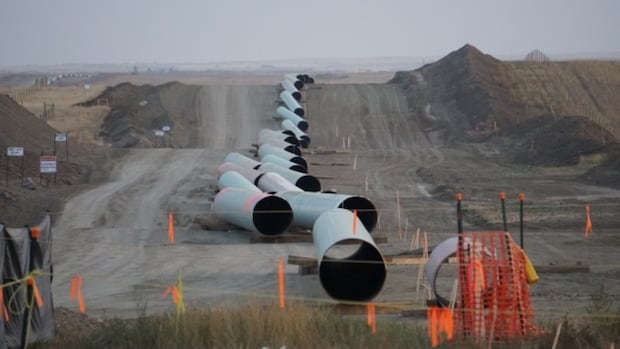
An independent Alberta's U.S. oil exports would mostly be piped through other provinces
Canada and Alberta could reach pipeline shipment deals.
uncertain
Alberta → pip → deals
But no guarantees in trade talks, experts say
In some Alberta separatists’ arguments, their big idea isn’t so much about severing the province from Canada.
asserted
idea → say → Canada
The goal is to fortify trade bonds with Alberta’s southern neighbour.
asserted
goal → fortify → neighbour
“We sit beside the largest economy in the world, with the shortest and lowest-cost trade routes to our most important customer,” independence leader Keith Wilson said in a social media post last week.
asserted
Wilson → sit → post
It’s true that Alberta is a five-million-barrel-a-day oil powerhouse, and that more than two-thirds of that oil is piped to the United States, making it more valuable than any other export product in Canada.
asserted
it → ’ → Canada
But while the graphic Wilson posted shows a series of thick arrows from Alberta pointing directly south — likely for simplicity’s sake — reality looks a lot different.
asserted
reality → post → sake
And that could complicate any notions of an independent Alberta easily ditching the rest of Canada to focus on U.S. trade.
uncertain
Alberta → complicate → trade
The vast majority of Alberta crude is shipped through pipelines that cross into the States via other western provinces.
asserted
that → ship → provinces
While three of Canada’s six transborder oil pipelines cross into the States directly from Alberta, they account for less than one-tenth of Canada’s total export pipeline capacity.
asserted
they → cross → capacity
The rest gets shipped through British Columbia and Manitoba.
asserted
rest → ship → Columbia
It’s a more imbalanced map for exports of natural gas, that other major Alberta commodity.
asserted
It → ’ → gas
No gas pipelines go straight from Alberta into Montana; all U.S. shipments transit through other provinces.
What this means is that Alberta’s biggest economic driver would rely on products transiting through a third country to its biggest customer.
asserted
driver → go → customer
That third country would be the one it just exited from, and there won’t be a guarantee Alberta’s resources would get a free ride.
asserted
resources → exit → ride
It would not be uncomplicated,” said Sonya Savage, Alberta’s former energy minister and a former pipeline executive.
asserted
Savage → say → ?
Experts told CBC News that an independent Alberta and Canada may well reach a drama-free deal to let Alberta goods flow through other provinces to the United States.
uncertain
goods → tell → States
There’s a local model in the 1977 Pipeline Treaty that safeguards the flow of Alberta oil through midwest states toward Ontario and Quebec refineries.
asserted
that → ’ → refineries
“Everything starts from scratch with a new independent country,” said Lawrence Herman, a veteran international trade lawyer and senior fellow at the C.D. Howe Institute.
asserted
Herman → start → Institute
“They cannot just tag along on existing Canadian treaties because they wouldn’t be part of Canada.”
asserted
they → tag → Canada
He said it will be immensely complex to negotiate these new deals for trade and what’s known as transshipment, which is also how Canadian goods flow south to Mexico and vice versa.
asserted
goods → say → Mexico
Piping Alberta oil through Canada to the United States could prove more complicated than direct Alberta-U.S. flow, Herman said.
uncertain
Herman → pip → flow
But Alberta just wouldn’t know for sure until negotiations unfolded.
asserted
negotiations → know → ?
Even established treaties and deals aren’t necessarily ironclad, and that isn’t just referring to free-trade agreements in the Trump era.
asserted
that → establish → era
There have been threats to Central Canada’s access to Western Canada oil through Enbridge’s Line 5 pipeline — a Chippewa band in Wisconsin and the state of Michigan have both used lawsuits to threaten its closure over spill risks.
asserted
band → use → risks
A U.S. appeals court last week found Enbridge liable for trespass through Bad River Band territory, and ruled the company will have to reroute Line 5 and pay damages.
asserted
company → find → damages
Meanwhile, Michigan’s highest court also rejected a permit for a future replacement section for Line 5 beneath the strait connecting Lake Huron and Lake Michigan, and ordered a new environmental review.
asserted
court → reject → review
In the event the leave side wins Alberta’s fall referendum and then a subsequent secession vote, Canada could make agreeing to let U.S.-bound oil travel through Saskatchewan, Manitoba and B.C. one of its leverage points in the negotiations that would follow.
uncertain
that → win → negotiations
But Alberta would have plenty of its own leverage to wield, including the heavy reliance by many Canadian refineries and gas distribution networks on what this current province produces.
asserted
province → have → what
Wilson, a lawyer who fronts the independence group Let Alberta Decide, sees other leverage points that give Alberta the upper hand as well.
asserted
that → front → hand
“If and when Alberta becomes independent, we can negotiate from a position of strength with the other provinces,” Wilson told CBC News.
asserted
Wilson → become → News
“We can reset our relationship, including the trading relationship and the mobility relationship, because British Columbia, for example, is continentally landlocked.”
asserted
Columbia → reset → example
There’s much talk in secession discourse about how Alberta, with no international coastline, would struggle as a landlocked country.
asserted
Alberta → ’ → country
Wilson tries to flip that argument toward the other side of the Rocky Mountains, noting that B.C. would be geographically cut off from the rest of Canada, and the rest of Canada from its west-coast ports to Asia.
asserted
B.C. → try → Asia
Custom duties could be theoretically applied to transiting goods, or that could be threatened to pressure negotiations in other areas.
uncertain
that → apply → areas
If it came to it, the rest of Canada could try sourcing oil and gas from the U.S. or other foreign sources to wean itself off Alberta, suggested Andrew Leach, an energy economist and University of Alberta law professor.
uncertain
Leach → come → Alberta
“There is a normal course of events where you run a pipeline through another country and there are transshipment considerations, and those tend to be pretty seamless,” Leach said.
asserted
Leach → be → country
An independent Alberta's U.S. oil exports would mostly be piped through other provinces
Canada and Alberta could reach pipeline shipment deals.
uncertain
Alberta → pip → deals
“But this is not a situation we’ve explored before.”
asserted
we → explore → ?
Alberta’s oil and gas export pipelines through other provinces trace back to the original “Mainline” conduits for each commodity.
asserted
pipelines → trace → commodity
In the 1940s and 1950s, the province was emerging as a major producer of fossil fuels.
asserted
province → emerge → fuels
Canada approved separate oil and gas pipelines that travelled eastbound and then south, to serve both Eastern Canada customers and Americans in the midwest.
asserted
that → approve → midwest
…and 70 more, not listed.
 The Aporia