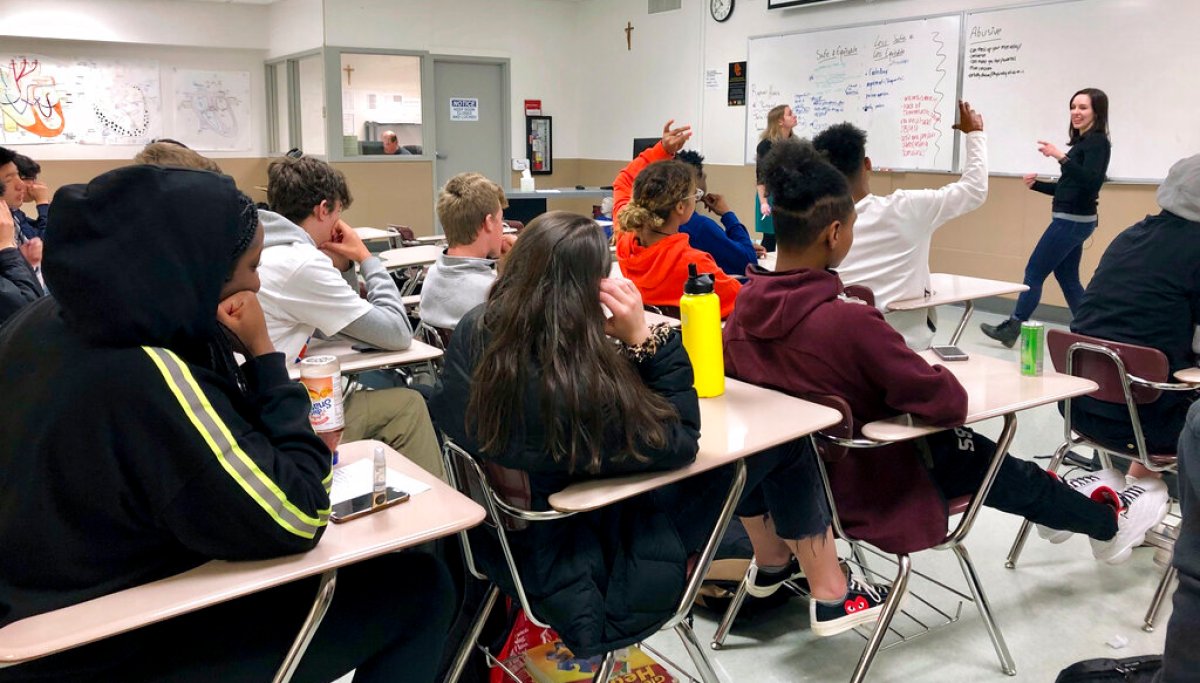
EXCLUSIVE — Required curriculum at a California high school is teaching critical race theory, its tenets, and recurring themes of power, privilege, and oppression threaded throughout retellings of American history.
asserted
curriculum → require → history
The North Monterey County Unified School District’s newly introduced ethnic studies course teaches high school students that America is an “imperial colonizer” and that “9/11 served as a catalyst to bring about more blatant discrimination” against Muslims, according to instructional documents obtained by Defending Education and shared exclusively with the Washington Examiner.
uncertain
9/11 → introduce → Examiner
Recommended Stories
The one-semester course in ethnic studies is a graduation requirement for students graduating in 2029 and beyond.
asserted
course → graduate → 2029
In order to obtain a high school diploma, students must complete the mandatory course between grades 9 and 12, the school board policy manual says.
asserted
manual → obtain → grades
NMCUSD recently approved the “district-developed” ethnic studies course at a July 23 school board meeting.
asserted
NMCUSD → approve → meeting
North Monterey County High School began teaching the class this school year, which started on Aug. 11.
asserted
which → begin → Aug.
The California school district mandating CRT curriculum comes as the Trump administration seeks to crack down on politicized lesson plans in public education.
asserted
administration → mandate → education
In 2025, President Donald Trump signed an executive order aimed at stopping “radical indoctrination” in K-12 schools, specifically targeting teachings that advance “anti-American, subversive” ideologies and “undermine national unity.”
asserted
that → sign → unity
The course description states that “students will understand the intersectional themes of Indigeneity, coloniality and hegemony to explore issues of self and communal identities, examine intergenerational trauma and foster collective hope and healing.”
asserted
students → state → hope
According to the class syllabus, students enrolled in the ethnic studies course are supposed to “gain the knowledge, skills, and disposition necessary for transformational change through a positive image of self, community, and critical hope for a more just and equitable world.”
uncertain
students → accord → world
Critical hope, a core CRT concept, is an action-oriented social justice mindset that pairs “critical consciousness” about perceived power imbalances with transformative activism as a means of liberating marginalized communities from “systemic oppression.”
asserted
that → orient → oppression
The final course unit focuses on “decolonization through the lens of critical hope” and “schooling as a space to learn and practice civic engagement.”
asserted
unit → focus → engagement
Course material forwarded by a concerned parent shows that the class as a whole is centered thematically on historical and contemporary power structures.
asserted
class → forward → structures
One unit slide, saying “Different identities have different relationships to POWER & PRIVILEGE,” features the Wheel of Power/Privilege in which “the closer you are to the center, the more privilege you have.”
asserted
you → say → privilege
On the outskirts are the “marginalized,” including illegal immigrants and obese individuals.
asserted
marginalized → include → immigrants
“Being black while living in the U.S. may offer some challenges (less power) when considering commonly faced experiences like racism,” one example explanation says.
uncertain
explanation → live → racism
“Being a woman living in a traditionally patriarchal society may also pose challenges depending on the place or context.”
uncertain
Being → live → place
Unit 3 on “Power in Its Multiple Manifestations” includes topics such as “Americanization and Whiteness,” teaching, for instance, how “whiteness” purportedly played a part in the Treaty of Guadalupe Hidalgo, the 1848 peace treaty that ended the Mexican-American War.
asserted
that → include → War
Presentation slides for that unit features the “Tree of Racism” and a hierarchical social-class pyramid that places blue-collar workers and manual labor jobs at the bottom and asserts those at the top with college degrees most likely “inherited money from family.”
asserted
those → feature → family
Unit 4 explores “Othering and Belonging” by examining the American public’s perception toward Muslims following the terrorist attacks of Sept. 11, 2001, particularly the “rise of Islamophobia” post-9/11.
asserted
Unit → explore → Islamophobia
One unit slide on “9/11 — Labeling and Categorizing the Enemy” teaches that “jihad” is simply an “Arabic word which literally means striving or struggling, especially with a praiseworthy aim.”
asserted
which → label → aim
“The othering of Muslims and of people from the Middle East did not begin or end with 9/11,” the unit claims.
uncertain
unit → begin → 9/11
“9/11 served as a catalyst to bring about more blatant discrimination.”
asserted
9/11 → serve → discrimination
Calling the jihadist plot an “event” that was “labeled as a terrorist attack on America,” the unit says, “America and its principles were seen as in danger.”
asserted
America → call → danger
The unit’s lesson summary, called “Enduring Understandings,” reiterates that “9/11 can be understood as a catalyst igniting and justifying the War on Terror.”
asserted
9/11 → call → Terror
The course takes particular issue with the conflict’s characterization as a war on terrorism, with quotations placed around “terror” in the lesson panel.
asserted
quotations → take → panel
“It should also be acknowledged that 9/11 made the already existing prejudices against Arab and Muslim Americans more obvious and shameless,” the lesson recap says.
asserted
recap → acknowledge → Americans
On the following presentation slide, the unit suggests that Osama bin Laden’s “Letter to America,” his 2002 manifesto outlining al Qaeda’s grievances, serves as evidence that the United States was intentionally “target[ing] Muslim communities.”
uncertain
States → follow → communities
Another slide depicts a map of “Anti-Sharia Legislation” introduced in America.
asserted
slide → depict → America
Throughout the unit, the course reinforces an “US versus THEM” dichotomy that casts parts of the Western world as “oppressors” and the Eastern Hemisphere, spanning the Middle East, Asia, and Africa, as perpetually “oppressed.”
asserted
that → reinforce → East
Rhyen Staley, the director of research at Defending Education, lambasted this binary viewpoint intended to be instilled throughout the class.
asserted
Staley → lambast → class
“No child should be forced to take a course that teaches them to view Western culture and the United States with contempt,” Staley told the Washington Examiner, “or to engage in class activities that shame them for their proximity to ‘power’ and ‘privilege.’
asserted
that → force → power
“Students deserve an education that helps them develop their reading and writing skills and promotes an appreciation for history and other cultures; not one that frames everything in an oppressor versus oppressed framework,” Staley said.
asserted
Staley → deserve → framework
NMCUSD previously contracted with the University of California, Santa Cruz’s “History & Civics Project” for ethnic studies professional development.
asserted
NMCUSD → contract → development
The program promotes the idea of anti-racism and offers free lessons such as “Teaching the January 6, 2021 Insurrection on Capitol Hill,” which compares the riot to Ku Klux Klan demonstrations.
asserted
which → promote → demonstrations
Defending Education says the district, however, did not renew its contract with UCSC for the 2025-26 school year.
asserted
district → say → year
The Washington Examiner contacted NMCUSD for comment.
asserted
Examiner → contact → comment
 The Aporia