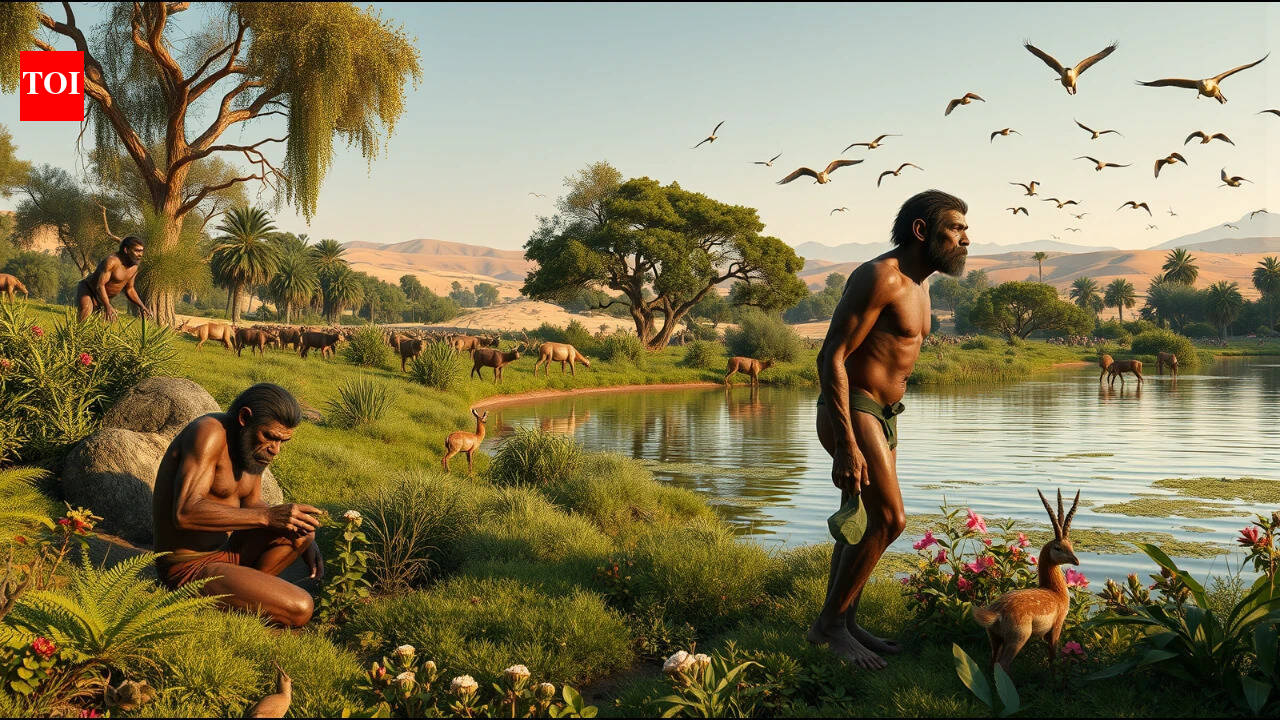
55,000 years ago, Neanderthals may have trekked deep into Saudi Arabia

World News, Today World News, Latest International News, World Breaking News, Trending News of World - Times of India · collected 2026-08-21 · by TOI World Desk
Read the original at World News, Today World News, Latest International News, World Breaking News, Trending News of World - Times of India ↗

Summary

Researchers have found evidence suggesting Neanderthals may have trekked as far south as Saudi Arabia around 55,000 years ago. The study analyzed stone tools from a site called Jebel Katefeh 1 in the Nefud Desert, which showed similarities to those made by Neanderthals rather than early Homo sapiens toolmakers nearby. The researchers used statistical analysis of hundreds of stone flakes to determine the identity of the toolmakers, as no Neanderthal bones or DNA were found at the site. This discovery pushes the known geographical range of Neanderthals farther south than previously thought, expanding their presence into a region that was previously believed to be inhospitable to them.
Written by the local model on 2026-08-21, using this article's own text rather than the other coverage of the same event (that is the story summary below).

Signals How these are calculated →

Claims extracted
24
claim-shaped sentences
Uncertain
25%
6 of 24 hedged
Leaning
not political
takes no side on a contested political question
Publisher trust
94.0
red-flag proxy, not a credibility rating
Outlets on this story
1
Science
Narrative spread
1
articles carrying this framing
Analyzed 2026-08-21 · how these are computed

AI analysis (generated at analysis time, not now)

Story summary

Neanderthals may have trekked as far south as Saudi Arabia, around 55,000 years ago, according to a new study. Researchers found evidence of Neanderthal stone tools at the Jebel Katefeh 1 site, located near an ancient lake in the Nefud Desert. Since no Neanderthal bones or DNA were found, the team relied on the shape and design of the stone flakes to determine who made them. By comparing these tools with others from known sites, they concluded that they were likely made by Neanderthals. This discovery pushes the known range of Neanderthals farther south than previously thought, contradicting their traditional association with cooler environments in Europe. The researchers dated the site to around 55,000 years ago**, a time when the desert was becoming wetter and greener, and Neanderthals were the only hominin group known to inhabit southwest Asia at that time.

Written for “Ancient Neanderthal Expedition” on 2026-08-31, grounded in this article and the 0 other(s) covering the same event.
Why this leaning score
This article does not take a side on a contested political question, so it has no leaning score. That is an answer rather than a gap: a match report or a rescue can be warmly or critically written without being left or right, and scoring it anyway is how approval of a subject gets recorded as a political position.
No political leaning scored for article 1884 · logged 2026-08-28

Story

📰 Ancient Neanderthal Expedition
Science · 1 article(s) covering the same event. This is the one the site leads with.

How this is being covered How these are calculated →

Article leaning vs. publisher reliability
Source leaning vs. consistency

Compared with similar articles

Nothing to compare against. No article is close enough to this one for the pipeline to have linked or judged the pair.

Publisher

World News, Today World News, Latest International News, World Breaking News, Trending News of World - Times of India · 97 article(s) · 0 correction(s) detected
SignalValueWeight
Correction rate 0.000 0.4
Uncertainty density 0.121 0.25
Assertive mismatch rate 0.000 0.35
No corrections detected for this publisher. That may mean careful reporting, or simply that nothing has been checked.

Who wrote this

TOI World Desk
63 article(s) here · 1 carrying a prediction
🔮 Its forests were cleared for cultivation, coconut plantations covered parts of the island and its seabirds became a resource that could be harvested.
🔮 The revised rates will come into effect from September 1, 2026. Under the new rates, Super 98 petrol will cost Dh3.80 per litre, up from Dh3.60 in August.
🔮 According to GUARD Archaeology, people and animals may have shared the same buildings at certain times of the year.
🔮 What if some of the waste we throw away could eventually become part of the roads we drive on?
🔮 The source is seasonal, meaning there may be no visible stream during dry weather.
🔮 He began looking for a way to ensure that the island's undeveloped areas could remain protected.
🔮 A self-described hurling enthusiast, Sweeney found that training on dark winter evenings could be difficult when there was not enough light to see the sliotar clearly.
🔮 Kathy Kite, a Harrisburg, Mo., grandmother, has been serving neighbors free breakfasts since May, Fox News Digital reported.
🔮 A student who learns about gravity, for example, may move beyond remembering a scientific definition and begin asking why objects behave in a particular way, how the theory was developed and what discoveries it helped make possible.
🔮 According to National Park Service, visitors could put a handkerchief into it and watch it disappear into the water.
Wire or desk byline, not an individual reporter.
Also by TOI World Desk
In 1973, Cadbury saved a stripped Seychelles island; today, more than 1M seabirds breed there yearly
2026-08-31 · World News, Today World News, Latest International News, World Breaking News, Trending News of World - Times of India
UAE fuel prices rise from September 1: Check new rates for petrol, diesel
2026-08-31 · World News, Today World News, Latest International News, World Breaking News, Trending News of World - Times of India
3,000 years ago, 12 Bronze Age houses stood where a Scottish suburb is rising
2026-08-31 · World News, Today World News, Latest International News, World Breaking News, Trending News of World - Times of India
Melbourne's M80 became Victoria's first major road with recycled content in every pavement layer
2026-08-31 · World News, Today World News, Latest International News, World Breaking News, Trending News of World - Times of India
Nothing else under this byline is closely related to this article, so these are simply their most recent.
All 63 articles by TOI World Desk →

Topics

Arabia Jubbah Neanderthal Neanderthals Saudi Arabia

Subjects

Neanderthals NORP · 8× Arabia GPE · 5× Neanderthal NORP · 5× Arabian NORP · 1× Homo sapiens NORP · 1× Jubbah GPE · 1× Knut Bretzke PERSON · 1× Saudi Arabia GPE · 1× the University of Tübingen ORG · 1×

Narrative

Why the discovery pushes the Neanderthal range farther south than expected Neanderthals have traditionally been associated with Europe and other relatively cool environments, but archaeological discoveries over the past two decades have substantially expanded their known geographical range.
framing: mixed · carried by 1 article(s) · first seen 2026-08-21
🔮 A new study suggests Neanderthals may have trekked far deeper into the Arabian Peninsula than scientists previously thought possible, reaching a lakeside site in what is now Saudi Arabia around 55,000 years ago.
2026-08-21 · World News, Today World News, Latest International News, World Breaking News, Trending News of World - Times of India
55,000 years ago, Neanderthals may have trekked deep into Saudi Arabia · mixed framing

Claims (24 extracted, 6 hedged)

A new study suggests Neanderthals may have trekked far deeper into the Arabian Peninsula than scientists previously thought possible, reaching a lakeside site in what is now Saudi Arabia around 55,000 years ago. uncertain
what → suggest → site
Researchers examined stone tools from Jebel Katefeh 1, a site beside an ancient lake near the city of Jubbah in the Nefud Desert. asserted
Researchers → examine → Desert
No Neanderthal bones or DNA have ever been found in Arabia, so the team relied on the shape of stone flakes to identify who made them. asserted
who → find → them
Using a statistical model built from sites with well-established toolmakers, researchers found the tools far more closely resembled those made by Neanderthals than by early Homo sapiens toolmakers nearby. asserted
tools → use → toolmakers
New dating work narrowed the age of the site to about 55,000 years, a period when the desert was becoming wetter and greener, and Neanderthals were the only hominin group known to inhabit southwest Asia at that time. asserted
Neanderthals → narrow → time
How researchers identified Neanderthal stone tools in the Nefud Desert Lacking bones or ancient DNA, the research team turned to the physical shape of stone flakes struck from carefully prepared cores, a technique that can preserve distinctive differences between toolmaking groups. asserted
that → identify → groups
The findings, published in the study Neanderthals in the desert? Population history best explains Middle Palaeolithic technological heterogeneity in Arabia, describe how the team measured hundreds of flakes from Jebel Katefeh 1 and a smaller nearby site called ALM 3. asserted
team → publish → Katefeh
Researchers then compared them statistically against tools from other locations across Arabia, the Levant and northeast Africa where the identity of the toolmakers was already established. asserted
identity → compare → toolmakers
This comparison allowed the researchers to build a model capable of distinguishing patterns associated with Neanderthal toolmaking from those associated with early Homo sapiens. asserted
researchers → allow → Homo
Because no human remains were recovered from Jebel Katefeh 1, the statistical analysis is central to the study's argument that Neanderthals, rather than another hominin population, were responsible for producing the tools. asserted
Neanderthals → recover → tools
Why the discovery pushes the Neanderthal range farther south than expected Neanderthals have traditionally been associated with Europe and other relatively cool environments, but archaeological discoveries over the past two decades have substantially expanded their known geographical range. asserted
discoveries → push → range
Evidence has placed Neanderthals thousands of miles eastward into Siberia and across parts of the Middle East, while the new study suggests they may also have ventured deep into the Arabian interior. uncertain
they → place → interior
Establishing when people occupied Jebel Katefeh 1 was therefore crucial. asserted
people → establish → Katefeh
Researchers excavated a new trench and used optically stimulated luminescence, a dating technique that measures when mineral grains were last exposed to sunlight, to establish the age of the sediment. asserted
grains → excavate → sediment
The tools were recovered from a layer marking a transition between older desert sand and younger lake sediment, placing the occupation at a time when environmental conditions were changing. asserted
conditions → recover → time
Around 55,000 years ago, parts of Arabia periodically became substantially wetter than they are today, creating lakes, grasslands and other habitats capable of supporting large populations of grazing animals. asserted
they → become → animals
Those temporary green conditions may have opened routes through landscapes that are now among the driest places on Earth. uncertain
that → open → Earth
What outside experts think about the evidence for Neanderthals in Arabia Independent archaeologists have described the evidence as compelling, while emphasising that the identification remains based on indirect archaeological evidence rather than human remains. asserted
identification → think → remains
Knut Bretzke, an archaeologist at the University of Tübingen who was not involved in the research, said the case for a Neanderthal presence in northern Arabia was strong and suggested that wetter conditions could have attracted grazing animals into the desert interior, potentially providing a reason for Neanderthals to follow them. uncertain
Neanderthals → involve → them
He also noted that several sites used in the statistical comparison were surface sites, meaning their stone tools could have accumulated over extended periods rather than representing a single occupation. uncertain
tools → note → occupation
That limitation makes the precise interpretation of technological differences important. asserted
interpretation → make → differences
Study co-lead author Huw Groucutt, an archaeologist at the University of Malta, has likewise acknowledged that a Neanderthal fossil would provide much stronger confirmation. asserted
fossil → acknowledge → confirmation
However, bones and ancient DNA are particularly difficult to preserve in Arabia's harsh environment, leaving stone tools as one of the few surviving traces of human activity. asserted
bones → preserve → activity
If the interpretation is correct, the Jebel Katefeh evidence suggests Neanderthals were capable of travelling much farther into Arabia's changing landscapes than previously documented, following temporary lakes and wildlife across an environment that today appears almost completely inhospitable to human settlement. uncertain
that → suggest → settlement

💬 Give feedback
🕘 History 🎫 Support