Prime Minister Mark Carney expressed interest in Canada joining Europe's Erasmus+ exchange program during a speech at the European Parliament on Thursday. The EU's flagship initiative allows people to study and train across member countries for up to a year, with over 16 million participants since its inception. While details remain unclear, Carney emphasized opportunities for Canadian students to learn at top universities in Europe and build lasting ties between the two regions.
Written locally by qwen2.5:14b on 2026-09-18,
using this article's own text rather than the other coverage of the
same event (that is the story summary below).
Story summary
Canadian Prime Minister Mark Carney announced plans to seek a "unique alliance" with the European Union (EU) during a speech at the Toronto International Film Festival on Sunday. The move comes amid escalating trade tensions between Canada and the US; in 2025, 72.5% of Canadian merchandise exports went to the U.S. Carney emphasized that this new alliance would not seek full EU membership but rather closer economic ties based on shared values and priorities. Talks will focus on allowing free movement for goods, services, and workers in strategic sectors like energy, AI, defense, and critical minerals without Canada becoming a formal member of the EU.
Written for “Canada EU Alliance Talks” on 2026-09-18,
grounded in this article and the 62 other(s) covering the same event.
Carney wants Canada to join Europe's Erasmus+ program.
asserted
Canada → want → program
PM signalled interest in Europe's flagship exchange program in speech to EU
As Canada and the EU court closer ties, Prime Minister Mark Carney signalled clear interest in joining Erasmus+, a popular European exchange program.
asserted
Carney → signal → Erasmus+
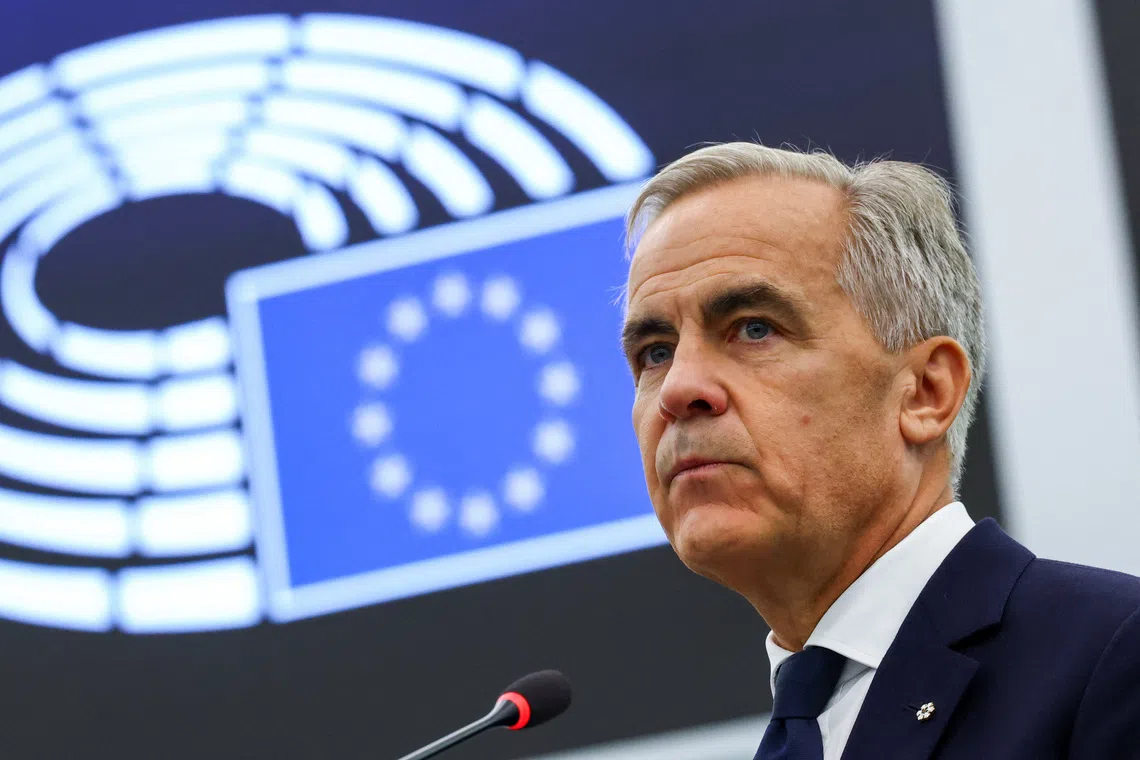
While many details of the suggested new partnership are left to be ironed out — like what it would mean to be the EU's first "associate member" — Carney specifically pitched Canadian involvement in Erasmus+ when he delivered a speech at the European Parliament in Strasbourg, France, on Thursday.
uncertain
he → suggest → Thursday
"Canadian membership of Erasmus+ would give your students and ours more opportunity to learn at some of the world's top universities, to broaden their horizons and to build those lasting ties that will sustain our alliance for the future," Carney said.
asserted
Carney → give → future
Carney has been clear that Canada is not seeking full EU membership and that the possible new partnership requires a different framework.
asserted
partnership → seek → framework
He also expressed interest in getting involved in the next iteration of Horizon, Europe's research and innovation funding program in which Canada already participates.
asserted
Canada → express → which
The current Horizon framework for 2021-2027 has over $140 billion in funding.
asserted
framework → have → funding
Speaking to reporters alongside Carney, European Parliament President Roberta Metsola said the EU is optimistic for new opportunities with allies like Canada.
asserted
EU → speak → Canada
"If you ask our young people what they associate the European Union with, I would tell you Erasmus is the first thing they mention," Metsola said.
asserted
Metsola → ask → you
"Horizon is the second thing they mention in terms of opportunities that with Canada could only get bigger.
uncertain
that → mention → Canada
"
"Just think of the opportunity young people in Europe, in Canada, to study in our two jurisdictions, to live and work in those jurisdictions, to learn from each other, build the bonds that will strengthen our ties," Carney said.
asserted
Carney → think → ties
While there were no concrete details of what Canada's involvement in Erasmus+ would entail, the U.K.'s recent agreement to join the exchange program could serve as a possible roadmap, given they aren't an EU member either.
uncertain
they → be → roadmap
The U.K. signed a temporary deal to join Erasmus+ in April.
asserted
U.K. → sign → April
The deal currently only lasts for one year where the U.K. is expected to contribute 570 million pounds (over $1 billion Cdn) to the program in 2027.
asserted
U.K. → last → 2027
First established in 1987 as Erasmus, the flagship EU program allows people to study and train at institutions across Europe for up to a year.
asserted
people → establish → year
The initial program focused on university exchanges, but has since expanded to include exchanges for work experience, apprenticeships and sport.
asserted
program → focus → experience
What we know about the proposed partnership between Canada and the EU
European Parliament to open Ottawa office as Carney seeks 'unique alliance' with EU
Over 16 million people have taken part in the program since its inception, according to the program's 2024 report.
uncertain
people → know → report
In 2014, the program expanded under a new name, Erasmus+, to include a number of separate initiatives and cover new areas like European competence and sport, receiving €14.7 billion (over $23 billion Cdn) in funding from the EU for 2014 to 2020.
- What questions do you have about the proposed partnership between Canada and the EU?
asserted
you → expand → Canada
The EU's budget is composed of member states' contributions, which are based on their respective gross national incomes.
asserted
which → compose → incomes
The program's total funding doubled for the current period of 2021-2027 to an estimated €28.5 billion — roughly $45 billion Cdn — according to its 2024 report.
uncertain
funding → double → report
The report shows 60 per cent per cent of its budget supports learning mobility.
asserted
cent → show → mobility
The remainder of the program's funding supports its other goals, namely co-operation projects and policy development activities.
asserted
remainder → support → goals
Erasmus+ includes all 27 EU member states and also Norway, Iceland, Liechtenstein, Serbia, Turkey, North Macedonia and the U.K.
asserted
Erasmus+ → include → states
 The Aporia