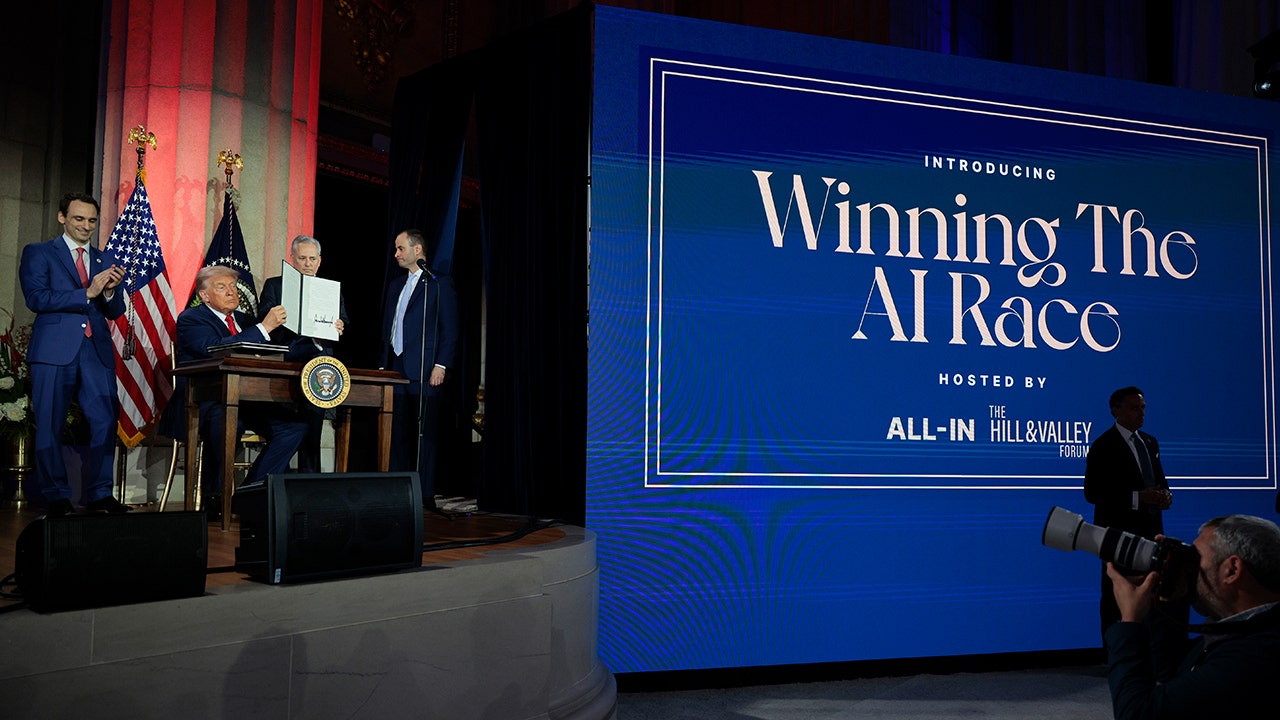
Photo via The Daily Caller

China Caught Copying American AI’s Homework, Hundreds Of Documents Show

Read the original at The Daily Caller ↗
Cite

Kresak, D. (2026, November 17). China Caught Copying American AI’s Homework, Hundreds Of Documents Show. The Daily Caller. https://dailycaller.com/2026/11/17/china-caught-artificial-intelligence-models-openai-alibaba

Dated from the outlet's own feed. Check the original for its byline.

The Daily Caller · collected 2026-11-17 · by Dylan Kresak

Quick Summary

Reuters reports that Chinese tech firms are using responses from American AI models to train their own systems, based on a review of over 300 Chinese academic papers and government files. This practice, known as distillation, allows Chinese companies to develop competitive AI models despite export controls on advanced chips. For instance, a paper from Shanghai Jiao Tong University and Meituan describes using OpenAI’s GPT-4o to train Alibaba’s Qwen model. Chinese officials deny U.S. allegations, calling distillation a normal technological practice and asserting China’s self-reliance in AI development.
Written by AI on 2026-11-18, from this article's own text only (the story summary below draws on all the coverage).

Compared with similar articles

This article reads unscored and hedges 29% of its claims. Each row says how that neighbour differs.
Fox News
Leans right Hedges 15 of 58 claims Outlet record 67/100
“The articles describe different aspects of China's efforts in the AI domain, one focusing on the use of distillation techniques in academic and government papers to train AI models, while the other discusses a potential export control loophole involving Nvidia chips.”
Fox News
Leans strongly right Hedges 1 of 33 claims Outlet record 67/100
“The articles discuss different aspects of the AI race between the US and China, with Article A focusing on the need for trust in the US to win the race and Article B reporting on Chinese firms allegedly copying American AI advancements.”
Semafor
Hedges 0 of 4 claims Outlet record 65/100
“The articles discuss related topics about the US-China AI competition but describe different aspects of the issue.”

Story

China Caught Copying American AI’s Homework, Hundreds
Other · 1 article(s) covering the same event.
How this article was measured signals, leaning charts, publisher record, byline, topics and claims

Signals How these are calculated →

Claims extracted
24
sentences that state something as happening or true
Uncertain
29%
7 of 24 hedged ("reportedly", "may", "according to")
Leaning
withheld
no quote in the article backed the model's score
Publisher signals
93/100
The Daily Caller's corrections and hedging, across everything collected from it. Not a measure of accuracy.
Outlets on this story
1
Other
Same framing elsewhere
1
articles that frame the event the way this one does
Analyzed 2026-11-18 · how these are computed

How this is being covered How these are calculated →

Article leaning vs. publisher reliability
Source leaning vs. consistency

Publisher

The Daily Caller · 315 article(s) · 0 correction(s) detected
No corrections detected for this publisher. That may mean careful reporting, or simply that nothing has been checked.

Who wrote this

Dylan Kresak
22 article(s) here · 1 carrying a prediction
The practice of distillation is conducted worldwide to train AI models, but the process may allow China to compete in the AI race without accessing as many chips restricted through export controls.
The former 33-year CEO said he would be “honored” to return to the role if the company’s Board of Directors decides his reinstatement would be in its best interest, Huang wrote Tuesday in an X post.
Helme warned that those who put their card information on affected websites on Monday, copied and pasted the address of a crypto wallet, logged into one of these sites and users of Apple’s iPhones and iPads on iOS 18.6 or earlier may be at risk due to the attack, he told the DCNF.
As a major supplier of advanced chips powering American artificial intelligence, the uncertainty over the company’s leadership following Huang’s Thursday resignation may impact U.S. dominance over the industry.
The hackers record the victim without their knowledge as their wait for the meeting to begin, which the hackers will later use to impersonate them, Robertson explained.
Microsoft says that more than a hundred million users may finally be able to use their emails after a nearly day-long outage.
Vovan and Lexus asked the officials if they would give Ukraine access to AI models to support its military efforts, according to the call.
A coalition of nonprofit groups is suing some of the biggest artificial intelligence companies over concerns that their technology could pose catastrophic risks to public safety.
Colette Kress, Nvidia’s chief financial officer, will fill in for Huang as the company searches for a new CEO, Reuters reported.
“While the Board has no reason to believe that either national security or Nvidia secrets were compromised, the Board’s inquiry will examine all available information,” Nvidia’s Board of Directors said in a Sunday press release.
Also by Dylan Kresak
Nothing else under this byline is closely related to this article, so these are simply their most recent.
All 22 articles by Dylan Kresak →

Topics

Alibaba America China Chinese OpenAI

Subjects

Chinese NORP · 10× Alibaba ORG · 6× OpenAI ORG · 5× DCNF ORG · 4× America GPE · 3× American NORP · 3× China GPE · 3× U.S. GPE · 3× Reuters ORG · 2× Shanghai Jiao Tong University ORG · 2×

Narrative

“The U.S. allegations are unfounded and politicize a normal technological and commercial practice,” a spokesperson for the Chinese Embassy in Washington, D.C., told the Daily Caller News Foundation when asked about model distillation.
framing: mixed · carried by 1 article(s) · first seen 2026-11-18
The practice of distillation is conducted worldwide to train AI models, but the process may allow China to compete in the AI race without accessing as many chips restricted through export controls.
2026-11-18 · The Daily Caller
China Caught Copying American AI’s Homework, Hundreds Of Documents Show · mixed framing

Claims (24 extracted, 7 hedged)

America’s top artificial intelligence models are training their Chinese competitors, whether the leading labs like it or not. asserted
labs → train → it
Chinese tech firms are using frontier AI labs’ model responses to train their own systems, according to a Reuters review of more than 300 Chinese academic papers, government files and other records. uncertain
firms → use → papers
The practice of distillation is conducted worldwide to train AI models, but the process may allow China to compete in the AI race without accessing as many chips restricted through export controls. uncertain
China → conduct → controls
One February research paper from Shanghai Jiao Tong University and Meituan researchers, “AgentConductor,” discussed its process for using OpenAI’s GPT-4o to train Alibaba’s small Qwen model to coordinate AI agent coding. asserted
paper → discuss → coding
(RELATED: Alibaba’s New AI May Run Circles Around America’s Best) uncertain
AI → run → America
“The U.S. allegations are unfounded and politicize a normal technological and commercial practice,” a spokesperson for the Chinese Embassy in Washington, D.C., told the Daily Caller News Foundation when asked about model distillation. asserted
spokesperson → politicize → distillation
“The development of AI in China comes from greater self-reliance and strength in science and technology, and is fueled by open cooperation.” asserted
development → come → cooperation
“We hope the U.S. side will stop leveling false allegations to smear Chinese companies,” the spokesperson added. asserted
spokesperson → hope → companies
Similarly, researchers from Alibaba Cloud published a paper called “DistilQwen2.5” in April 2025, which outlined the distillation of OpenAI’s GPT-4 and GPT-4o models to collect non-Chinese training data for Alibaba’s Qwen models. asserted
which → publish → models
OpenAI and Alibaba did not immediately respond to the DCNF’s requests for comment. asserted
OpenAI → respond → comment
Qwen4-Max by @Alibaba_Qwen has landed as #6 in the Code Arena: WebDev! asserted
Max → land → Arena
With 1750 pts (preliminary), it’s +74 pts over its predecessor, Qwen3.8-Max (0902) at 1676. asserted
it → ’ → 1676
It’s also the top Chinese model in: - #6 HTML: 1748 pts - #8 Brand & Marketing: 1705 pts - #8 Reference-Based Design: 1770 pts Congrats to the @Alibaba_Qwen team on this release! asserted
It → ’ → release
— Arena.ai (@arena) November 16, 2026 Another paper from Nov. 2024, “O1 Replication Journey – Part 2,” describes that researchers at Shanghai Jiao Tong University trained an Alibaba model on OpenAI’s o1 model outputs. asserted
researchers → describe → outputs
The Department of Commerce warned Chinese regulators during July meetings that some distillation of American models may be considered theft of intellectual property, three anonymous sources told Reuters. uncertain
sources → warn → Reuters
The department referred the DCNF to its rule released Monday to combat attempts to remotely gain access to advanced AI chips. asserted
department → refer → chips
The rule, “Addressing Remote Access to Advanced Semiconductors,” requires companies to acquire a license from Commerce to supply restricted chips to data centers overseas. asserted
rule → address → centers
Tight chip restrictions cannot ensure Chinese AI is weakened, Daniel Castro, president of the Information Technology and Innovation Foundation, told the DCNF Monday. asserted
Castro → ensure → DCNF
“The U.S. government should be careful not to assume that restricting China’s access to technology automatically strengthens America’s competitive position,” Castro said. asserted
Castro → assume → position
Alibaba released its most advanced AI model to date, Qwen4-Max, on Sunday. asserted
Alibaba → release → Sunday
The reportedly closed-weight model ranked higher than Anthropic’s Claude Fable 5.1 on Arena.ai’s Code Arena leaderboard. uncertain
model → close → leaderboard
Jason Hsu, a senior fellow at the Hudson Institute, said American businesses that incorporate Chinese-based AI face several risks. asserted
that → say → risks
“American companies building on Chinese models could face intellectual property vulnerabilities, software supply-chain risks, and long-term technological dependence,” Hsu told the DCNF on Monday. uncertain
Hsu → build → Monday
“The larger national security concern is that widespread adoption of Chinese AI models could give Beijing greater influence over global digital infrastructure and technological standards.” OpenAI and Anthropic both restrict the use of their respective models’ outputs to train outside AI. uncertain
OpenAI → give → AI

Give feedback · no sign-in needed

No sign-in needed for now. Your note is sent without a name, so it cannot be answered.

History Support