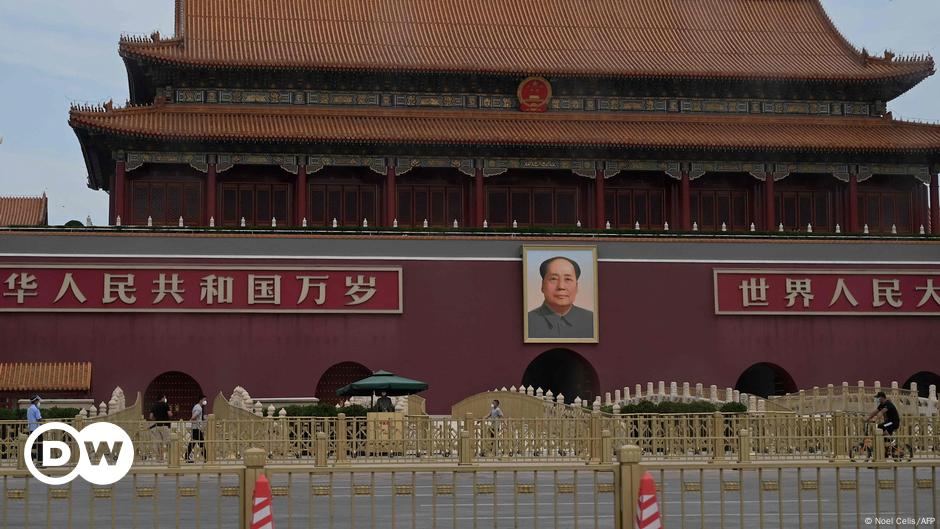
The leaders of China, the United States and Russia are due to hold their first trilateral meeting on the sidelines of the Asia-Pacific Economic Cooperation (APEC) summit this week.
asserted
leaders → hold → summit
Separately, US President Donald Trump will also hold talks with Chinese President Xi Jinping during the November 18-19 gathering in Shenzhen, China.
asserted
Trump → hold → Shenzhen
Several experts interviewed by DW do not expect any major breakthroughs on US-China trade, technology or other issues.
asserted
experts → interview → trade
Maintaining the existing trade truce and preventing bilateral relations from deteriorating further may be the more realistic shared objectives.
uncertain
Maintaining → maintain → relations
Patricia M. Kim, a senior fellow at the Brookings Institution, believes neither leader is looking to significantly expand the bilateral agenda, as both have an incentive in maintaining the existing trade truce.
asserted
both → believe → truce
Over the next two years, Kim expects to see "neither uncontrolled escalation in tensions between the US and China nor a dramatic improvement in ties, but rather the continuation of the transactional détente we see today."
asserted
we → expect → détente
Zhang Lun, a professor at CY Cergy Paris University, believes Trump is under pressure both at home and abroad.
asserted
Trump → believe → home
"Domestically, Trump faces the prospect of becoming a lame-duck president following the Republicans' heavy losses in the midterm elections," Zhang told DW.
asserted
Zhang → face → DW
"Internationally, damage to relations with allies, the weakening of the US-led international order, indifference toward democratic values and freedoms, and the difficulties encountered in the Iran war have all reduced America's leverage, resources and influence."
asserted
damage → lead → leverage
Zhang believes strained ties with US allies and the war in Iran have weakened Trump's hand with Beijing, making him more eager to secure diplomatic wins and Xi's cooperation on key policy priorities.
asserted
him → believe → priorities
Contentious issues may be left for later
Jia Hui Tee, a senior trade policy analyst at the Hinrich Foundation, expects Trump and Xi to focus on stabilizing their fragile trade relationship.
She says the two leaders could make progress on reciprocal tariff cuts covering goods worth $30 billion (€27.3 billion) on each side.
uncertain
leaders → leave → side
"While the list of products has been announced, the timeline has not been set and an indicative implementation timeline would be an easy win" for both governments.
asserted
timeline → announce → governments
Washington wants Beijing to accelerate purchases of US agricultural products and increase exports of rare earths and other critical minerals.
asserted
Beijing → want → earths
But Tee believes that "China would likely be cautious with delivering on its commitments especially when Trump is weaker at home after the midterms with Democrats pushing back on his tariffs."
asserted
Democrats → believe → tariffs
She also points out that neither side would want to cede their bargaining chips easily, including rare earth exports and technology export controls.
asserted
side → point → exports
With another meeting between the two leaders is expected in December at the G20 summit in Miami, "there is room to push more contentious issues to a later date and further extend the trade truce in the next meeting," Jia told DW.
asserted
Jia → expect → DW
China, the US and Russia: three leaders, three agendas
Russia hopes that talks with the leaders of the US and China will enhance its diplomatic standing and help secure a settlement to the war in Ukraine on terms favorable to Moscow.
asserted
talks → hop → Moscow
Yun Sun, director of the China Program at the Stimson Center, told DW that Moscow wants to create the impression that Washington is willing to sit down with Russia and negotiate.
asserted
Washington → tell → Russia
This, in turn, could undermine confidence in Europe and Ukraine.
uncertain
This → undermine → Europe
"Trump wants trilateral nuclear talks," she said, while Beijing "wants the optics of China hosting the unprecedented historical meeting among the three."
asserted
China → want → three
Alicja Bachulska, a policy fellow at the European Council on Foreign Relations, believes Beijing wants to use the meeting to demonstrate its ability to bring major powers together and facilitate international dialogue.
asserted
Beijing → believe → dialogue
"Russia wants recognition, the US wants arms control, and China wants status without strings attached," she said.
asserted
she → want → strings
"I expect each leader to restate their own positions rather than produce real solutions."
asserted
leader → expect → solutions
Ukraine: why Beijing is reluctant to mediate
Michael Kimmage, director of the Kennan Institute in the United States, told DW last month that China may be more concerned with the survival of Russian President Vladimir Putin's regime than with actively bringing the war in Ukraine to an end.
uncertain
China → mediate → end
Russia remains an important source of energy and a key diplomatic partner for Beijing, Kimmage noted.
asserted
Kimmage → remain → Beijing
An outright Russian victory may not necessarily be Beijing's objective, he said.
uncertain
he → say → ?
For that reason, Kimmage does not expect China to pressure the Russian president into ending the war if Putin is unwilling to do so.
asserted
Putin → expect → war
Zhang Lun believes the current situation is "most in line with Beijing's interests."
The Trump administration's pro-Putin stance has made it harder for Ukraine to resist Russia, Zhang said, while Europe has been forced to bear greater costs and has been weakened.
asserted
Europe → believe → costs
He argued that the United States has also "lost moral authority" and "the postwar international order and the alliances built around Washington have been further eroded," making China's "position and influence more prominent."
He believes Beijing wants to keep Russia from collapsing, but not support it so openly or extensively that it alienates Europe and other Western countries.
asserted
it → argue → Europe
"At the same time, China does not want Ukraine to be defeated, because that would reduce Russia's dependence on Beijing," he told DW.
asserted
he → want → DW
"For now, China is unlikely to intervene directly.
asserted
China → intervene → ?
Instead, it will wait for a more favorable moment and then potentially step in as a neutral mediator in order to maximize its gains.
asserted
it → wait → gains
"
Iran: little sign of substantive cooperation
W.A. Figueroa, an assistant professor of history and international relations at the University of Groningen in the Netherlands, told DW that there is little indication of any real cooperation between China and the US on Iran.
asserted
Figueroa → tell → Iran
The two countries do share some interests, "including opposition to a toll system in the Strait of Hormuz and opposition to nuclear proliferation," Figueroa noted, but "China has consistently called for negotiations and denounced both sanctions and military force as a way to achieve these or any other objectives."
asserted
China → share → these
Figueroa says China does not want further escalation or prolonged instability in the Middle East.
asserted
China → say → East
However, Beijing has been able to manage the current situation without too much difficulty, leaving it with little pressure to change its position.
asserted
Beijing → manage → position
"China continues to provide Iran with crucial financial support through its purchases of Iranian oil," Figueroa noted, adding that Beijing's diplomatic support has so far brought no substantial change, largely because China has little leverage over either Iran or the US in the region.
asserted
China → continue → region

 The Aporia