On September 9, 1976, Mao Zedong died.
asserted
Zedong → die → September
The revolutionary leader who led the Chinese Communist Party (CCP) to power and founded the People's Republic of China left behind a profoundly contradictory historical legacy.
asserted
who → lead → legacy
He shaped the narratives of revolution, nation-building and national independence, but also left behind immense social trauma as a result of successive political campaigns and persecutions.
asserted
He → shape → campaigns
50 years of transformation: How far has China moved away from Mao?
asserted
China → move → Mao
Over the past five decades, China has undergone radical changes.
asserted
China → undergo → changes
When Mao died, China was still a poor and relatively isolated communist state.
asserted
China → die → ?
Today, it is the world's second-largest economy, deeply embedded in the supply and value chains of global capitalism, with a vast private sector, a large urban middle class and a highly digitalized society.
asserted
it → embed → sector
Zhang Lun, a professor at Cergy-Paris University, said Mao left behind four major political legacies: the authoritarian and highly centralized political system; a model of governance that relies on revolution and political campaigns to solve social problems; populist tendencies marked by anti-elitism and anti-rationalism; and utopian visions of egalitarianism and moralism.
asserted
that → say → egalitarianism
From the perspective of political legacies, Zhang told DW, the most fundamental change in China over the past five decades has been "de-Maoization" — while its greatest challenge has been that this process was never fully completed.
asserted
process → tell → decades
The legacy that never left: the party's supremacy
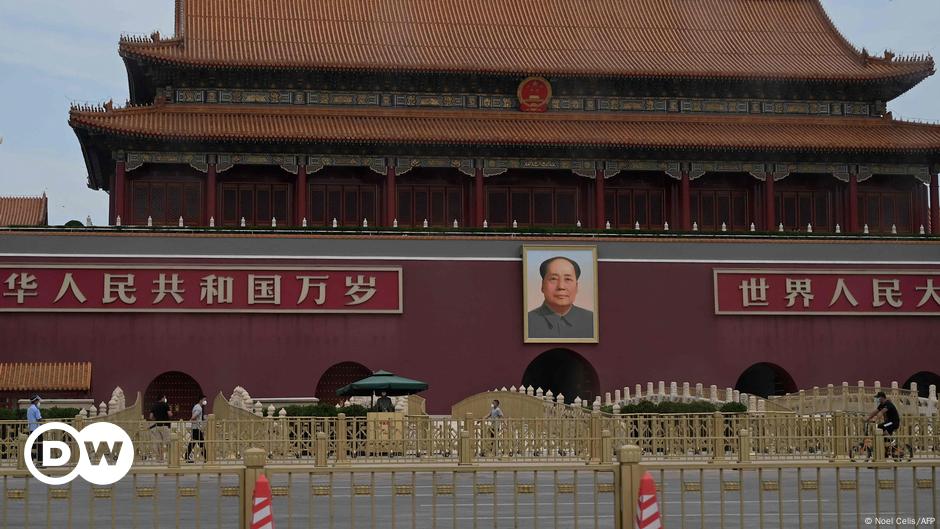
Mao's name remains written into the CCP's constitution, while his thought remains part of China's official ideology and his portrait still hangs in Beijing's Tiananmen Square.
asserted
portrait → leave → Square
Mao helped forge the Chinese Communist Party, and his insistence on the party's supremacy over the state and society has remained a fundamental principle throughout the decades, said Jean Christopher Mittelstaedt, professor at the University of Zurich.
asserted
Mittelstaedt → forge → Zurich
Veteran journalist and political commentator Chang Ping agrees, adding that what has truly endured is the institutional core of the principle that "the party leads everything," serving a state vision of being able to "concentrate resources to accomplish major tasks."
The CCP, he said, can pursue such objectives "at all costs" — meaning the interests of ordinary people can be sacrificed to the maximum extent necessary to preserve the regime.
asserted
interests → agree → regime
Under current leader Xi Jinping, a number of political concepts and methods of governance associated with the Mao era — such as ideological unity and the spirit of "struggle" — have again attracted attention.
asserted
number → associate → attention
Xi's actions such as abolishing the presidential term limits, strengthening his personal authority and the incorporation of his political thought into the party and state constitutions have invited comparisons between him and Mao.
asserted
actions → abolish → him
Chang argues that the very term "return" is misleading, since elements of the Mao era have never fully disappeared.
asserted
elements → argue → era
Zhang holds a similar view.
asserted
Zhang → hold → view
Authoritarian rule, political rigidity, weak rule of law and the lack of effective guarantees for citizens' rights, he argues, are not only important elements of Mao's political legacy but also among the most significant continuities between the Mao era and China's current political system, he underscored.
asserted
he → argue → era
And Xi, who personally suffered during the Cultural Revolution, seems even move closer to Mao-era policies.
asserted
who → suffer → policies
"What Xi learned from the Cultural Revolution was not the lesson of a victim, but the lesson of power," Chang told DW.
asserted
Chang → learn → DW
The lesson was not that "such a system must never exist again," but rather that "whoever loses power is at the mercy of others," he added.
asserted
he → exist → others
Felix Wemheuer, professor of modern China studies at the University of Cologne, echoed this view.
"
asserted
Wemheuer → echo → view
The conclusion Xi appears to have drawn from his own experience of the Cultural Revolution was clearly not that Mao should be completely abandoned," he told DW, "but rather that, for political reasons, Mao's historical status as the founder of the state, the military and the party must be upheld."
asserted
status → appear → state
Wemheuer views the current CCP leadership's approach to Mao as "fundamentally Machiavellian and pragmatic.
asserted
Wemheuer → view → Mao
"
In economic policy, for instance, there is no sign of a return to the Mao era, he said.
asserted
he → be → era
Today's China operates a highly dynamic model of state capitalism, with a mix of ownership forms coexisting and maintaining a strong private sector.
asserted
mix → operate → sector
Nor is there any indication that China intends to return to the Mao-era model of a communist welfare state.
asserted
China → intend → state
The same applies to the idea of "self-reliance."
asserted
same → apply → reliance
Today's China could hardly afford to withdraw from the global economy and international supply chains.
uncertain
China → afford → economy
Xi remains a product of the system Mao created
Experts say similarities between Mao and Xi can be seen in areas such as the emphasis on the CCP's supremacy, the elevation of a core leader, and populist elements that stress a close connection between the people and the leadership.
asserted
that → remain → people
Wemheuer argues that Xi possesses neither Mao's historical authority nor his personal charisma.
asserted
Xi → argue → authority
The two also exercise power in fundamentally different ways.
asserted
two → exercise → ways
Mao could bypass party institutions, go for years without convening a party congress and mobilize the masses against the party and state apparatus.
uncertain
Mao → bypass → apparatus
Mao himself was a populist with certain anarchic tendencies, Wemheuer said, and even tolerated the temporary collapse of the party-state system at the grassroots level in 1966-67.
asserted
Wemheuer → say → 1966
Xi, by contrast, would never allow such a situation to occur, the expert stressed.
asserted
expert → allow → contrast
Xi places greater emphasis than Mao on control and top-down governance, consolidating power by strengthening institutions and the party apparatus.
asserted
Xi → place → institutions
Mittelstaedt likewise cautions against equating Xi with Mao.
asserted
Mittelstaedt → caution → Mao
First, Mao was a revolutionary who destroyed existing institutions during the Cultural Revolution and was fundamentally anti-bureaucratic in his political orientation.
asserted
who → destroy → orientation
Xi, Mittelstaedt argues, does the opposite.
asserted
Mittelstaedt → argue → opposite
Second, Mao stood above the party.
asserted
Mao → stand → party
His power came from "being Mao himself" rather than from the party's institutional structures.
asserted
power → come → structures
…and 12 more, not listed.
 The Aporia