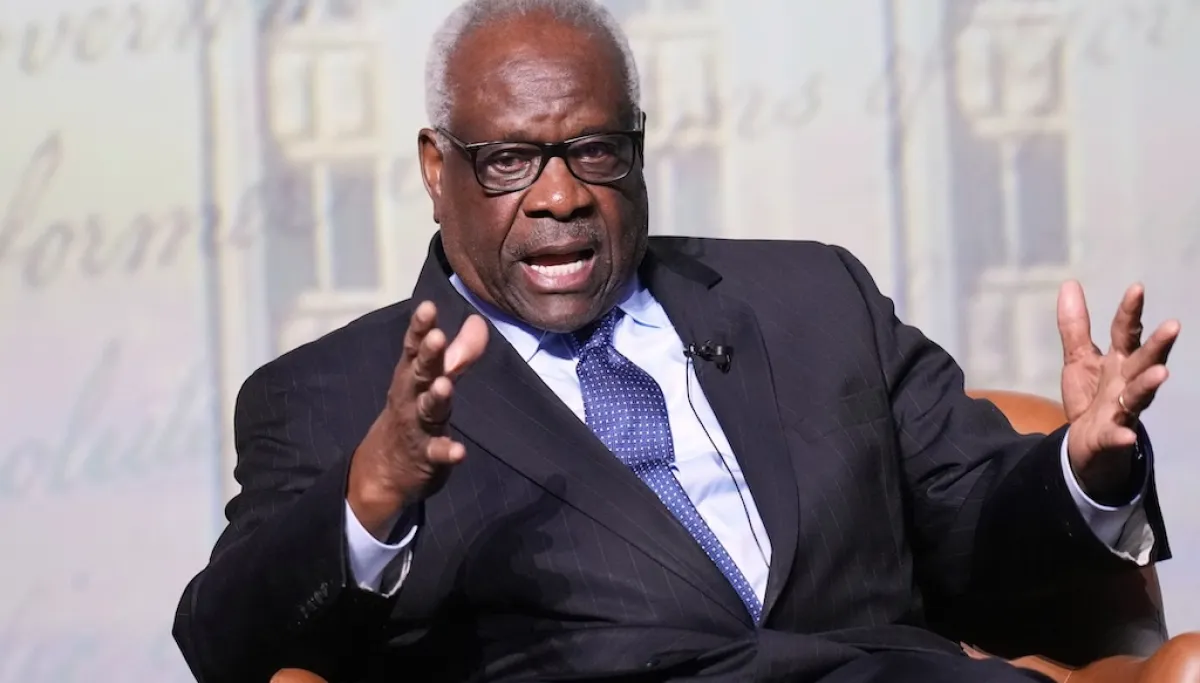
Justice Thomas on the Second Amendment in "Sensitive Places"

Read the original at Reason ↗
Cite

Volokh, E. (2026, November 16). Justice Thomas on the Second Amendment in "Sensitive Places". Reason. https://reason.com/volokh/2026/11/16/justice-thomas-on-the-second-amendment-in-sensitive-places/

Dated from the outlet's own feed. Check the original for its byline.

Reason · collected 2026-11-17 · by Eugene Volokh

Quick Summary

Justice Clarence Thomas issued a statement regarding the denial of certiorari in Novotny v. Moore, where petitioners challenged Maryland’s laws that prohibit carrying firearms in various public places. Maryland’s restrictions apply to areas such as mass transit, healthcare facilities, and state parks. Thomas expressed skepticism about these laws being consistent with historical traditions of firearm regulation, but agreed with the court’s decision not to hear the case due to the broad nature of petitioners' challenge. He suggests that in a more narrowly focused case, the court should consider the extent to which states can ban firearms in what they define as "sensitive places."
Written by AI on 2026-11-17, from this article's own text only (the story summary below draws on all the coverage).
See how they differ ↓

AI analysis

Story summary

On November 16, 2026, the U.S. Supreme Court declined to hear a challenge to Maryland's laws that restrict carrying firearms in "sensitive places," such as schools, parks, and government buildings. The court's decision leaves in place a set of Maryland laws that prohibit firearms from being brought on school property, at public demonstrations, on public transit, and in parks, museums, and casinos. Justice Clarence Thomas, while agreeing with the court's decision not to hear the case, expressed skepticism about the constitutionality of sensitive-place restrictions and urged the court to consider the scope of states' authority to ban firearms in a narrower case. Maryland's laws also prohibit carrying firearms at daycare and medical facilities, government buildings, and other places where the public gathers for entertainment or social pursuits.

Written for “Supreme Court Rejects Maryland Gun Ban Challenge” on 2026-11-17, grounded in this article and the 5 other(s) covering the same event.

How they differ

6 outlets covered “Supreme Court Rejects Maryland Gun Ban Challenge”.

What each outlet says

One AI summary per outlet of its latest article on this story, written from that article alone and checked against it. Open the article for the outlet's own words.

ReasonThis outlet17 Nov

Justice Clarence Thomas issued a statement regarding the denial of certiorari in Novotny v. Moore, where petitioners challenged Maryland’s laws that prohibit carrying firearms in various public places. Maryland’s restrictions apply to areas such as mass transit, healthcare facilities, and state parks. Thomas expressed skepticism about these laws being consistent with historical traditions of firearm regulation, but…

Justice Thomas on the Second Amendment in "Sensitive Places" (this article)
CBS News16 Nov

The Supreme Court has rejected a challenge to Maryland’s laws that prohibit firearms in specific public areas such as schools, parks, and government buildings. This decision upholds previous rulings by lower courts. The case was brought by Maryland residents and gun rights groups who argued that the restrictions violate the Second Amendment. Maryland’s laws, passed in 2023, extend gun-free zones to include daycare…

High court rejects challenge to Maryland gun ban in sensitive places →
NBC News16 Nov

The Supreme Court declined to hear a challenge to Maryland’s restrictions on carrying firearms in designated “sensitive places,” including state parks, public transport, and healthcare facilities. Justice Clarence Thomas agreed with the court’s decision but expressed skepticism about the legality of the Maryland provisions and indicated interest in a more narrowly focused future case. The decision leaves intact a…

Supreme Court rejects challenge to Maryland’s ‘sensitive places’ gun ban →
Washington Examiner16 Nov

Justice Clarence Thomas has called for the Supreme Court to review laws that restrict firearms in certain public areas, known as "sensitive places," after the court declined to hear a case involving Maryland’s restrictions. These laws, which ban guns in places like state parks, schools, and public transit, are the subject of legal challenges from gun rights advocates who argue that such prohibitions violate the…

Clarence Thomas urges Supreme Court to review ‘sensitive places’ gun laws →
Just the News16 Nov

The U.S. Supreme Court has declined to hear a case challenging Maryland's restrictions on carrying firearms in certain "sensitive places" like schools, parks, and government buildings. The decision was met with a concurring statement from Justice Clarence Thomas, who expressed skepticism about the constitutionality of such sensitive-place restrictions but urged the court to address the issue in a narrower case. The…

Supreme Court declines to consider challenge to Maryland's 'sensitive places' gun ban →

Where they agree and split

Framing

How the first headlines put it

Stated as fact5
The headlines (5)

High court rejects challenge to Maryland gun ban in sensitive places CBS News · stated as fact

Supreme Court rejects challenge to Maryland’s ‘sensitive places’ gun ban NBC News · stated as fact

Clarence Thomas urges Supreme Court to review ‘sensitive places’ gun laws Washington Examiner · stated as fact

Supreme Court declines to consider challenge to Maryland's 'sensitive places' gun ban Just the News · stated as fact

Justice Thomas on the Second Amendment in "Sensitive Places" Reason · stated as fact

The full story: what happened, how it changed, and all 6 articles →

Compared with similar articles

This article reads leans strongly right and hedges 7% of its claims. Each row says how that neighbour differs.
Washington Examiner
Centre further left than this Hedges 0 of 3 claims Outlet record 67/100
NBC News
Leans right further left than this Hedges 1 of 21 claims Outlet record 78/100
The Daily Caller
Leans right further left than this Hedges 1 of 25 claims Outlet record 92/100
“The articles describe different legal actions regarding gun laws in different states and contexts.”
Just The News
Hedges 0 of 8 claims Outlet record 94/100
“While both articles discuss the Supreme Court's decision regarding Maryland's 'sensitive places' gun ban, Article A covers the court's decision not to take up the case, whereas Article B focuses on Justice Thomas's statement about the Second Amendment in the context of the decision.”

Story

Supreme Court Rejects Maryland Gun Ban Challenge
Politics · 6 article(s) covering the same event. Compare every outlet's account →
How this article was measured signals, leaning charts, publisher record, byline, topics and claims

Signals How these are calculated →

Claims extracted
29
sentences that state something as happening or true
Uncertain
7%
2 of 29 hedged ("reportedly", "may", "according to")
Leaning
Leans strongly right
of the writing, not the subject · beta estimate
Publisher signals
67/100
Reason's corrections and hedging, across everything collected from it. Not a measure of accuracy.
Outlets on this story
6
Politics
Same framing elsewhere
1
articles that frame the event the way this one does
Analyzed 2026-11-17 · how these are computed

How this is being covered How these are calculated →

Article leaning vs. publisher reliability
Source leaning vs. consistency

Publisher

Reason · 1358 article(s) · 4 correction(s) detected
Running correction rate · 4 correction(s)

Who wrote this

Eugene Volokh
215 article(s) here · 1 carrying a prediction
Under Maryland law, an individual may not carry a firearm in public demonstrations, mass transit, places of amusement, healthcare facilities, locations that sell alcohol for onsite consumption, and tens of thousands of acres of state park and forest land.
I would have granted certiorari to clarify the government-speech doctrine.
"In the limited circumstance where a business requires nudity as a central purpose of the business," the addition reads, "such business may maintain a rule that entry to spaces where nudity is required be based on genital characteristics."
As the Church grew, Gioia began to look for a new space that could accommodate a larger group.
From Judge W. Scott Hardy in Doe v. Blank Rome LLP, the opinion was issued under seal in May, but just unsealed last week (at my behest): Plaintiff is an attorney who filed a detailed, 197-paragraph Complaint under the pseudonym "Jane Doe" against Defendant Blank Rome LLP …, her former employer, alleging claims for sex discrimination, hostile work environment, and retaliation pursuant to Title VII ….
{The Government was clear that any search of the contents of the phone would utilize a taint team to protect privileged information.}
Like it would not have had the legs it had if he hadn't posted about it.
From the Stanford site; "degradation" indeed: Degradation (started 9:53 AM Nov 12, 2026) Vendor is reporting a service issue that may prevent users from accessing their Office 365 E-mail via Outlook and/or webmail.
2026-11-12 · speculative framing · Living Today Without Email—Like Animals!
Some of these performance issues may have been due to the lack of oversight and direction supplied by [Marketing Manager] Cattelan, but Cattelan was not Plaintiff's supervisor.
That doctrine rests on the assumption that when a civil statute of limitations runs, a tortfeasor has a vested right to the property that could have been the subject of a potential claim….
Also by Eugene Volokh
Nothing else under this byline is closely related to this article, so these are simply their most recent.
All 215 articles by Eugene Volokh →

Topics

Maryland Second Amendment States The Fourth Circuit the Second Amendment's

Subjects

Maryland GPE · 3× States GPE · 2× America GPE · 1× American NORP · 1× Court ORG · 1× Moore PERSON · 1× Novotny PERSON · 1× State ORG · 1× The Fourth Circuit ORG · 1× Thomas PERSON · 1×

Narrative

While "courts can use analogies to those historical regulations of 'sensitive places' to determine that modern regulations … are constitutionally permissible," "expanding the category of 'sensitive places' … to all places of public congregation … would eviscerate the general right to publicly carry arms for self-defense.
framing: assertive · carried by 1 article(s) · first seen 2026-11-17
Under Maryland law, an individual may not carry a firearm in public demonstrations, mass transit, places of amusement, healthcare facilities, locations that sell alcohol for onsite consumption, and tens of thousands of acres of state park and forest land.
2026-11-17 · Reason
Justice Thomas on the Second Amendment in "Sensitive Places" · assertive framing

Claims (29 extracted, 2 hedged)

Maryland is one of several States that prohibit law-abiding gun owners from carrying firearms in a wide variety of public places. asserted
that → prohibit → places
Under Maryland law, an individual may not carry a firearm in public demonstrations, mass transit, places of amusement, healthcare facilities, locations that sell alcohol for onsite consumption, and tens of thousands of acres of state park and forest land. uncertain
that → carry → land
The Fourth Circuit upheld these restrictions against petitioners' Second Amendment challenge because it concluded that each law banned firearms in a "sensitive place." asserted
law → uphold → place
Still, I agree with the Court's decision not to grant certiorari. asserted
I → agree → certiorari
Because each Maryland statute implicates a distinct historical tradition of firearm regulation, the breadth of petitioners' challenge would complicate our review. asserted
breadth → implicate → review
In an appropriate and more narrowly focused case, however, we should consider the scope of States' authority to ban firearms in "sensitive places." asserted
we → focus → places
The Second Amendment recognizes the people's "inherent" right to keep and bear firearms, a right that admits of only historically grounded exceptions. asserted
that → recognize → exceptions
Before and after the founding, it was well understood that individuals enjoyed a natural right to keep and bear arms, which included the right to carry firearms in public spaces for self-defense. asserted
which → understand → defense
The Constitution "codified [that] pre-existing right." asserted
Constitution → codify → right
The first generations after the founding recognized the breadth of the Second Amendment's "guarante[e]," and "those who sought to carry firearms publicly and peaceably in antebellum America were generally free to do so." asserted
who → recognize → America
Thus, when a State seeks to restrict the right to bear arms—including by limiting the places in which a law-abiding citizen may carry his firearm—the State must root its law in the Second Amendment's "historical understanding" by "demonstrat[ing] that the regulation is consistent with this Nation's historical tradition of firearm regulation." uncertain
regulation → seek → regulation
This Court has previously acknowledged a limited tradition of States' regulating the right to carry firearms in certain "sensitive places." asserted
States → acknowledge → places
In Bruen, we observed that early American legislatures sometimes prohibited weapons in "legislative assemblies, polling places, and courthouses." asserted
legislatures → observe → assemblies
But, we emphasized that this tradition was narrow. asserted
tradition → emphasize → ?
"[T]he historical record yields relatively few 18th- and 19th-century 'sensitive places' where weapons were altogether prohibited." asserted
weapons → yield → places
While "courts can use analogies to those historical regulations of 'sensitive places' to determine that modern regulations … are constitutionally permissible," "expanding the category of 'sensitive places' … to all places of public congregation … would eviscerate the general right to publicly carry arms for self-defense. asserted
expanding → use → defense
Nevertheless, States have seized on the idea of "sensitive places" to prohibit the peaceable carry of firearms in locations that bear little resemblance to legislatures, polling places, or courthouses. asserted
that → seize → legislatures
New Jersey, for example, prohibits firearms in at least 25 locations, including zoos, public libraries, casinos, and state-owned beaches. asserted
Jersey → prohibit → zoos
New York has designated 20 locations as "sensitive," ranging from "any place of worship" to "residential settings licensed … by the department of health." asserted
York → designate → health
California's 29 gun-free spaces include "athletic facilit[ies]," "financial institution[s]," and any government-permitted "public gathering or special event." asserted
spaces → include → facilit[ies
{Several other States ban firearms in many public places.} asserted
States → ban → places
These restrictions stand on questionable historical ground. asserted
restrictions → stand → ground
And, their cumulative effect is to prohibit firearms wherever people gather for eating, drinking, recreation, amusement, and free speech—an affront to the right of "law-abiding citizens" to "carr[y] arms in public for" their "ordinary self-defense." asserted
people → prohibit → defense
The lower courts have largely blessed these ahistorical ventures. asserted
courts → bless → ventures
The Fourth Circuit below upheld all but one of Maryland's locational restrictions. asserted
Circuit → uphold → restrictions
A now-vacated decision of the Third Circuit upheld many of New Jersey's "sensitive-place" laws. asserted
decision → vacate → laws
Courts of Appeals have also rejected challenges to specific locational restrictions in New York, California, and Hawaii. asserted
Courts → reject → York
I harbor serious doubts that our Nation's historical tradition of firearm regulation supports many of these sweeping restrictions. asserted
tradition → harbor → restrictions
In an appropriate case, this Court should consider whether particular sensitive-place laws are consistent with the right to public carry. asserted
laws → consider → carry

Give feedback · no sign-in needed

No sign-in needed for now. Your note is sent without a name, so it cannot be answered.

History Support