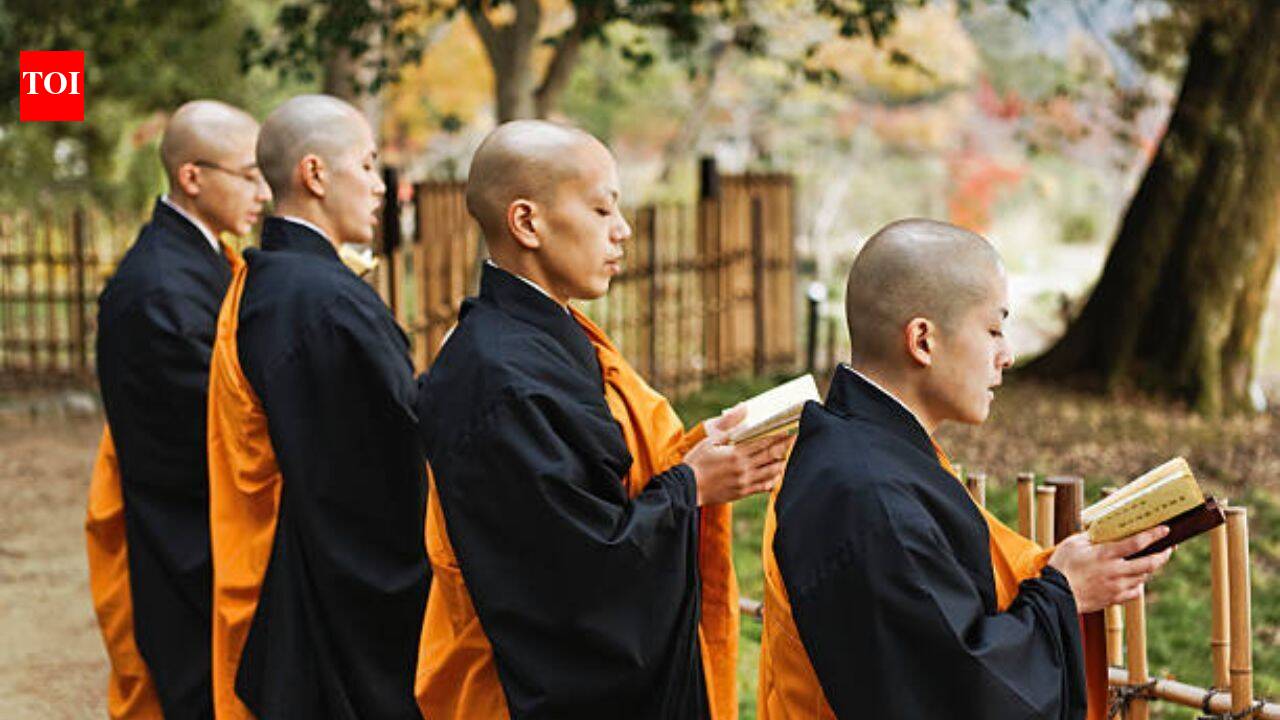
According to estimates, 30% of temples in Japan may disappear by 2040.
uncertain
% → accord → 2040
The cause of the event will not be some extravagant sci-fi catastrophe or a predicted public uprising but the decrease in religiosity.
asserted
cause → predict → religiosity
Against this backdrop, it seems monks in the country have turned to shake hands with AI and use it to turn more people towards Buddhism while also helping them out spiritually, according to a report by The Japan Times.
uncertain
monks → seem → Times
At Ganshuji temple in the city of Odawara, Kanagawa Prefecture, resident monk Souou Iwayama has pioneered a change.
asserted
Iwayama → pioneer → change
During the pandemic, he introduced an online zazen service as companies shifted to remote work and transformed the temple cemetery into one centred on jumokuso, a form of burial in which cremated remains are interred beneath trees, shrubs or flowers rather than a stone monument requiring expensive maintenance.
asserted
remains → introduce → maintenance
At the time he took over the management of the temple some years ago, it relied on just four danka for support.
asserted
it → take → support
Today, more than 550 families use the burial plots, helping rebuild the temple's finances and broaden its parish base amid wider demographic decline.
asserted
families → use → decline
Not just operational changes, he has also begun integrating AI into the temple's daily operations, using it to manage memorial schedules and refine written materials for parishioners.
asserted
he → begin → parishioners
“Rather than seeing AI as a threat, we as monks must consider how it can be incorporated into our own efforts at propagation,” he said.
asserted
he → see → propagation
“The central question is whether robots or AI can take over our role.
asserted
robots → take → role
“When someone dies, and you hold their hand like this, telling them it will be all right, that moment matters,” he said.
asserted
he → die → them
“There’s something essential in a human presence, where body and mind come together in an instant.
asserted
body → ’ → instant
That, too, is what it means to be a religious practitioner.
asserted
it → mean → what
I don’t imagine that being replaced.”
No single doctrine
In the West, the Catholic Church has given a formal response to the rise of AI.
asserted
Church → imagine → AI
In a doctrinal note, the Vatican drew a clear distinction between human and artificial intelligence, emphasising that AI must remain subject to human judgment and respect human dignity.
asserted
AI → draw → dignity
Religion itself in the country is not a major driving force.
asserted
Religion → drive → country
A long-running survey by the Institute of Statistical Mathematics offers insight into how people in Japan view religion.
asserted
people → run → religion
One question asks whether respondents have any religious belief.
asserted
respondents → ask → belief
In the most recent survey, conducted in 2018, 26% said they did, while 74% said they did not, a ratio that has remained largely unchanged since 1958.
asserted
that → conduct → 1958
Another question asks whether having a “religious spirit” is important.
asserted
having → ask → spirit
Here, 57% said yes, compared to 24% who said no.
asserted
who → say → %
Practices such as Shinto weddings and Buddhist funerals are widely observed but understood as part of everyday life, customs rather than expressions of piety.
asserted
Practices → observe → piety
That overlap is evident in the Agency of Cultural Affairs’ annual statistical research on religion, which shows that as of Dec. 31, 2024, there were approximately 86 million adherents of Shinto and 80 million of Buddhism.
asserted
which → show → Buddhism
Combined, the total exceeds Japan’s population by roughly 47 million.
asserted
total → combine → million
AI taking up as a quasi-spiritual presence may not feel as disruptive in Japan.
uncertain
AI → take → Japan
“If someone said AI was a kind of god, it might just be seen as one more added to the many,” said Takako Inoue, a Tokyo-based antique art dealer to the outlet, referring to the concept of yaoyorozu no kami, or “8 million deities," the belief that gods are present in everything.
uncertain
gods → say → everything
A chance to speak to Buddha
More than two and a half millennia ago, when Buddha was alive, he is said to have answered questions from his followers, offering them guidance and clearing their doubts.
asserted
he → speak → doubts
After his death, that exchange became impossible.
asserted
exchange → become → death
His teachings were preserved instead in scriptures, compiled, transmitted and interpreted across generations, but the immediacy of dialogue was lost.
asserted
immediacy → preserve → dialogue
“For 2,500 years, we haven’t been able to speak with the Buddha,” said Seiji Kumagai, a Buddhist priest and professor at Kyoto University’s Institute for the Future of Human Society.
asserted
Kumagai → speak → Society
“So from a Buddhist historical perspective, our project can be understood as a partial realisation of that aspiration to be able to talk to the Buddha.”
asserted
project → understand → Buddha
Kumagai and Teraverse CEO Toshikazu Furuya began exploring how to build a system capable of responding to questions based on Buddhist texts.
asserted
Kumagai → begin → texts
The aim was to apply Buddhist ideas about happiness to contemporary life and address people's anxieties.
asserted
aim → apply → anxieties
Drawing on the Sutta Nipata, one of the oldest surviving collections of the Buddha’s discourses, the team released an initial version of the “BuddhaBot” in 2021.
asserted
team → draw → 2021
Built using Google’s Sentence-BERT algorithm and trained in a question-and-answer format, it responded using passages drawn directly from Buddhist scriptures.
asserted
it → build → scriptures
While it could retrieve relevant texts based on semantic similarity, it struggled to sustain natural conversation.
uncertain
it → retrieve → conversation
More recent versions include an upgraded "BuddhaBot-Plus" introduced in 2023.
asserted
versions → include → 2023
The team later introduced “Shinran-Bot,” modelled on Shinran, the founder of Japan’s largest Buddhist sect, and “Vasubandhu-Bot,” based on the influential Mahayana thinker Vasubandhu.
asserted
team → introduce → thinker
They have also developed augmented-reality interfaces enabling multimodal interaction through text, sound and visual avatars.
asserted
They → develop → text
In February, the team unveiled a humanoid “Buddharoid” equipped with BuddhaBot-Plus, adding a physical dimension to what had previously been a purely digital exchange.
asserted
what → unveil → dimension
…and 22 more, not listed.
 The Aporia