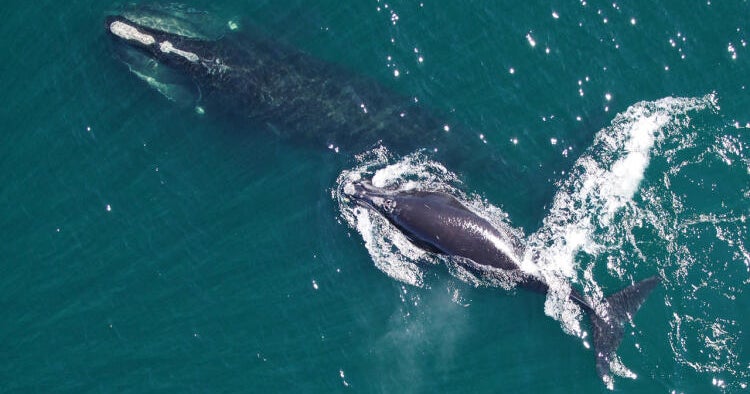
Photo via Toronto Star

Strong calving season provides glimmer of hope for endangered right whales

Read the original at Toronto Star ↗
Cite

Fitzpatrick, T. (2026, November 16). Strong calving season provides glimmer of hope for endangered right whales. Toronto Star. https://www.thestar.com/news/canada/nova-scotia/strong-calving-season-provides-glimmer-of-hope-for-endangered-right-whales/article_1bdd9ae8-5153-5d4c-a30c-90f0580d3052.html

Dated from the outlet's own feed. Check the original for its byline.

Toronto Star · collected 2026-11-16 · by Tori Fitzpatrick

Quick Summary

Scientists are gathering in Halifax for the annual meeting of the North Atlantic Right Whale Consortium, noting a strong calving season with 24 newborns, the highest number since 2009, but also reporting a two percent population decrease to 382 whales. Despite this uptick in births, experts like Lindsey Jones from the New England Aquarium emphasize the ongoing threats from vessel strikes and fishing gear entanglements, advocating for stricter regulations and testing of ropeless fishing gear. The U.S. Senate is currently considering a bill that would delay new protections for the whales until 2035, a move that Jones and others fear could jeopardize the species' recovery.
Written by AI on 2026-11-16, from this article's own text only (the story summary below draws on all the coverage).
See how they differ ↓

AI analysis

Story summary

The North Atlantic right whale population has declined to about 382 animals at the end of 2025, marking a seven-animal decrease from the previous year, according to the North Atlantic Right Whale Consortium's annual meeting in Halifax on November 16, 2026. Despite this, the 2025-2026 calving season saw a notable uptick with 24 calves born, the highest number since 2009. However, the population is still 20% below its peak of 483 whales in 2011. Scientists and environmental groups, like Oceana, are calling for stronger protections to prevent further decline due to ship strikes and entanglements. The U.S. is also considering deregulatory actions, potentially impacting future protections for the species.

Written for “Right Whale Population Trends” on 2026-11-18, grounded in this article and the 5 other(s) covering the same event.

How they differ

5 outlets covered “Right Whale Population Trends”.

What each outlet says

One AI summary per outlet of its latest article on this story, written from that article alone and checked against it. Open the article for the outlet's own words.

Toronto StarThis outlet16 Nov

Scientists are gathering in Halifax for the annual meeting of the North Atlantic Right Whale Consortium, noting a strong calving season with 24 newborns, the highest number since 2009, but also reporting a two percent population decrease to 382 whales. Despite this uptick in births, experts like Lindsey Jones from the New England Aquarium emphasize the ongoing threats from vessel strikes and fishing gear…

Strong calving season provides glimmer of hope for endangered right whales (this article)2 articles from Toronto Star on this story
The Globe and Mail16 Nov

The North Atlantic right whale population has declined to about 382 animals by the end of 2025, according to the North Atlantic Right Whale Consortium, marking a drop from the peak of 483 in 2011. This decline is attributed to entanglements in fishing gear and vessel strikes, exacerbated by climate change and ocean noise. The U.S. is weakening protections, including a congressional ban on new regulations for lobster…

North Atlantic right whale population declines as U.S. weakens protections →
CBS News16 Nov

Scientists report that the North Atlantic right whale population has dropped to 382 animals, reversing a previous trend of slow growth. This decline, despite a 2.1% increase from the previous year, is attributed to threats such as entanglement in fishing gear and ship collisions, exacerbated by the whales' movement to unprotected areas due to changing ocean temperatures. Heather Pettis of the North Atlantic Right…

Right whale population drops, alarming scientists →
Global News16 Nov

Scientists are gathering in Halifax for the annual North Atlantic Right Whale Consortium meeting, discussing the recent strong calving season that saw 24 newborn whales, the highest number since 2009. Despite this positive development, the overall population decreased by 2% to 382 whales as of 2025. Experts like Lindsey Jones from the New England Aquarium emphasize the need for stricter protections against human…

Strong calving season provides glimmer of hope for endangered right whales →
New York Post16 Nov

Scientists are concerned after the North Atlantic right whale population dropped to 382 animals, marking a 2% decline from the previous year's estimate. The population was showing a slow but steady increase until recently. Threats such as entanglement in fishing gear and ship collisions, exacerbated by climate change affecting the whales' food sources, are contributing to the decline. Heather Pettis, chair of the…

Rare North Atlantic right whale population drops, alarming scientists →

Where they agree and split

Framing

How the first headlines put it

Stated as fact5
The headlines (5)

North Atlantic right whale population declines as U.S. weakens protections The Globe and Mail · stated as fact

Strong calving season provides glimmer of hope for endangered right whales Toronto Star · stated as fact

Right whale population drops, alarming scientists CBS News · stated as fact

Strong calving season provides glimmer of hope for endangered right whales Global News · stated as fact

Rare North Atlantic right whale population drops, alarming scientists New York Post · stated as fact

Words to watch (3)

Rare North Atlantic right whale population drops, alarming scientists Toronto Star

Rare North Atlantic right whale population drops, alarming scientists New York Post

Right whale population drops, alarming scientists CBS News

The full story: what happened, how it changed, and all 6 articles →

Compared with similar articles

This article reads leans left and hedges 7% of its claims. Each row says how that neighbour differs.
Global News
Leans left Hedges 3 of 39 claims Outlet record 63/100
The Globe and Mail
Hedges 1 of 42 claims Outlet record 51/100
Toronto Star
Hedges 2 of 3 claims Outlet record 64/100
New York Post
Hedges 3 of 23 claims Outlet record 66/100
CBS News
Hedges 3 of 22 claims Outlet record 67/100
“While both articles discuss the population estimate of North Atlantic right whales released on the same day, they describe different aspects of the event (one focusing on the positive calving season, the other on the overall population decline).”
Global News
Hedges 4 of 18 claims Outlet record 63/100
“While both articles discuss the North Atlantic Right Whale Consortium meeting in Halifax, they describe different aspects of the event: one focuses on the calving season results, the other on a research presentation about fetal loss due to inbreeding.”

Story

Right Whale Population Trends
Environment · 6 article(s) covering the same event. Compare every outlet's account →
How this article was measured signals, leaning charts, publisher record, byline, topics and claims

Signals How these are calculated →

Claims extracted
41
sentences that state something as happening or true
Uncertain
7%
3 of 41 hedged ("reportedly", "may", "according to")
Leaning
Leans left
of the writing, not the subject · beta estimate
Publisher signals
64/100
Toronto Star's corrections and hedging, across everything collected from it. Not a measure of accuracy.
Outlets on this story
6
Environment
Same framing elsewhere
2
articles that frame the event the way this one does
Analyzed 2026-11-16 · how these are computed

How this is being covered How these are calculated →

Article leaning vs. publisher reliability
Source leaning vs. consistency

Publisher

Toronto Star · 15734 article(s) · 31 correction(s) detected
Running correction rate · 31 correction(s)
2026-11-17
Correction
2026-10-26
Correction
2026-10-24
Correction
2026-10-07
Correction
2026-09-24
Correction

Who wrote this

Tori Fitzpatrick
6 article(s) here · 1 carrying a prediction
Lindsey Jones, a scientist who manages the New England Aquarium’s North Atlantic right whale catalogue, said the notable uptick in births may be a short-lived blessing. “We just need to help ensure that those calves can survive to maturity and contribute to further population growth,” Jones said in a recent interview from Boston.
William Burns, a communications adviser with the premier's office, said Chen's "slanted comments" were irresponsible and not backed by research on the local community.
Forces participate in safety briefings before an exercise begins and are given specific instructions on what they are permitted to shoot and what orders they will be given to stop the exercise in the event something goes wrong, he said.
Nova Scotia Supreme Court Justice John Keith is set to make a decision on the pending sale Friday, which could see CFFI Ventures sell most of its holdings to New York-based New Tide Capital LP.
Also by Tori Fitzpatrick
Nothing else under this byline is closely related to this article, so these are simply their most recent.
All 6 articles by Tori Fitzpatrick →

Topics

Canada HALIFAX U.S. the New England Aquarium’s the North Atlantic Right Whale Consortium

Subjects

Jones PERSON · 5× Canada GPE · 2× HALIFAX GPE · 2× U.S. GPE · 2× the North Atlantic Right Whale Consortium ORG · 2× Boston GPE · 1× Donald Trump PERSON · 1× Lindsey Jones PERSON · 1× the New England Aquarium’s ORG · 1× the United States GPE · 1×

Narrative

Jones said human impacts not only prolong the period for right whales to produce their first calf but also increase the amount of time between calves. “Right whales should be able to give birth every three or four years, but we’ve seen extended inter-calving intervals of five to seven-plus,” she said.
framing: assertive · carried by 2 article(s) · first seen 2026-11-16
Lindsey Jones, a scientist who manages the New England Aquarium’s North Atlantic right whale catalogue, said the notable uptick in births may be a short-lived blessing. “We just need to help ensure that those calves can survive to maturity and contribute to further population growth,” Jones said in a recent interview from Boston.
2026-11-16 · Toronto Star
Strong calving season provides glimmer of hope for endangered right whales · assertive framing

Claims (41 extracted, 3 hedged)

The most recent calving season for North Atlantic right whales was one of the strongest on record, providing a glimmer of hope for the critically endangered species. asserted
season → provide → species
But as scientists gather Monday in Halifax for the annual meeting of the North Atlantic Right Whale Consortium, some experts are renewing calls for more protection for the majestic mammals. asserted
experts → gather → mammals
Despite the recent baby boom — 24 calves were born during the 2025-2026 season, the most since 2009 — a preliminary estimate released Monday says the annual population as of 2025 decreased by two per cent to 382 whales. asserted
population → bear → whales
Lindsey Jones, a scientist who manages the New England Aquarium’s North Atlantic right whale catalogue, said the notable uptick in births may be a short-lived blessing. “We just need to help ensure that those calves can survive to maturity and contribute to further population growth,” Jones said in a recent interview from Boston. uncertain
Jones → manage → Boston
She said right whales continue to face threats from human activity, the most lethal of which are vessel strikes and entanglements in fishing gear. asserted
lethal → say → gear
That’s why the need for better regulations and more protective measures will be on the agenda for this week’s conference. asserted
need → ’ → conference
As an example, Jones said speed limits imposed on ships entering designated slow-down zones off the east coast of the United States currently apply to ships 65 feet or longer. asserted
limits → say → ships
But she said those rules should also apply to smaller vessels. asserted
rules → say → vessels
As well, she said more testing is required for ropeless fishing gear, which is designed to prevent entanglements. asserted
which → say → entanglements
The calls for change come as U.S. President Donald Trump’s administration has taken steps to delay new protections for the whales. asserted
administration → come → whales
Meanwhile, the U.S. House of Representatives recently passed a bill that would extend that pause to 2035. asserted
that → pass → 2035
Jones said if the bill becomes law, it would threaten the species’ recovery. asserted
it → say → recovery
“It would be a pretty big hit ... if the measure goes forward,” she said. asserted
she → go → ?
In May, The Canadian Press obtained an internal memo from Fisheries and Oceans Canada that showed experts within the department believed the bill could have grave consequences for right whales. uncertain
bill → obtain → whales
North Atlantic right whales are a migratory species typically found along the east coast of North America, from Florida to Newfoundland and Labrador. asserted
whales → find → Newfoundland
A portion of the population gathers to feed each summer in the Gulf of St. Lawrence. asserted
portion → gather → Lawrence
Heather Pettis, a scientist and chair of the North Atlantic Right Whale Consortium, said the latest estimate shows the population is not yet on a path to recovery. asserted
population → say → recovery
“Recovery for this species depends on sustained, protective actions in both the U.S. and Canada,” she said in a statement. asserted
she → depend → statement
Earlier this year, the consortium documented two right whale deaths. asserted
consortium → document → deaths
A four-year-old male was found dead off the coast of North Carolina in January after becoming entangled in snow crab gear from Canada. asserted
male → find → Canada
And a three-year-old female was found dead in February off the coast of Virginia, but the cause of death could not be determined. uncertain
cause → find → death
Scientists also recorded eight human-caused injuries this year, including one blamed on a vessel strike and seven due to fishing gear. asserted
Scientists → record → gear
Jones said these threats can prevent right whales from reaching an age where they can reproduce. asserted
they → say → age
Earlier this year, three females, all of them around nine or 10 years old, gave birth to calves for the first time, she said. asserted
she → give → time
“North Atlantic right whales are a long-lived species and take a long time to grow to maturity,” she said. asserted
she → live → maturity
Jones said human impacts not only prolong the period for right whales to produce their first calf but also increase the amount of time between calves. “Right whales should be able to give birth every three or four years, but we’ve seen extended inter-calving intervals of five to seven-plus,” she said. asserted
she → say → seven
“There’s some whales that only give birth once every decade. asserted
that → ’ → birth
And that’s a concern … in such a small population.” asserted
that → ’ → population
Federal agencies in Canada and the United States have measures in place to reduce the impact of vessel traffic and fishing gear. asserted
agencies → have → traffic
Transport Canada implements speed restrictions and enforces a vessel exclusion zone in the Shediac Valley of the Gulf of St. Lawrence during the summer to reduce the risk of collisions. asserted
Canada → implement → collisions
Meanwhile, Fisheries and Oceans Canada enforces seasonal fishing closures and other measures to reduce the risk of entanglement. asserted
Canada → enforce → entanglement
In the United States, the National Oceanic and Atmospheric Administration implements vessel slowdowns seasonally. asserted
Oceanic → implement → slowdowns
And several states also implement measures to reduce the risk of entanglements. asserted
states → implement → entanglements
It’s believed the right whale population peaked at about 21,000 before aggressive hunting drastically reduced their numbers. asserted
hunting → believe → numbers
By the 1920s, fewer than 100 remained. asserted
100 → remain → 1920s
They are called right whales because they were considered by whalers to be the “right” whales to hunt. asserted
they → call → whalers
They floated when killed and produced high amounts of whale oil. asserted
They → float → oil
After a ban on hunting was imposed in 1935, the population grew to 483 by 2010. asserted
population → impose → 2010
But a steep decline began in 2017 after 12 whales died in Canadian waters and another five died in U.S. waters, with most of the deaths linked to entanglements and vessel strikes. asserted
most → begin → entanglements
Since 2020, however, their numbers have been slowly increasing. asserted
numbers → increase → 2020
…and 1 more, not listed.
Give feedback · no sign-in needed

No sign-in needed for now. Your note is sent without a name, so it cannot be answered.

History Support