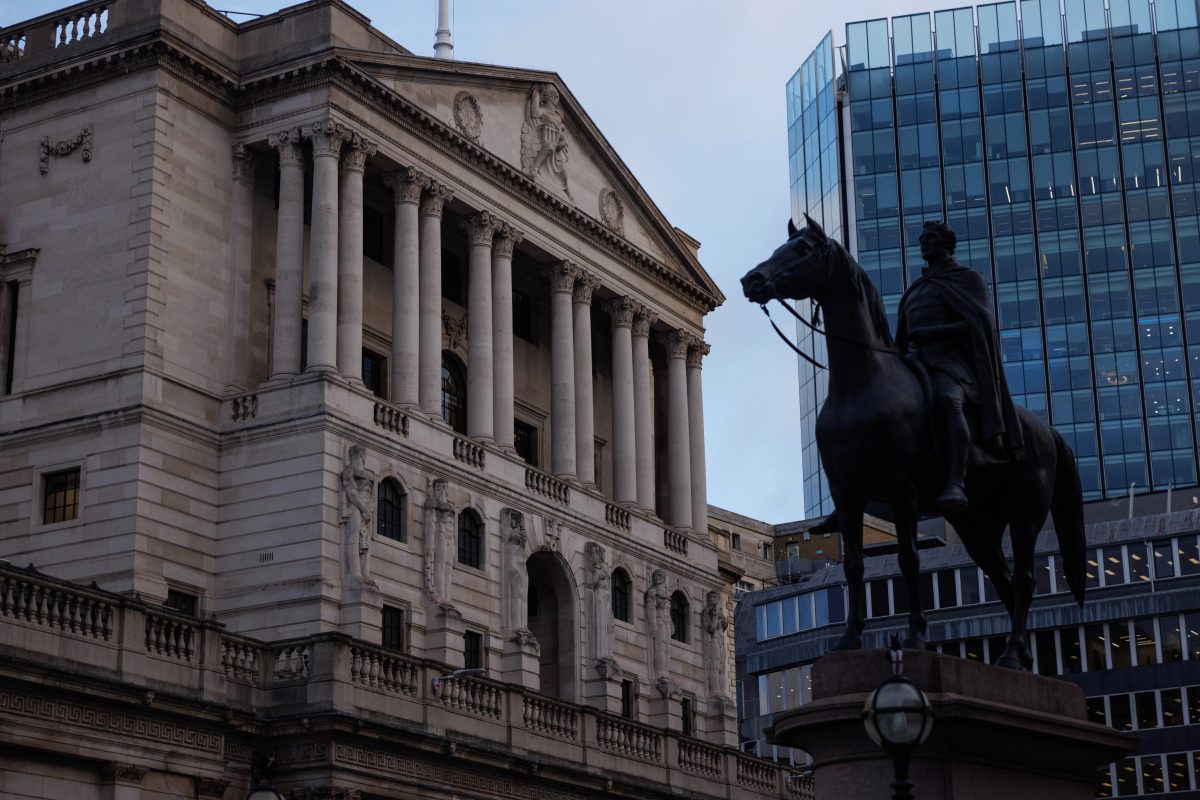
Photo via The Guardian

A rapid interest rate rise seems inevitable – and households are expected to pick up the tab

Read the original at The Guardian ↗
Cite

Inman, P. (2026, November 14). A rapid interest rate rise seems inevitable – and households are expected to pick up the tab. The Guardian. https://www.theguardian.com/business/2026/nov/14/interest-rate-rise-phillip-inman-inflation-economy

Dated from the outlet's own feed. Check the original for its byline.

The Guardian · collected 2026-11-14 · by Phillip Inman

Quick Summary

The Bank of England is likely to raise interest rates again due to inflation forecasted to reach 5% next spring, with some analysts predicting an increase as early as December 17. Huw Pill, the Bank’s chief economist, suggests more than one rate rise is almost certain. While this move aims to curb inflation, it will make borrowing more expensive for households already strained by previous inflationary periods. The article highlights that businesses may pass higher costs onto consumers, and if consumers resist, the government’s spending might indirectly support price hikes across various sectors.
Written by AI on 2026-11-15, from this article's own text only (the story summary below draws on all the coverage).

AI analysis

Story summary

The Bank of England is poised to raise interest rates next month, with another increase expected in early 2027, according to Huw Pill, the bank’s chief economist. Pill told the Financial Times that with inflation projected to reach 5% in spring 2027, driven by high oil and gas prices due to the Iran war, further interest rate hikes are necessary to combat inflation. The central bank’s policymakers believe the UK economy has strengthened over the past year, leading to higher wages, but also see the need to cool the economy to prevent inflation from spiraling out of control. This could mean higher mortgage payments for an estimated 2.3 million homeowners who will need to refinance their loans next year, as the cost of borrowing is expected to increase from the current rate of 4%.

Written for “Interest Rate Rise Imminent” on 2026-11-17, grounded in this article and the 1 other(s) covering the same event.

Compared with similar articles

This article reads leans right and hedges 9% of its claims. Each row says how that neighbour differs.
The Guardian
Hedges 2 of 15 claims Outlet record 65/100
City AM
Hedges 8 of 25 claims Outlet record 94/100
“The articles discuss different timeframes and specific predictions for interest rate hikes, suggesting they are reporting on distinct phases or predictions rather than the same specific event.”
Evening Standard
Hedges 3 of 15 claims Outlet record 64/100
“The articles discuss the likelihood of future rate hikes but describe different timeframes and specific events.”

Story

Interest Rate Rise Imminent
Economy/Business · 2 article(s) covering the same event. See how they differ ↑
How this article was measured signals, leaning charts, publisher record, byline, topics and claims

Signals How these are calculated →

Claims extracted
33
sentences that state something as happening or true
Uncertain
9%
3 of 33 hedged ("reportedly", "may", "according to")
Leaning
Leans right
of the writing, not the subject · beta estimate
Publisher signals
65/100
The Guardian's corrections and hedging, across everything collected from it. Not a measure of accuracy.
Outlets on this story
2
Economy/Business
Same framing elsewhere
1
articles that frame the event the way this one does
Analyzed 2026-11-15 · how these are computed

How this is being covered How these are calculated →

Article leaning vs. publisher reliability
Source leaning vs. consistency

Publisher

The Guardian · 3579 article(s) · 7 correction(s) detected
Running correction rate · 7 correction(s)

Who wrote this

Phillip Inman
12 article(s) here · 1 carrying a prediction
With inflation also at 3.5% and expected to rise for a fourth consecutive month to 3.7% when figures are released on Wednesday, the average worker faces a fall in real wages growth to zero or even into negative territory.
With the latest forecasts by the central bank showing inflation rising to 5% next spring, another increase in the cost of borrowing seems inevitable, and may come as soon as next month.
The Bank of England will probably need to raise interest rates next month and again in early 2027 to combat rising inflation, its chief economist has said.
“Inflation is set to rise above 4% in the new year, just as most pay awards for 2027 are being agreed, so the risk that it becomes embedded is rising. “
Many people will be incredulous when they hear of the decision to increase the cost of borrowing by 0.25 percentage points, looking around their neighbourhood for signs of a booming economy. The official figures show the economy has proved resilient in response to the jump in oil and gas prices after the outbreak of war in Iran, but UK high streets are struggling and the underlying drivers of inflation are absent.
The Resolution Foundation said on Thursday that measures to ease household gas and electricity costs would still leave energy bills higher this year than during the last energy shock.
John Healey will present his first budget on Wednesday, which will set the tone for Andy Burnham’s premiership.
The threat of a renewed round of inflation from the persistently high cost of oil has spooked investors, who believe central banks will be forced to raise rates in the coming months to prevent price increases from becoming embedded.
The UK is losing out on annual exports to the EU that could be worth as much as £6.5bn without a deal with Brussels that allows manufacturers to jettison duplicate product testing.
Attacks on the government’s independent economic forecaster from left and right of the political spectrum are akin to “shooting the messenger”, according to an influential group of MPs.
Also by Phillip Inman
Nothing else under this byline is closely related to this article, so these are simply their most recent.
All 12 articles by Phillip Inman →

Topics

Bank Homes England NHS the Bank of England the Financial Times

Subjects

Bank ORG · 3× Birmingham GPE · 1× England GPE · 1× Homes England ORG · 1× Huw Pill PERSON · 1× London GPE · 1× NHS ORG · 1× Scrooge PERSON · 1× the Bank of England ORG · 1× the Financial Times ORG · 1×

Narrative

So sclerotic is the economy, so lacking in flexibility or productive spare capacity, that even the burst of growth experienced by the UK over the last year, defying most forecasters, must be calmed down with higher interest rates or else inflation will rip.
framing: assertive · carried by 1 article(s) · first seen 2026-11-15
With the latest forecasts by the central bank showing inflation rising to 5% next spring, another increase in the cost of borrowing seems inevitable, and may come as soon as next month.

Claims (33 extracted, 3 hedged)

A head of steam is building up behind the Bank of England raising interest rates again. asserted
Bank → build → rates
With the latest forecasts by the central bank showing inflation rising to 5% next spring, another increase in the cost of borrowing seems inevitable, and may come as soon as next month. uncertain
increase → show → month
A growing number of analysts predict the Bank’s policymakers will don Scrooge masks when they meet on 17 December to deliver a message of austerity and sacrifice. asserted
they → grow → austerity
So sclerotic is the economy, so lacking in flexibility or productive spare capacity, that even the burst of growth experienced by the UK over the last year, defying most forecasters, must be calmed down with higher interest rates or else inflation will rip. asserted
inflation → experience → rates
Huw Pill, the Bank’s chief economist, told the Financial Times on Saturday that more than one rate rise was almost certain. asserted
rise → tell → Saturday
This is not a message anyone who borrows money will want to hear, especially when the festive season is in full swing. asserted
season → borrow → swing
If interest rates edge up from 4% to 4.25%, mortgage deals will rise and business loans will become more expensive. asserted
loans → edge → %
The central bank expects businesses to react to the higher costs of doing business by hitting their customers with price hikes. asserted
businesses → expect → hikes
It is an argument that presumes consumers have money available to pay higher prices, despite plenty of evidence to the contrary. asserted
consumers → presume → contrary
Only households in the top half of the income scale have spent more this year and that has depended on running down their savings. asserted
that → spend → savings
Consumers are also battle-hardened after the greedflation period following the pandemic that morphed into its evil cousin, shrinkflation. asserted
that → harden → cousin
They know about grifting retailers and consumer product suppliers that try to build a narrative about the inevitability of surging inflation to disguise their own price hikes. asserted
that → know → hikes
The Bank says its business surveys have failed to detect efforts by the corporate sector to increase prices. asserted
surveys → say → prices
It’s just that a majority of policymakers are convinced pressure is building and inflation will be more than double their 2% target in a few months. asserted
inflation → ’ → months
But if consumers don’t have any spare cash, or have become more savvy about how they spend it, there is still a weak link – a special kind of consumer who could aid corporates in pushing up prices. uncertain
who → have → prices
The NHS is a big purchaser, so is local government and the many agencies that are funded by government, from Homes England to National Highways. asserted
that → fund → Highways
Government expenditure on goods and services accounts for 25% of overall consumption in the economy. asserted
expenditure → account → economy
Everything from concrete and medical supplies to food and furniture will cost more, and sellers will be prepared to justify the rise with a wide range of excuses. asserted
sellers → cost → excuses
Corporates will blame the war in the Middle East for an increase in transport costs and the impact of climate change that makes growing stuff harder. asserted
growing → blame → stuff
They will even accuse the government of raising costs by introducing new worker protection rules. asserted
They → accuse → rules
Let’s add another one: contractors will say they can’t get the skilled staff and so must pass on the cost of higher wages. asserted
they → add → wages
After 15 years of austerity and job cuts, there is a question mark over whether the public sector has the nous and resolve to push back to keep costs in check. asserted
sector → be → check
Budgets on the London to Birmingham high-speed rail line (HS2) have spiralled out of control. asserted
Budgets → spiral → control
The costs of the next largest infrastructure project in England, the 14.5-mile (23km) lower Thames crossing linking Essex and Kent via two tunnels, have more than doubled to £11bn. asserted
costs → link → 11bn
Government spending on consultants reached £3.7bn in 2024-25 from £2.9bn in 2022-23 and there seems to be no end to their uses, from advisers on artificial intelligence to strategies for reaching net zero. asserted
spending → reach → zero
The public sector is also notorious for commissioning plans for new town or city developments for which there is no funding, except for the inflationary bill from consultants. asserted
sector → commission → consultants
These public sector organisations have huge clout, and should use it. asserted
organisations → have → it
If they do, there will be knock-on effects to inflation deals struck within the business community, which in many cases can only ramp up prices knowing the public sector is the ultimate buyer. asserted
sector → do → prices
Inside Threadneedle Street, policymakers expect everyone – consumers, government and business – to cave in to sellers’ demands. asserted
everyone → expect → demands
And that many of the UK’s 33 million workers will subsequently demand big pay rises to compensate. asserted
many → demand → rises
Yet it must be possible that all three consumer groups will adopt the slogan Can’t Pay, Won’t Pay, limiting the rise in inflation and eliminating the need for elevated pay rises. asserted
groups → adopt → rises
Even if the poor, financially bombed-out household consumer is the only one to take a stand against greedy corporates, inflation will not hit the heights forecast by the Bank of England. asserted
inflation → bomb → England
In the meantime, it might have raised interest rates too far, laying waste to whatever growth there is in the economy. uncertain
it → raise → economy

Give feedback · no sign-in needed

No sign-in needed for now. Your note is sent without a name, so it cannot be answered.

History Support