How China gets around the U.S. ban on Nvidia chips
asserted
China → get → chips
CEO's affair with Alice Huang alleged to have aided at least $7.5B in Nvidia chip shipments to China
The revelation that Nvidia CEO Jensen Huang had an affair with a former executive of a Singapore-based company has raised concerns about China's ability to acquire advanced microchips restricted from the country.
asserted
Huang → allege → country
Jensen Huang has admitted to having an affair with Alice Huang, a Chinese businesswoman who later became the controlling shareholder of Singapore-based cloud-computing company Megaspeed International.
asserted
who → admit → International
The New York Times reported last month that U.S. authorities had concluded she was a Chinese intelligence asset who passed information to Beijing while developing a close relationship with the Nvidia CEO — accusations that China's Foreign Ministry has called "groundless."
asserted
Ministry → report → that
Megaspeed has also drawn scrutiny from U.S. authorities over suspicions that it helped Chinese companies obtain advanced Nvidia chips, subject to Washington's export restrictions.
asserted
companies → draw → restrictions
Meanwhile, the scandal has put the effectiveness of the U.S. restrictions on these advanced chips to China under a spotlight.
asserted
scandal → put → spotlight
Here's a look at why China needs these top-tier chips, why the U.S. has banned them from export, and how China is still able to acquire them.
asserted
China → need → them
Why would China want Nvidia's chips?
asserted
China → want → chips
Nvidia designs the world’s most powerful AI chips, which are considered the gold standard, analysts say.
asserted
analysts → design → chips
"Their chips are at the forefront of the AI revolution," said Ryan Ellis, an associate professor at Northeastern University in Boston, whose research focuses on communication law and policy, infrastructure politics and cybersecurity.
asserted
research → say → law
Artificial intelligence takes a huge amount of graphics processing (GPU) capacity, added Dennis Wilder, a former senior U.S. intelligence officer and National Security Council director for China.
asserted
Wilder → take → China
China might be winning the AI race.
uncertain
China → win → race
Does it matter?
asserted
it → matter → ?
Nvidia rides AI boom to become the first company to reach $5-trillion valuation
High-end chips, like those offered by Nvidia, provide a cheaper means of developing AI, without having to create more data centres to create more GPU capacity, Wilder said.
asserted
Wilder → rid → capacity
They also support the most advanced AI models, Ellis said, meaning a lack of access to those chips hampers development.
asserted
lack → support → development
"Inside China, there is an incredible hunger and thirst for these chips," he said.
asserted
he → be → chips
"
Why did the U.S. block sales of these chips to China?
asserted
U.S. → block → China
In October 2022, under the Biden administration, the U.S. Department of Commerce implemented export controls on advanced computing chips going to China.
asserted
Department → implement → China
That means Nvidia's top-end chips, Blackwell Ultra and Vera Rubin — both GPUs used for AI models, are blocked from being sold to the country.
asserted
chips → mean → country
The U.S. government has two main reasons for blocking these sales: To maintain the country's global lead in AI development and to protect national security.
asserted
government → have → security
Whoever is winning the AI race — and able to train the best models — has the ability to be in the driver's seat for this next era of the AI revolution, said Chris Mattmann, who was the inaugural chief data and AI officer at the University of California, Los Angeles (UCLA).
asserted
who → win → California
While the U.S is still ahead of China, that gap is closing, Mattmann said.
asserted
Mattmann → close → China
And anything that might "move the needle," like access to advanced chips, helps close that gap, he said.
uncertain
he → move → gap
The U.S. government is also trying to preserve national security, with concerns that allowing China access to such chips could help advance its military technology, potentially allowing the development of systems that might one day threaten U.S. interests.
uncertain
that → try → interests
"Export controls are always … trying to both allow a market to grow, but also to shape that market in such a way that it doesn't undermine national security," said Ellis.
asserted
Ellis → try → security
U.S. President Donald Trump, however, has eased up on some restrictions, and now allows other Nvidia chips that were initially blocked — typically those used in consumer electronics — to be sold to China under certain conditions.
asserted
that → ease → conditions
So how is China getting Nvidia chips?
asserted
China → get → chips
Soon after advanced chip restrictions to China were implemented, an illegal smuggling and underground network was set up by many vendors to get the chips into China and sell them on to companies there, Germany's Deutsche Welle (DW) news agency reported.
asserted
agency → implement → companies
The U.S. has cracked down on those vendors, where possible.
asserted
U.S. → crack → vendors
In December 2025, the Department of Justice announced two Chinese men were in custody for allegedly smuggling Nvidia chips to China.
uncertain
men → announce → China
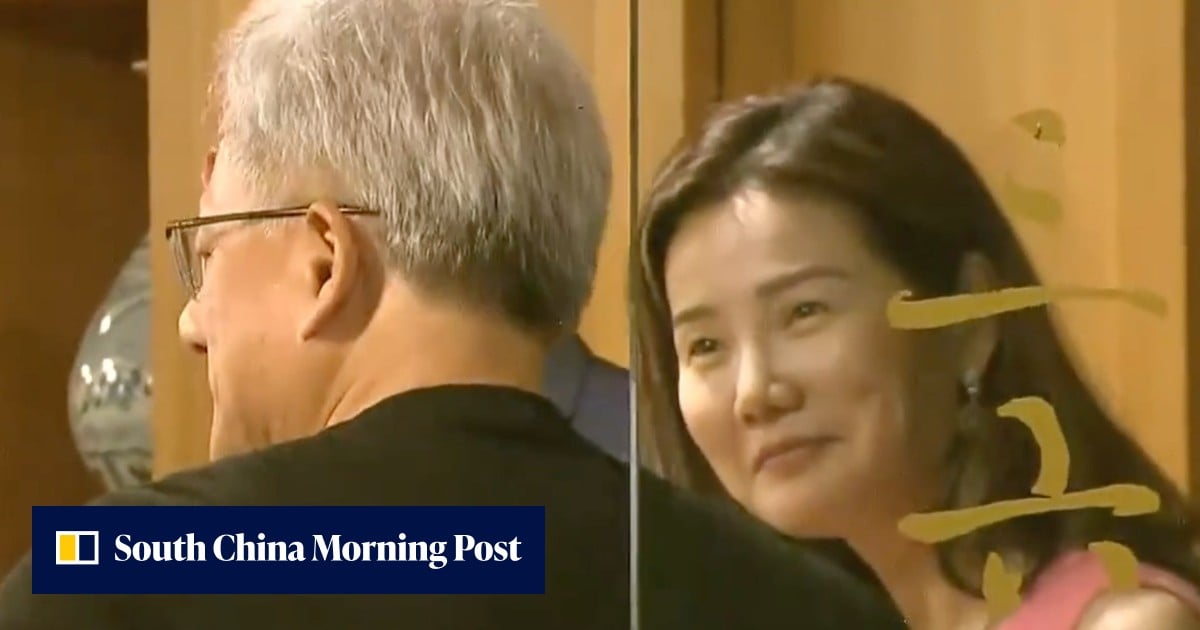
A screengrab from CTI video footage shows a woman identified by Reuters as Alice Huang, after comparison with a photograph obtained separately, attending a dinner with Nvidia CEO Jensen Huang at a restaurant in Taipei, Taiwan, on May 22, 2025.
uncertain
woman → show → May
But there's also a legal loophole that can be exploited to send chips to China.
asserted
that → be → China
While Nvidia can't sell their most advanced chips directly to China or China-based companies, they can sell them to other countries, and third-party data centres can then rent out access to those data centres to companies affiliated with China.
asserted
centres → sell → China
For example, Nvidia could sell the chips to a Malaysian company that then turns around and rents that computing power to a Chinese company, Ellis said, and "that would be above board.
uncertain
that → sell → board
While some U.S. lawmakers believe this loophole should be closed, others believe it is a reasonable accommodation, Ellis said.
asserted
Ellis → believe → ?
But, Ellis said, the current scandal suggests that what's often happening is that these chips are being sold to these other countries, where they are then moved straight into China.
uncertain
they → say → China
According to Ellis, U.S. export controls are "never going to be 100 per cent perfect.
uncertain
controls → accord → Ellis
But there could certainly be more spot checks and more aggressive oversight to make sure the purchasers of these chips remain the end users, he said.
uncertain
he → make → chips
"The enforcement is missing."
asserted
enforcement → miss → ?
The U.S. Commerce Department's enforcement arm, the Bureau of Industry and Security, is just not staffed well enough to enforce the restrictions, Wilder agreed.
asserted
Wilder → staff → restrictions
…and 6 more, not listed.

 The Aporia