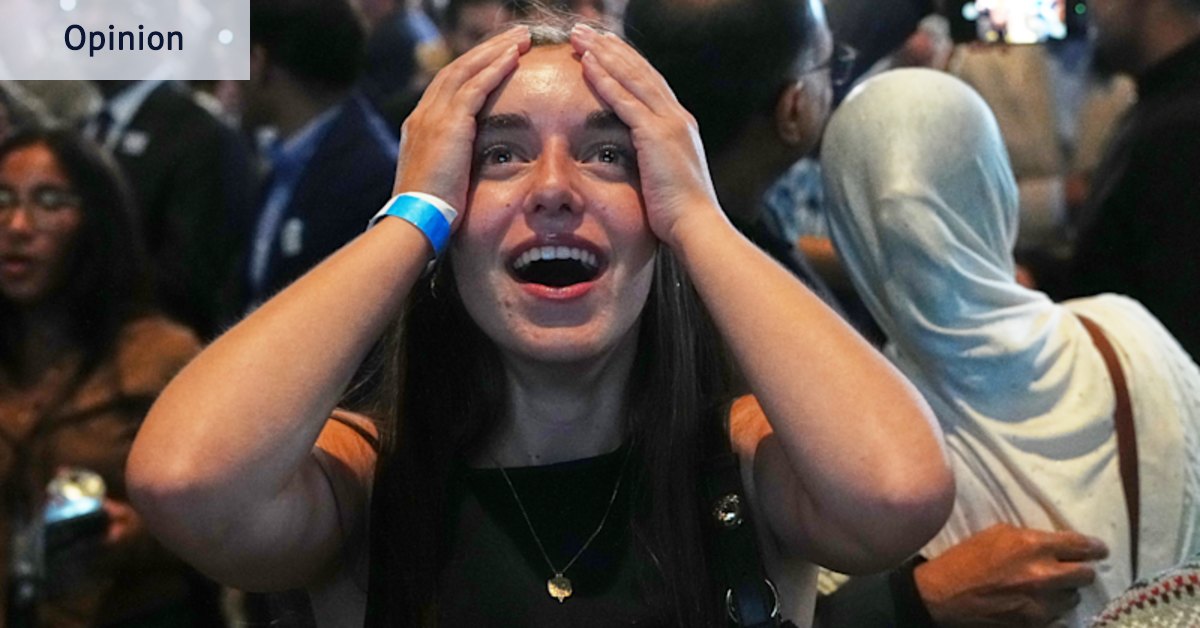
So far this year, when their hand has been held to the stove, voters have chosen what the Texas senator-elect James Talarico, the new face of the US’s Christian left, campaigned on as a “politics of love”: a society where we aren’t at each other’s throats, or a police state at ours.
asserted
we → hold → ours
Is it any surprise that when there is clarity about the choice on offer, voters have started to shrink away from a vision fuelled by billionaire wealth and runaway inequality?
asserted
voters → be → wealth
Are we living, perhaps, through an extended “democratic spring” that began in Budapest in April with the overthrow of Viktor Orbán, and will continue all the way through to the arrival of the Élysée Palace’s next occupant in May?
uncertain
that → live → May
That’s what it felt like to wake up on Wednesday morning, blanketed in an unexpected optimism sparked by a country that has fed my inner cynic for too long.
asserted
that → ’ → cynic
In Michigan, voters chose a man who responded to a hate-filled question about sharia law with disarming, acerbic humour about shawarma law instead.
asserted
who → choose → law
In neighbouring Ohio, where I grew up, voters refused to suffer the fundamental indecency of one candidate (the billionaire entrepreneur Vivek Ramaswamy) trying to weaponise the childhood abuse suffered by his opponent Amy Acton via Acton’s estranged mother.
asserted
voters → neighbour → mother
Acton defeated Ramaswamy to become Ohio’s first female governor and its first Democrat in two decades.
asserted
Acton → defeat → decades
Farther south, New Mexico has the first ever female Native American governor; in Georgia, a Black woman will hold that office for the first time; in Texas, the first Latina.
asserted
woman → have → Texas
There are dozens of stories like these that have temporarily transformed scrolling from an experience of doom to one of hope.
asserted
that → be → hope
Beneath them is something more structural; there is, as a French historian messaged me early Wednesday morning, a “Rooseveltian” quality to what has happened in the US.
asserted
what → be → US
For a decade, we have been dealing, across international borders, with the feeling that governments are no longer “in control” – not of starkly advancing inequality and growing corporate power, or the pace and direction of technological change and climate breakdown.
asserted
governments → deal → change
The far-right response has been to try to assert control over the things within immediate grasp: immigration and identity.
asserted
response → try → grasp
Those of us who believe in democracy, environmental and social justice have a far more difficult task, both to sell to voters and to accomplish.
asserted
who → believe → voters
That is to actually take back control (not superficially, as Brexit once proposed) of the forces that pose an existential threat to the type of society we want to inhabit.
asserted
we → take → society
In Europe, this is all the more difficult because of an internal split – between those who think this is possible on a national scale, and those who, like me, think it obliges us to pool sovereignty.
asserted
it → think → sovereignty
In the 1930s, Franklin D Roosevelt recognised that liberal democracy, faced with an existential threat, had to evolve to survive.
asserted
democracy → recognise → threat
He knew that it would be impossible to defend an open society or the rule of law unless the state could guarantee economic progress in people’s lives, so he responded with the flurry of government actions that together comprised the New Deal.
uncertain
that → know → Deal
In the US, the Democrats, who now control Congress, have a chance to rebuild democratic foundations after decades of self-inflicted destruction.
asserted
who → control → destruction
In part because the youngest generation of voters, who have only ever known Trumpism, massively rejected everything Trump has birthed, and that rejection echoed down the ballot – all the way to state legislatures and school boards.
asserted
rejection → know → legislatures
That didn’t only happen because they were angry and the Democrats offered anger in return; it happened because they were angry and a slate of exceptional candidates said: “So are we, and it doesn’t have to be this way.”
asserted
it → happen → candidates
In Europe, the rule of law and the institutions that maintain it have not bent as much in the US, but an equivalently forceful snapback of hope and relief is still incomplete.
asserted
snapback → maintain → hope
For the past month, France’s high schoolers have crystallised the social and economic dilemma Roosevelt encountered, and there are candidates out there mirroring their justified anger.
asserted
Roosevelt → crystallise → anger
I worry, though, that this offer remains a politics of anger tinged with nationalism, and uninterested in defending European democracy; that it risks throwing away what Europe painstakingly constructed in response to its institutional shortcomings, rather than proposing a resolutely European type of renewal.
asserted
Europe → worry → renewal
Or that France – where an overwhelming majority abhors Trump, but where huge numbers seem to want their own version of him – will stubbornly stumble into just what the US has been through, before coming out on the other side, in full rejection of the far-right National Rally.
asserted
US → abhor → Rally
Both sides of the Atlantic woke up with more hope on Wednesday, even if neither side has a clearcut and easy path forward.
asserted
side → wake → path
Europe’s path, though, now seems the more difficult one to navigate.
asserted
path → seem → ?
Alexander Hurst writes for Guardian Europe from Paris.
asserted
Hurst → write → Paris
His memoir Generation Desperation is out now
-
Do you have an opinion on the issues raised in this article?
asserted
you → have → article
If you would like to submit a response of up to 300 words by email to be considered for publication in our letters section, please click here.
asserted
you → like → section
 The Aporia