Photo via Al Jazeera

‘Going hungry’: Garment workers in Bangladesh say wages barely cover needs

Read the original at Al Jazeera ↗
Cite

Sujan, M. A. (2026, November 3). ‘Going hungry’: Garment workers in Bangladesh say wages barely cover needs. Al Jazeera. https://www.aljazeera.com/news/2026/11/3/going-hungry-garment-workers-in-bangladesh-say-wages-barely-cover-needs?traffic_source=rss

Dated from the outlet's own feed. Check the original for its byline.

Al Jazeera · collected 2026-11-03 · by Moudud Ahmmed Sujan

Quick Summary

Laili Begum, a 37-year-old garment worker in Bangladesh earning around 15,000 taka ($121) monthly, struggles to feed her family and pay for her children's education. She represents thousands of Bangladeshi garment workers protesting for higher wages due to rising costs of living; they are demanding a minimum wage increase from the current 12,500 taka ($102) to 30,000 taka ($241). The protests have disrupted factory operations and led to arrests, while the government responded by forming a wage board.
Written by AI on 2026-11-03, from this article's own text only (the story summary below draws on all the coverage).

AI analysis

Story summary

Garment workers in Bangladesh are struggling to make ends meet as their wages fail to cover basic needs like food and education. Laili Begum, a 37-year-old sewing operator at Virtual Bottoms Limited near Dhaka, earns about 15,000 taka ($121) monthly, sometimes rising to 18,000–20,000 taka ($145–$161) with overtime. Begum cannot afford her children's education; her 15-year-old daughter and 12-year-old son dropped out of school this year due to financial constraints. She reports days when the family has only puffed rice and snacks, barely managing one proper meal daily. This situation highlights the broader issue of inadequate wages in Bangladesh’s garment industry, despite its significant role in the country's economy.

Written for “Garment Workers' Wages Struggle” on 2026-11-03, grounded in this article and the 0 other(s) covering the same event.
Why this leaning score
The article's own words the score was based on. Each is quoted verbatim and was checked against the article text before being stored, so you can find it in the original.
Reading Leans left (beta estimate) Confidence high 1 quote(s) discarded as not found in the article
Leaning: leans left for article 124902 (high confidence, 1 verified quote) · logged 2026-11-03

Story

📰 Garment Workers' Wages Struggle
Economy/Business · 1 article(s) covering the same event.

Compared with similar articles

This article reads leans left and hedges 4% of its claims. Each row says how that neighbour differs.
The Hindu
Hedges 2 of 17 claims Outlet record 77/100
“Article A describes the reopening of garment factories after closures due to wage protests, while Article B discusses workers' struggles with low wages and mentions ongoing protests but does not focus on a single specific event occurring at the same time.”
Al Jazeera
⚖️ Leans left Hedges 0 of 1 claims Outlet record 60/100
“The articles describe different aspects related to workers' conditions and protests, but not the same specific incident or time.”
BBC News
⚖️ Leans left Hedges 3 of 21 claims Outlet record 68/100
“Article A describes violent protests leading to factory closures, while Article B focuses on workers' struggles with low wages and their daily living conditions.”
Dawn
⚖️ Leans left Hedges 2 of 21 claims Outlet record 72/100
“Article A describes a specific incident where workers clashed with police on November 2nd, while Article B provides context and ongoing details of the wage issues but does not clearly refer to the same specific day's events.”
The Hindu
Hedges 1 of 10 claims Outlet record 77/100
“While both articles discuss issues related to garment workers' wages and protests in Bangladesh, they describe different aspects or time periods of the ongoing situation.”
Times of India
⚖️ Leans left Hedges 1 of 17 claims Outlet record 59/100
“Article A describes violent protests and clashes occurring in Bangladesh's garment industry on a specific date, while Article B discusses workers' struggles to cover basic needs and mentions ongoing disruptions but does not detail the same specific incident as Article A.”
Al Jazeera
Hedges 0 of 20 claims Outlet record 60/100
“While both articles discuss worker protests in Bangladesh over low pay, Article A reports on ongoing protests and disruptions in garment factories for the third day, while Article B focuses on the personal struggles of a specific garment worker.”
Al Jazeera
Hedges 2 of 15 claims Outlet record 60/100
“The articles cover related issues but describe different aspects and times — one about the formation of a wage board amidst ongoing protests, the other about workers' living conditions and wages.”
South China Morning Post
⚖️ Leans left Hedges 0 of 2 claims Outlet record 63/100
“Article A describes a protest and clash with police on Monday, while Article B discusses workers' living conditions and mentions ongoing protests but does not specify the same incident.”
How this article was measured signals, leaning charts, publisher record, byline, topics and claims

Signals How these are calculated →

Claims extracted
53
sentences that state something as happening or true
Uncertain
4%
2 of 53 hedged ("reportedly", "may", "according to")
Leaning
Leans left
of the writing, not the subject · beta estimate
Publisher signals
60/100
Al Jazeera's corrections and hedging, across everything collected from it. Not a measure of accuracy.
Outlets on this story
1
Economy/Business
Same framing elsewhere
1
articles that frame the event the way this one does
Analyzed 2026-11-03 · how these are computed

How this is being covered How these are calculated →

Article leaning vs. publisher reliability
Source leaning vs. consistency

Publisher

Al Jazeera · 4759 article(s) · 3 correction(s) detected
Running correction rate · 3 correction(s)

Who wrote this

Moudud Ahmmed Sujan
2 article(s) here · 1 carrying a prediction
🔮 An experienced sewing operator at Virtual Bottoms Limited, a ready-made garments factory near Bangladesh’s capital Dhaka, Begum earns around 15,000 taka ($121) a month, which sometimes rises to 18,000–20,000 taka ($145–$161) when she works overtime. Recommended Stories list of 4 items- list 1 of 4Bangladesh garment factories disrupted as protests continue for third day - list 2 of 4Bangladesh forms wage board as garment workers protest - list 3 of 4Bangladesh garment exporters fear $1bn losses after huge airport fire - list 4 of 4Bangladesh per capita GDP forecast to outstrip India’s: What does it mean? Her 15-year-old daughter and 12-year-old son dropped out of school earlier this year because she could not afford their education. “We can barely afford one proper meal a day.
🔮 Recommended Stories list of 4 items- list 1 of 4Bangladesh President Mohammed Shahabuddin resigns - list 2 of 4Sheikh Hasina vows to return, but will Bangladesh accept convicted ex-PM? - list 3 of 4Bangladesh make history with first-ever Test cricket win in Australia - list 4 of 4Bangladesh landslides kill nine, including eight Rohingya in refugee camp The election was triggered by the resignation last month of Mohammed Shahabuddin, who was elected unopposed in 2023 as a nominee of ousted Prime Minister Sheikh Hasina’s Awami League (AL) party.
Also by Moudud Ahmmed Sujan
Nothing else under this byline is closely related to this article, so these are simply their most recent.

Topics

4Bangladesh Bangladesh China Dhaka Virtual Bottoms Limited

Subjects

Bangladesh GPE · 5× Dhaka GPE · 5× 4Bangladesh GPE · 4× Begum PERSON · 4× Al Jazeera ORG · 3× China GPE · 2× Bombay GPE · 1× India GPE · 1× Laili Begum PERSON · 1× Virtual Bottoms Limited ORG · 1×

Narrative

Sheikh Hossain Muhammad Mustafiz, an official at Bangladesh Garment Manufacturers and Exporters Association and managing director of Cute Dress Industry Ltd, told Al Jazeera that fair wages and employment security must go hand in hand with their ability to compete in the international market.
framing: assertive · carried by 1 article(s) · first seen 2026-11-03
🔮 An experienced sewing operator at Virtual Bottoms Limited, a ready-made garments factory near Bangladesh’s capital Dhaka, Begum earns around 15,000 taka ($121) a month, which sometimes rises to 18,000–20,000 taka ($145–$161) when she works overtime. Recommended Stories list of 4 items- list 1 of 4Bangladesh garment factories disrupted as protests continue for third day - list 2 of 4Bangladesh forms wage board as garment workers protest - list 3 of 4Bangladesh garment exporters fear $1bn losses after huge airport fire - list 4 of 4Bangladesh per capita GDP forecast to outstrip India’s: What does it mean? Her 15-year-old daughter and 12-year-old son dropped out of school earlier this year because she could not afford their education. “We can barely afford one proper meal a day.

Claims (53 extracted, 2 hedged)

Laili Begum can no longer afford to keep her two children in school. asserted
Begum → afford → school
There are days when the 37-year-old garment worker struggles to put even one proper meal on the table. asserted
worker → be → table
An experienced sewing operator at Virtual Bottoms Limited, a ready-made garments factory near Bangladesh’s capital Dhaka, Begum earns around 15,000 taka ($121) a month, which sometimes rises to 18,000–20,000 taka ($145–$161) when she works overtime. Recommended Stories list of 4 items- list 1 of 4Bangladesh garment factories disrupted as protests continue for third day - list 2 of 4Bangladesh forms wage board as garment workers protest - list 3 of 4Bangladesh garment exporters fear $1bn losses after huge airport fire - list 4 of 4Bangladesh per capita GDP forecast to outstrip India’s: What does it mean? Her 15-year-old daughter and 12-year-old son dropped out of school earlier this year because she could not afford their education. “We can barely afford one proper meal a day. uncertain
We → make → meal
This morning, we had only puffed rice and Bombay mix [a snack]. asserted
we → have → rice
We’ve been going hungry, hoping to have a proper meal tonight. asserted
We → go → meal
This is how we survive now,” she told Al Jazeera. asserted
she → survive → Jazeera
“My son is so thin that you can count every rib in his chest. asserted
you → count → chest
What else can I do? asserted
I → do → What
They are now protesting for better wages. asserted
They → protest → wages
The country’s ready-made garment sector accounts for more than 80 percent of its export earnings, which touched $39bn last financial year. asserted
which → make → 39bn
Yet, the people sewing those clothes say their pay no longer covers basic living costs. asserted
pay → sew → costs
‘Government only makes promises’ asserted
Government → make → promises
A Muslim-majority South Asian nation of 170 million people, Bangladesh has one of the world’s lowest wages among apparel-producing countries. asserted
Bangladesh → have → countries
Cambodia has a minimum wage of $210 a month for garment workers, Vietnam’s range from $140-$210, while wages at China’s manufacturing hub of Guangdong range between $286 and $378. asserted
wages → have → 286
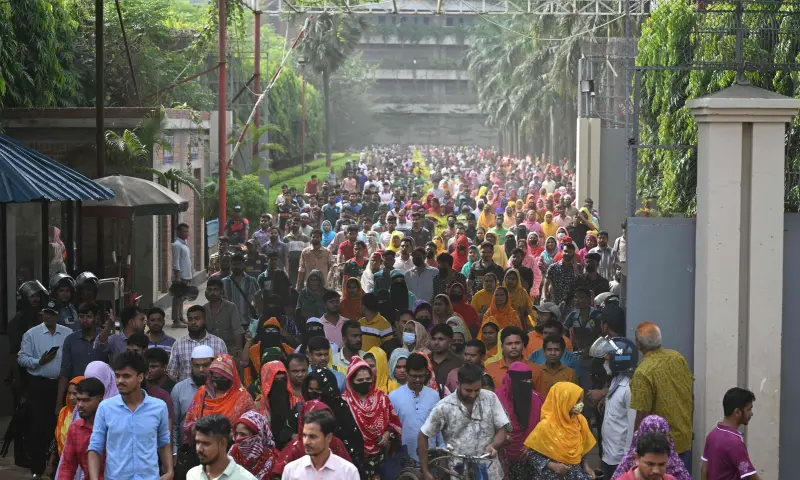
That disparity – worsened by rising inflation and the growing cost of living – pushed the workers to strike and hit the streets on Saturday to demand a minimum wage of 30,000 taka ($241), more than double the current wage of 12,500 taka ($102). asserted
disparity → worsen → taka
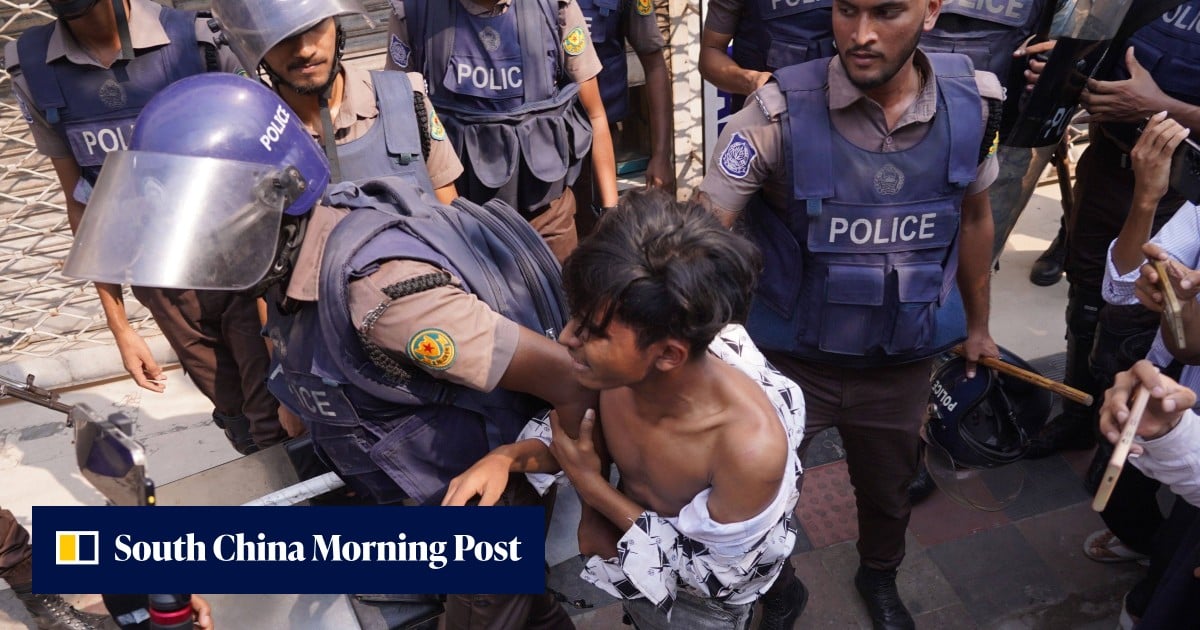
On Sunday, Begum joined one such protest in the Jamgora part of the Ashulia industrial area on the outskirts of the capital Dhaka, with the police firing tear gas and stun grenades to disperse the protesters, and arresting dozens of them. asserted
police → join → them
The Bangladesh Garment Manufacturers and Exporters Association said the demonstrations disrupted operations at 529 factories on Sunday and affected nearly a million workers. asserted
demonstrations → say → workers
Later that day, the government announced the formation of a six-member wage board to review the workers’ demands. asserted
government → announce → demands
But that did not stop the garment workers from returning to the streets for a third straight day on Monday. asserted
that → stop → Monday
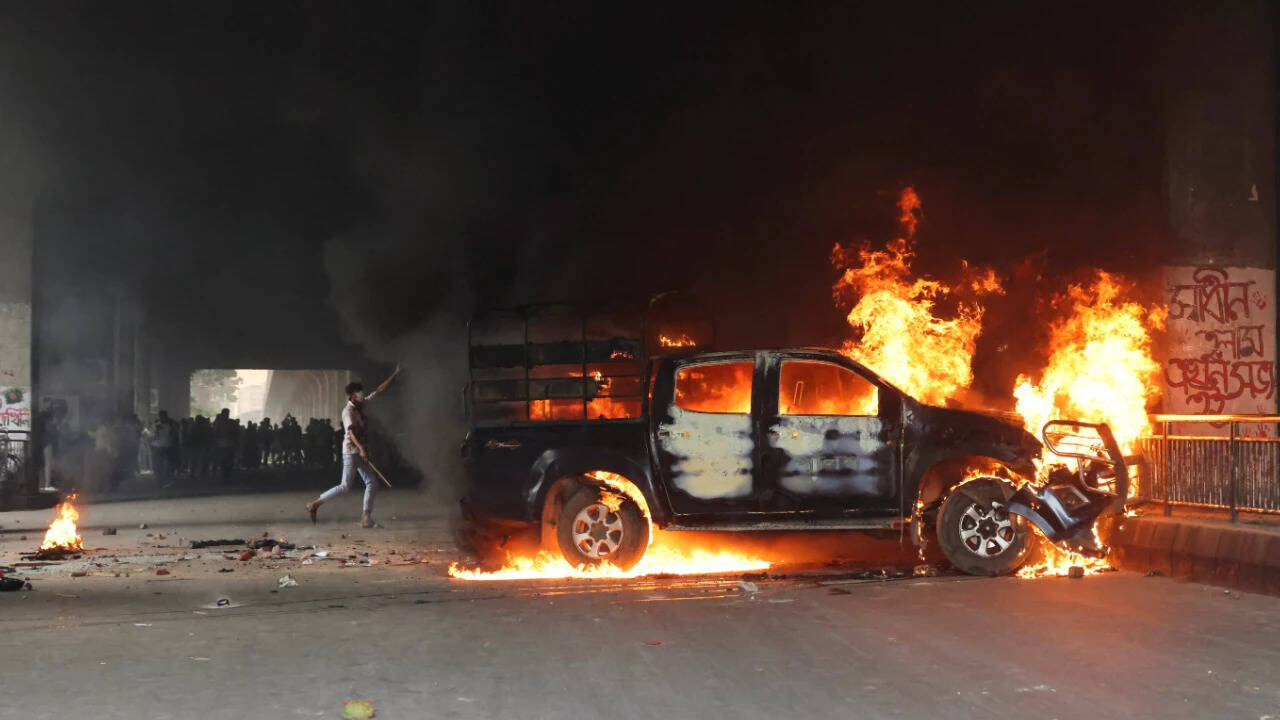
In northern Dhaka’s Gazipur area, the workers blocked the Dhaka-Tangail highway, and vandalised and torched several vehicles, while clashes with police were reported from the neighbouring Mirpur district. asserted
clashes → block → district
“The government only makes promises,” Begum told Al Jazeera. asserted
Begum → make → Jazeera
“They haven’t told us when wages will increase and by how much.” asserted
wages → tell → much
Inflation eating into wages Rasel Khan, a 30-year-old garment worker at Ashulia, told Al Jazeera his monthly earnings of 18,000–20,000 taka ($145–$161), including overtime, were no longer enough to support his family, which included his mother and younger brother besides his wife and child. asserted
which → eat → wife
As living costs soar, he has accumulated a debt of about 100,000 taka ($805) to meet his needs. asserted
he → soar → needs
“It’s impossible to support a family on this income anymore. asserted
It → ’ → income
Prices keep rising, and we have to borrow money just to survive,” he said. asserted
he → rise → money
The last revision of the minimum wage in the garment sector took place in December 2023. asserted
revision → take → December
Since then, prices have continued to climb. asserted
prices → continue → ?
Official data put annual inflation at 8.34 percent in September, including 7.22 percent for food and 9.30 percent for non-food expenses. asserted
data → put → expenses
Begum says she pays 3,500 taka ($28) as rent for a single room shared with her mother and children. asserted
she → say → mother
Her father, living in their village in the central district of Sirajganj, also depends on her income. asserted
father → live → income
She says she is burning discarded paper and other materials to cook because she is not able to afford a gas cylinder that costs about 2,200 taka ($18). asserted
that → say → taka
Zahid Hussain, a former lead economist at the World Bank’s Dhaka office, said persistent inflation over the past five years has sharply eroded the purchasing power of low-paid workers. asserted
inflation → say → workers
“When real income falls, they have to cut their daily living standards,” he told Al Jazeera. asserted
he → fall → Jazeera
“They don’t have any surplus income.” asserted
They → have → income
Hussain said a recent hike in the salary of government employees has had a “demonstration effect” among private-sector workers waiting for a similar relief. asserted
hike → say → relief
The government’s announcement of a wage board follows an amendment to labour laws to reduce the wage review cycle from five years to three years. asserted
announcement → follow → years
The current three-year period ends in December. asserted
period → end → December
Prime Minister Tarique Rahman convened an emergency meeting of top government officials on Sunday, while Home Minister Salahuddin Ahmed met the garment factory owners on Monday, assuring them that a new minimum wage would be fixed through negotiations. asserted
wage → convene → negotiations
Labour Minister Ariful Haque Choudhury meanwhile urged the workers to resume work, saying the wage board would begin its deliberations shortly. But Babul Akhter, a workers’ representative on the board, called for the new wages to take effect with January 2027 salaries. asserted
wages → urge → salaries
…and 13 more, not listed.

💬Give feedback
🕘History 🎫Support