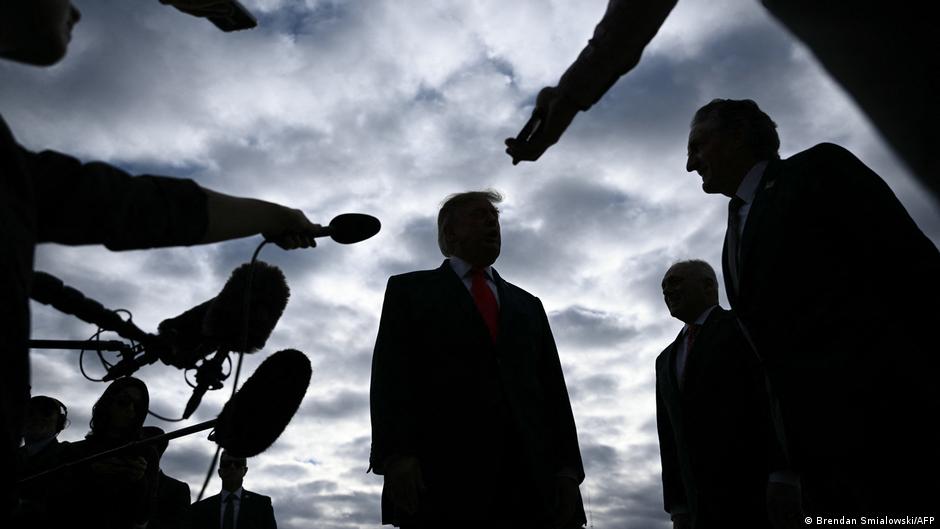
Across the Asia-Pacific region, governments and businesses reeling from the energy shock of the United States and Israel’s war on Iran are watching Tuesday’s US midterm elections closely.
asserted
governments → reel → elections
Many want to see “enormous changes” during the rest of President Donald Trump’s term, analysts say, from the war on Iran to his policies on trade and tariffs.
asserted
analysts → want → trade
But few expect that to happen, even with the Democrats poised to take the House of Representatives, and potentially the Senate, from Trump’s Republican Party.
asserted
Democrats → expect → Party
Recommended Stories
list of 3 items- list 1 of 3Lobster industry caught in Maine’s political headwinds before US midterms
- list 2 of 3How US oil firms profit $130bn from Iran war as household bills surge
- list 3 of 3How would Tehran respond if the US and Israel bomb Iran again?
asserted
US → catch → Iran
“Of course, everybody is watching,” said Steven Okun, a trade specialist and the chief executive of APAC Advisors, a Singapore-based consulting firm.
asserted
Okun → watch → Advisors
“It’s great political theatre.”
asserted
It → ’ → ?
Outside the Middle East, no region has been hit harder by the war on Iran than the Asia-Pacific.
asserted
region → hit → Pacific
Before the start of the conflict in January, the region took in most of the Gulf oil and gas that passed through the Strait of Hormuz.
asserted
that → take → Hormuz
When Iran closed the chokepoint in response to the US and Israel’s strikes, much of the region was left facing shortages.
asserted
much → close → shortages
The Philippines, which relies on the Gulf for more than 90 percent of its crude oil imports, has been under a national energy emergency since March.
asserted
which → rely → March
Soaring fuel costs have drained the foreign exchange reserves of the region’s poorest economies – Cambodia, Laos, Myanmar and East Timor, according to the Institute of Southeast Asian Studies (ISEAS)-Yusof Ishak Institute in Singapore.
uncertain
costs → soar → Singapore
Indonesia, Malaysia, Thailand and Vietnam have also spent heavily on fuel subsidies to shield consumers, it said.
asserted
it → spend → consumers
Public opinion in the Asia-Pacific region remains firmly opposed to the war, but Okun said a Democratic-controlled US Congress was unlikely to force Trump to end the eight-month conflict.
asserted
Congress → remain → conflict
“With Iran, I don’t see [a Democrat-controlled Congress] having much change at all, other than the fact that the war will be investigated and there will be oversight hearings,” Okun told Al Jazeera.
asserted
Okun → see → Jazeera
“We might even see an impeachment of the secretary of defence, but it doesn’t change the overall impact of the war.
uncertain
it → see → war
Under the US Constitution, Congress holds the power to formally declare war, but Trump has claimed the attacks on Iran were in self-defence and has so far ignored congressional resolutions directing him to withdraw US forces from hostilities.
asserted
attacks → hold → hostilities
If a Democrat-controlled Congress passes legislation restricting military operations or cutting funding for them, Trump can veto it.
asserted
Trump → control → it
Overriding a veto requires a two-thirds majority in both chambers, which Democrats are almost certain to fall short of.
asserted
Democrats → override → which
‘Tariffs don’t change’
On trade and tariffs, too, analysts see little room for Congress to rein in Trump.
asserted
Congress → change → Trump
The US president rattled global markets last year when he imposed “reciprocal” tariffs of 10 percent to 50 percent on some 90 countries, with the aim of shrinking the US trade deficit.
asserted
he → rattle → deficit
Asia was again hit harder than most.
asserted
Asia → hit → most
Cambodia faced a 49 percent tariff and Laos 48 percent.
asserted
Laos → face → tariff
Vietnam was slapped with 46 percent and Myanmar 45 percent.
asserted
Myanmar → slap → percent
After the Supreme Court struck down those tariffs in February, the Trump administration turned to other tools.
asserted
administration → strike → tools
In July, it imposed tariffs of 10 percent and 12.5 percent on goods from 60 trading partners, accusing them of failing to stop imports made with forced labour.
asserted
it → impose → labour
In Asia, the list includes China, Japan, South Korea and seven Southeast Asian nations – Cambodia, Indonesia, Malaysia, the Philippines, Singapore, Thailand and Vietnam.
asserted
list → include → China
“In some ways, the new Congress is not going to matter to the Asia Pacific because it’s not going to affect trade policy,” Okun said.
asserted
Okun → go → policy
“Congress cannot change that …
asserted
Congress → change → that
Tariffs don’t change.
asserted
Tariffs → change → ?
The war doesn’t change.”
asserted
war → change → ?
Still, some analysts see a narrow opening.
asserted
analysts → see → opening
Stephen Olson, a visiting fellow at the ISEAS-Yusof Ishak Institute, argued in a recent essay that a “strong rebuke of ‘Trumpism’” at the polls could embolden a pro-free-trade wing of the Republican Party that has been “intimidated into standing down during the Trump presidency”.
uncertain
that → visit → presidency
That, Olson wrote, offers “a glimmer of hope” for Southeast Asian countries that depend on the US market.
asserted
that → write → market
A Democratic-controlled Congress, he said, could also push for carve-outs and exceptions that would give the region’s exporters “a modicum of relief”.
uncertain
that → control → relief
But any deeper shift in US trade policy, he added, will have to wait for the 2028 presidential election.
asserted
he → add → election
Joshua Kurlantzick, a senior fellow for Southeast Asia and South Asia at the Council on Foreign Relations, said the region’s wish list goes beyond trade to security.
asserted
list → say → security
“I think nearly all of Asia would like to see enormous changes, across many domains, during the rest of Trump’s term,” he told Al Jazeera.
asserted
he → think → Jazeera
“But I think much of the region believes this will not happen.”
asserted
this → think → region
Besides “more stability” in trade and tariff policy, Asia-Pacific countries “would like to feel more stable in security guarantees from the US,” he said.
asserted
he → like → US
They would also like a “more clear, obvious US presence” in the South China Sea, where China’s claims overlap with those of five Southeast Asian nations, and in the Taiwan Strait, which separates China from Taiwan, the self-governed island Beijing claims as its territory.
uncertain
Beijing → like → territory
…and 13 more, not listed.
 The Aporia