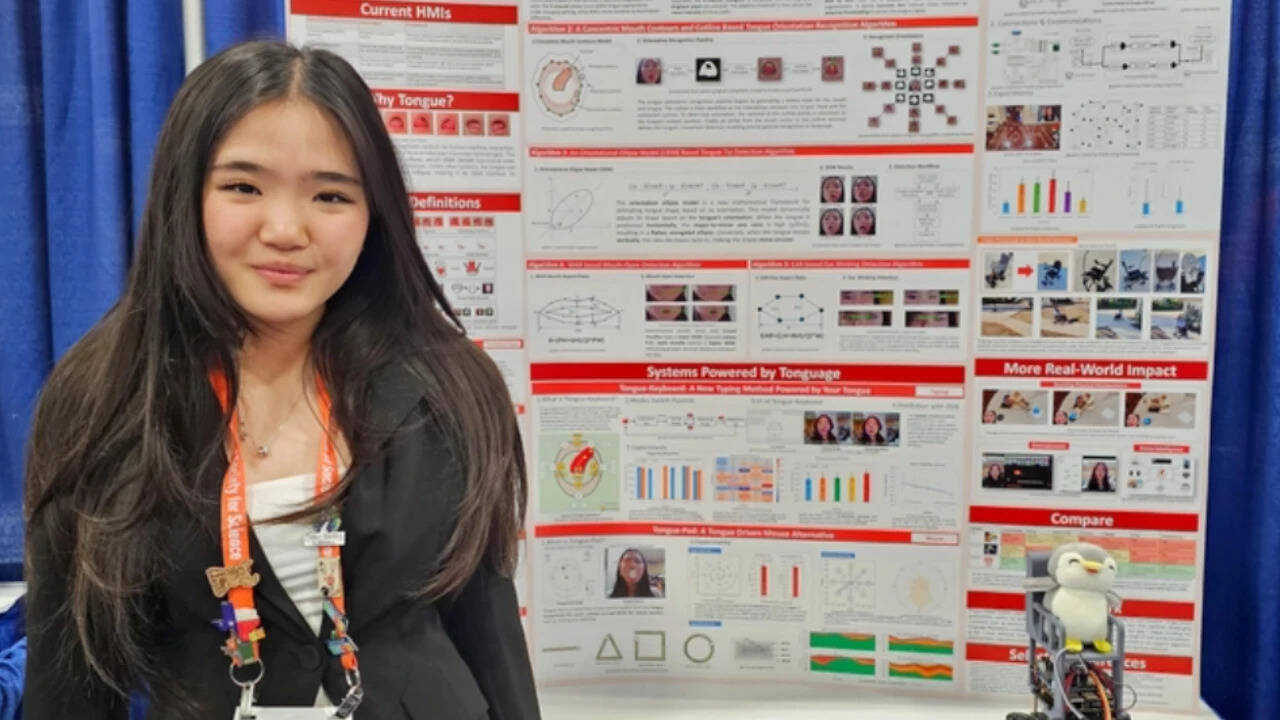
A California high school student has won the top $10,000 IEEE Presidents’ Scholarship for 2026 after developing a system that allows people with movement-related disabilities to control computers and other devices using their tongue and eye movements.
asserted
people → win → movements
Hollie Tang, a sophomore at Wilson High School in Hacienda Heights, created Tonguage, a camera-based technology that can be used to operate a computer, control a wheelchair and perform other tasks without using hands.
asserted
that → create → hands
Her project received the award at the Regeneron International Science and Engineering Fair (ISEF), held in Phoenix in May.
uncertain
project → receive → May
Tang was among three students recognised for developing technologies that could help people with disabilities or improve access to difficult environments.
uncertain
that → recognise → environments
The awards were presented by 2026 IEEE President Mary Ellen Randall during the science fair.
asserted
awards → present → fair
According to Institute of Electrical and Electronics Engineers, Tang wanted to develop a technology that people could use without buying expensive equipment.
uncertain
people → accord → equipment
Her system works with a standard laptop camera and does not require sensors to be implanted in or attached to the body.
asserted
sensors → work → body
The project addresses a problem faced by many people with limited physical movement.
asserted
project → address → movement
According to the World Health Organisation, more than one billion people worldwide, or around 16% of the global population, live with some form of disability.
uncertain
people → accord → disability
For some, using a conventional keyboard, mouse or other control device can be difficult.
asserted
using → use → keyboard
How Tang's tongue-controlled system work?
asserted
system → control → ?
Tang's invention uses computer vision, a technology that allows computers to interpret information captured by cameras.
asserted
computers → use → cameras
Her system tracks tongue movements and eye blinks, converting them into instructions that digital devices can understand.
asserted
devices → track → that
One feature is a tongue-based directional control that works like a computer cursor.
asserted
that → base → cursor
Users can move their tongue to control direction, while blinking their eyes allows them to make selections, much like clicking a mouse.
asserted
them → move → mouse
The technology can identify the tongue's position, direction and movement patterns.
asserted
technology → identify → position
It also uses other facial signals to understand what the user wants to do.
asserted
user → use → what
The project describes this approach as a multimodal human-machine interface, meaning it combines different forms of input to control a device.
asserted
it → describe → device
Tang also included a safety feature that identifies the intended user.
asserted
that → include → user
If another person enters the camera's view, the system is designed to ignore that person's movements.
asserted
system → enter → movements
This is particularly important when the technology is used to control a powered wheelchair, where an incorrect command could affect movement.
uncertain
command → use → movement
According to a project overview published on Fairfolio, Tonguage has been developed for several applications, including typing, cursor control, powered wheelchairs and robotic arms.
uncertain
Tonguage → accord → typing
The system uses a common recognition and control framework across these applications.
asserted
system → use → applications
What inspired Tang to create Tonguage
Tang initially planned to create an alternative to a keyboard and mouse.
asserted
Tang → inspire → keyboard
However, while researching the difficulties faced by people with motor disabilities, she realised that the technology could be useful for several other activities.
uncertain
technology → research → activities
Apart from helping users operate wheelchairs and robotic arms, she wanted the system to support gaming and entertainment.
asserted
system → help → gaming
“We’re so focused on trying to give people autonomy over just basic human tasks that we often leave out things like gaming,” she told IEEE Spectrum.
asserted
she → ’re → Spectrum
“They deserve the freedom to play games and enjoy entertainment as well,” she added.
asserted
she → deserve → entertainment
Keeping the technology affordable was another important part of her work.
asserted
Keeping → keep → work
Instead of depending on specialised equipment, she designed it to work with cameras commonly available on laptops.
asserted
she → depend → laptops
“Mobility conditions don’t discriminate.
asserted
conditions → discriminate → ?
They can affect anyone of any income, gender, and socioeconomic status,” she said.
asserted
she → affect → income
Tang, who hopes to study biomedical engineering, said visiting a rehabilitation centre helped her better understand the people who could benefit from her invention.
uncertain
who → hop → invention
“Including empathy in your technological solution is so important.
asserted
Including → include → solution
Empathy is hard to teach in a classroom, but it can be learned through experience, and through actually meeting people whose lives your work might change,” she said.
uncertain
she → teach → lives
Two other students recognised for their inventions
Tang received the top scholarship, but two other high school students were also recognised at the fair.
asserted
students → recognise → fair
Partap Sidhu, a junior at Bethpage High School in New York, secured second place and a $600 scholarship for NeuroGait, a lower-limb exoskeleton controlled by brain signals.
asserted
Sidhu → secure → signals
His system uses an electroencephalogram (EEG) headset to detect electrical activity associated with intended movement.
asserted
system → use → movement
A convolutional neural network (CNN) interprets these signals and sends instructions to a 3D-printed exoskeleton fitted with pneumatic artificial muscles.
asserted
network → interpret → muscles
According to Sidhu's results from 500 trials, the system achieved 95.2% accuracy in converting brain signals into physical movements.
uncertain
system → accord → movements
…and 7 more, not listed.
 The Aporia