Photo via Times of India

A Neanderthal who died 75,000 years ago may have been killed by a wooden spear deliberately aimed at his heart, scientists say, offering rare evidence of targeted violence among our closest ancient relatives

Read the original at Times of India ↗
Cite

TOI Lifestyle Desk. (2026, November 1). A Neanderthal who died 75,000 years ago may have been killed by a wooden spear deliberately aimed at his heart, scientists say, offering rare evidence of targeted violence among our closest ancient relatives. Times of India. https://timesofindia.indiatimes.com/science/archaeology/neanderthal-skeleton-reveals-evidence-of-targeted-violence-a-75000-year-old-murder-mystery-uncovered-by-scientists/articleshow/135426863.cms

Dated from the outlet's own feed. Check the original for its byline.

Times of India · collected 2026-11-01 · by TOI Lifestyle Desk

Quick Summary

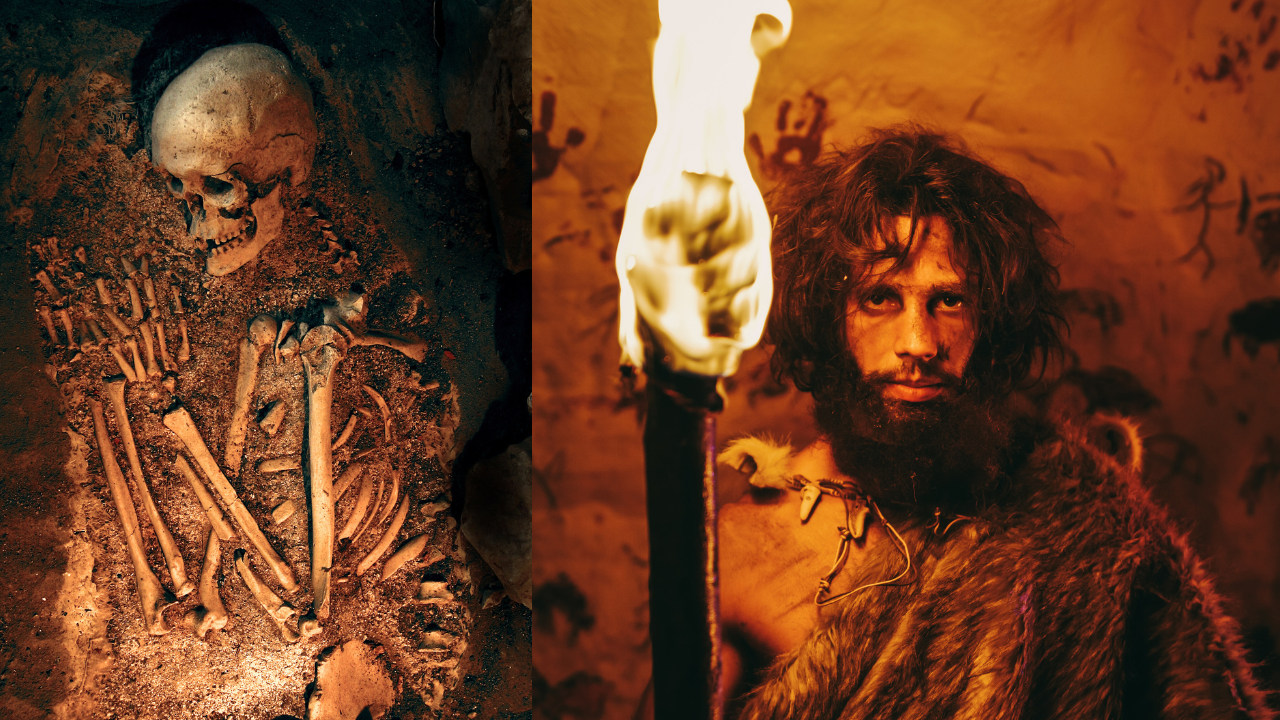
Scientists from the University of Cambridge report in the journal Scientific Reports that a 75,000-year-old Neanderthal skeleton found in Shanidar Cave in Iraqi Kurdistan shows signs of being killed by a wooden spear aimed at the heart. The evidence comes from a small, circular hole in the left shoulder blade of the remains named Shanidar A, which is consistent with a wound caused by a sharp wooden point rather than stone or flint tools. This discovery provides rare insight into deliberate lethal violence among ancient Neanderthals and could be one of the earliest known cases involving a wooden spear.
Written by AI on 2026-11-01, from this article's own text only (the story summary below draws on all the coverage).

AI analysis

Story summary

Scientists from the University of Cambridge believe they may have found evidence of one of the earliest known cases of targeted lethal violence among ancient humans. The discovery, published in the journal Scientific Reports, involves a 75,000-year-old Neanderthal skeleton unearthed in Iraqi Kurdistan. According to their analysis, the individual died after being struck by a wooden spear aimed directly at his heart, suggesting deliberate intent rather than accidental injury. The spear is believed to have entered the left chest and passed through vital organs before lodging behind the shoulder blade. This finding offers rare insight into early human behavior, indicating that violence was present even in ancient societies, challenging perceptions of prehistoric life as peaceful.

Written for “Neanderthal Killed by Spear Thrower” on 2026-11-02, grounded in this article and the 0 other(s) covering the same event.
Why this leaning score
This article does not take a side on a contested political question, so it has no leaning score. That is an answer rather than a gap: a match report or a rescue can be warmly or critically written without being left or right, and scoring it anyway is how approval of a subject gets recorded as a political position.
No political leaning scored for article 121860 · logged 2026-11-01

Story

📰 Neanderthal Killed by Spear Thrower
Science · 1 article(s) covering the same event.

Compared with similar articles

Nothing to compare against. No article is close enough to this one for the pipeline to have linked or judged the pair.
How this article was measured signals, leaning charts, publisher record, byline, topics and claims

Signals How these are calculated →

Claims extracted
36
sentences that state something as happening or true
Uncertain
39%
14 of 36 hedged ("reportedly", "may", "according to")
Leaning
not political
takes no side on a contested political question
Publisher signals
59/100
Times of India's corrections and hedging, across everything collected from it. Not a measure of accuracy.
Outlets on this story
1
Science
Same framing elsewhere
1
articles that frame the event the way this one does
Analyzed 2026-11-01 · how these are computed

How this is being covered How these are calculated →

Article leaning vs. publisher reliability
Source leaning vs. consistency

Publisher

Times of India · 3890 article(s) · 2 correction(s) detected
Running correction rate · 2 correction(s)

Who wrote this

TOI Lifestyle Desk
72 article(s) here · 1 carrying a prediction
🔮 That might be one of the reasons why people find their life's solutions in a book written thousands of years ago.
🔮 How children became parcels When the US Postal Service introduced its Parcel Post service on January 1, 1913, Americans could suddenly send packages weighing more than four pounds through the mail.
🔮 The funding will allow the Suwannee River Water Management District to purchase the Suwannee Sandhill Tract-Drew Property in Suwannee County, which includes approximately 1.5 miles of river frontage.
🔮 Yet, he captured their essence in a way few artists could.
🔮 A soft flower would probably be the last thing to come to mind, but nature has its own version of Dracula, and these are not creatures hiding deep inside dark forests, but rather some strange-looking flowers found in the cloud forests of South America.
🔮 Apart from their symbolic significance, the small objects could also produce sounds when they moved, acting as rattles that helped adults keep track of young children.
🔮 Located approximately three miles upstream from Lake Okeechobee, the proposed wetland system will capture and treat water from parts of the watershed that consistently record some of the highest phosphorus concentrations and pollution loads.
🔮 He also spoke about his government's support for community work, adding, “And I can assure you that the government will continue to back you in everything that we do.”
🔮 What shoppers could find at Joely Fisher’s 2-day living estate sale in Calabasas The sale ran on Saturday, December 13, and Sunday, December 14, from 10am to 3:30pm, according to the EstateSales.net listing.
Wire or desk byline, not an individual reporter.
Also by TOI Lifestyle Desk
Nothing else under this byline is closely related to this article, so these are simply their most recent.
All 72 articles by TOI Lifestyle Desk →

Topics

Iraqi Kurdistan Neanderthal Scientific Reports University of Cambridge the University of Cambridge

Subjects

Neanderthal NORP · 3× Iraqi Kurdistan GPE · 2× Cain PERSON · 1× Department of Archaeology ORG · 1× Emma Pomeroy PERSON · 1× Scientific Reports ORG · 1× University of Cambridge ORG · 1× the University of Cambridge ORG · 1× the University of Cambridge's ORG · 1×

Narrative

Based on their reconstruction, the researchers believe the spear entered the front of the individual's left chest, passed through a lung and probably major blood vessels before piercing the shoulder blade from behind.
framing: mixed · carried by 1 article(s) · first seen 2026-11-01
🔮 That might be one of the reasons why people find their life's solutions in a book written thousands of years ago.

Claims (36 extracted, 14 hedged)

But what if I tell you that the story of human anger and violence goes way beyond what we can imagine? asserted
we → tell → what
Everyone hears from their grandfathers and grandmothers how good and lovely the world was before, and they too have heard the same story, almost making early humans seem like they lived in an actual heaven. asserted
they → hear → heaven
Factually, long before modern civilisation, our ancestors lived in caves and depended on hunting and gathering for survival, but what if their psychology was not very different from ours? asserted
psychology → live → ours
Anger, greed and a thirst for possession grasped them as much as we deal with them. asserted
we → grasp → them
That might be one of the reasons why people find their life's solutions in a book written thousands of years ago. uncertain
people → find → years
Maybe we have not changed as much as we think. asserted
we → change → ?
A recent discovery in Iraqi Kurdistan has offered rare evidence of what could be one of the earliest known cases of deliberate lethal violence involving a wooden spear. uncertain
what → offer → spear
According to a study published in the journal Scientific Reports, researchers from the University of Cambridge have discovered a 75,000-year-old Neanderthal skeleton with a small, circular hole in its left shoulder blade. uncertain
researchers → accord → blade
The injury suggests that a sharpened wooden spear may have passed through the individual's chest, potentially in an attack deliberately aimed at the heart. uncertain
spear → suggest → heart
The remains, named Shanidar A, were discovered in Shanidar Cave in Iraqi Kurdistan and could represent the oldest known evidence of fatal interpersonal violence involving a wooden spear in the hominin fossil record. uncertain
remains → name → record
A 15 mm hole that may reveal a deadly attack uncertain
that → reveal → attack
The 75,000-year-old Neanderthal’s left shoulder blade shows the fractures. asserted
blade → show → fractures
One of the most interesting aspects of the discovery is the condition of the shoulder blade, also known as a scapula. asserted
One → know → scapula
The bone is extremely delicate, with some parts so thin that light can pass through them. asserted
light → pass → them
Yet, it remained almost completely intact after spending around 75,000 years beneath approximately 7.5 metres of rock and sediment. asserted
it → remain → rock
The only major damage was a remarkably circular opening measuring around 15 millimetres across. asserted
damage → measure → millimetres
According to the researchers, the shape of the hole provides an important clue about the weapon that may have caused it. uncertain
that → accord → it
Spears with flint or stone tips generally leave flatter or more angular openings, while the rounded shape of this injury is consistent with a sharpened wooden point. asserted
shape → leave → point
Based on their reconstruction, the researchers believe the spear entered the front of the individual's left chest, passed through a lung and probably major blood vessels before piercing the shoulder blade from behind. asserted
spear → base → behind
The force and position of the injury suggest that the weapon may have been deliberately directed towards the heart, causing a rapidly fatal wound. uncertain
weapon → suggest → wound
The researchers also identified small fragments of bone displaced during the impact. asserted
researchers → identify → impact
Their position and the bevelled edges around the opening helped the team reconstruct the direction in which the weapon travelled. asserted
weapon → help → which
The evidence suggests that the spear entered from above and moved downwards through the body. uncertain
spear → suggest → body
The question we all have been thinking about. asserted
we → think → question
Although the injury appears consistent with a targeted attack, researchers have not been able to establish with certainty what actually happened to Shanidar A. asserted
what → appear → certainty
One possibility is that the individual was attacked by another Neanderthal, while another is that the injury was just a tragic incident during hunting. asserted
injury → attack → hunting
Neanderthals were another human species that coexisted with Homo sapiens and hunted large and dangerous animals, sometimes at close range using thrusting spears. asserted
that → coexist → spears
An accident involving such a weapon could also have caused a fatal injury. uncertain
accident → involve → injury
Dr Emma Pomeroy, the lead author of the study from the University of Cambridge's Department of Archaeology, acknowledged that hunting large animals such as mammoths could have resulted in similar injuries. uncertain
hunting → acknowledge → injuries
Interestingly, the possible violent death of Shanidar A was not the only thing researchers discovered from his remains. asserted
researchers → discover → remains
His teeth showed evidence of an earlier severe facial injury, which had damaged one of his front teeth and pushed neighbouring teeth inward. asserted
which → show → teeth
However, the individual appears to have survived this injury for at least a year, possibly longer. uncertain
individual → appear → year
Researchers believe that such an injury would have made eating difficult, meaning that Shanidar A may have depended on other members of his group for support. uncertain
A → believe → support
According to Dr Emma Pomeroy, surviving with such damage would likely have required some form of care from others, possibly through softer foods that were easier to eat. uncertain
that → accord → foods
The discovery not only opens up our understanding of the physical aspects of Neanderthals but also their social behaviour, how the inability of one member brings care from the community. asserted
inability → open → community
This shows the two aspects of human civilisation itself: love and care, and anger and greed, with Cain and Abel represented in a single finding. asserted
Cain → show → finding

💬Give feedback
🕘History 🎫Support