Whenever we think of amphibians, we usually picture animals that live both on land and in water, such as frogs, salamanders and newts.
asserted
that → think → frogs
Their ability to survive in both environments is one of the defining features of the group.
asserted
ability → survive → group
But what if an amphibian once lived entirely in the sea?
asserted
amphibian → live → sea
A newly described fossil from China may offer evidence of just that.
uncertain
fossil → describe → that
Dating back around 237 million years, the armoured creature measured approximately 2.4 feet in length and could challenge what scientists have long understood about amphibian evolution.
uncertain
scientists → date → evolution
The newly identified species, named
Gerrothorax maritimus, lived during the Late Triassic period.
asserted
species → identify → period
Researchers examined two nearly complete fossilised skeletons discovered in what is now China's Guizhou Province, an area that was once covered by the sea.
asserted
that → examine → sea
The findings, published in the journal
Nature Ecology & Evolution, provide the first fossil evidence of a stem amphibian that may have lived entirely in a marine environment.
uncertain
that → publish → environment
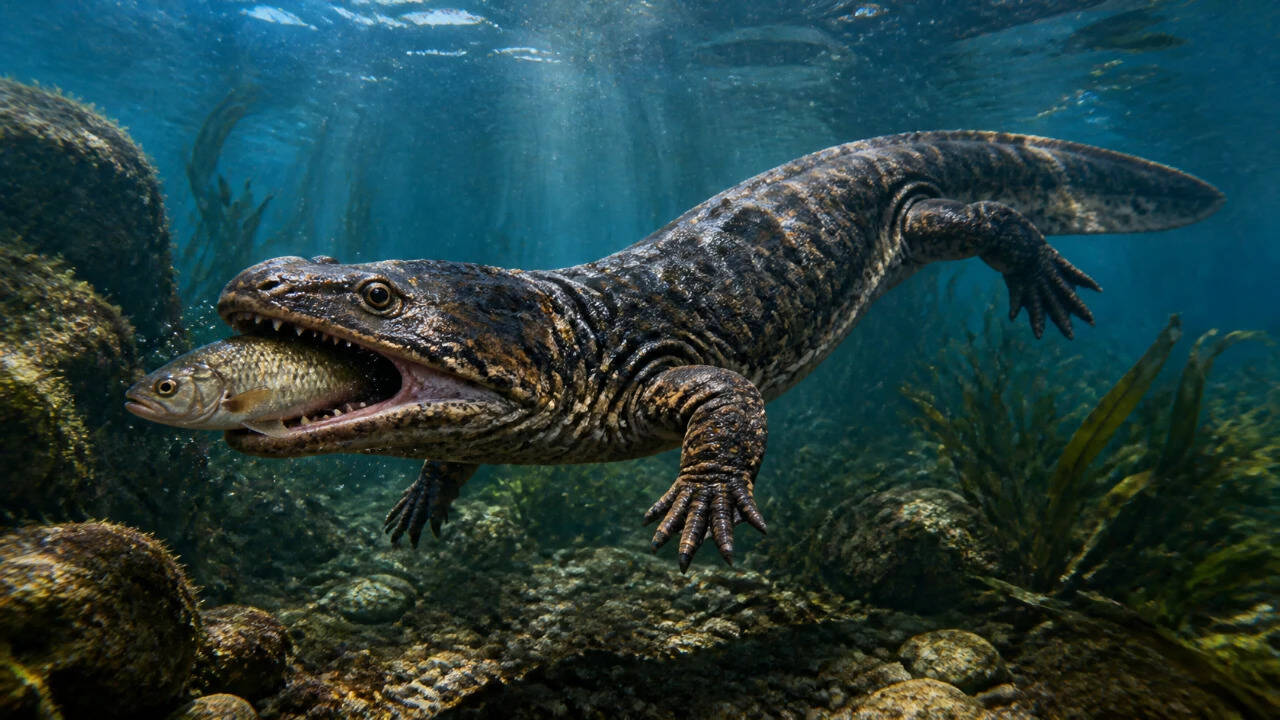
What did the ancient marine amphibian look like?
credit: Ryosuke motani (by BBC Wildlife Magazine)
Unlike the amphibians we are familiar with today,
Gerrothorax maritimus had a flattened, disc-shaped body covered in layers of bony armour.
asserted
maritimus → look → armour
Measuring around 74 centimetres, or approximately 2.4 feet, it was roughly the size of a large salamander.
asserted
it → measure → salamander
Its broad body and protective covering made it quite different from modern amphibians, which generally have soft, permeable skin.
asserted
which → make → skin
Researchers believe the animal was a bottom-dwelling creature that lived close to the seabed.
asserted
that → believe → seabed
Its broad head and mouth, along with its small conical teeth, suggest that it may have fed by sucking in smaller animals that passed nearby.
uncertain
that → suggest → animals
The armour may also have offered protection against predators, including large marine reptiles such as ichthyosaurs, whose fossils have been found in the same region.
uncertain
fossils → offer → region
Why is finding an amphibian living entirely at sea so unusual?
asserted
finding → find → sea
One of the biggest reasons this discovery is interesting is that amphibians are generally not suited to living in saltwater.
asserted
amphibians → suit → saltwater
Unlike reptiles, birds and mammals, most amphibians have highly permeable skin that allows them to absorb water and exchange gases with their surroundings.
asserted
them → have → surroundings
While this works well in freshwater environments, exposure to seawater can cause them to lose water through their skin, leading to dehydration.
asserted
them → work → dehydration
Even among the more than 8,000 living amphibian species, none is known to live entirely in a marine environment.
asserted
none → live → environment
Some, such as the crab-eating frog, can tolerate a certain amount of saltwater exposure, but they still need access to freshwater to recover.
asserted
they → eat → freshwater
This has long made a fully marine amphibian seem unlikely.
asserted
amphibian → make → ?
However, researchers believe
Gerrothorax maritimus may have overcome this limitation through its unusual body structure.
uncertain
maritimus → believe → structure
Its extensive bony armour could have restricted the movement of water and salts through its skin, reducing its dependence on the usual amphibian method of absorbing water.
uncertain
armour → restrict → water
Instead, it may have relied more heavily on its mouth and digestive system to take in water, while its gills helped regulate salt levels
How did scientists establish that it lived in the sea?
Credit: Ryosuke Motani (by BBC Wildlife magazine)
uncertain
it → rely → magazine
The researchers did not rely on the location of the fossils alone.
asserted
researchers → rely → fossils
Both skeletons were found in deep-sea sediments, hundreds of miles from major landmasses that existed during the Late Triassic period.
asserted
that → find → period
The researchers suggest that the animals probably died close to where they lived, rather than being carried into the sea after death, as their skeletons still preserved delicate parts such as the fingers.
asserted
skeletons → suggest → fingers
The team also conducted geochemical tests on the fossils, examining the proportions of different strontium isotopes preserved in the bones.
asserted
team → conduct → bones
Strontium isotope ratios can provide clues about the environment in which an animal lived.
asserted
animal → provide → which
In this case, the results closely matched the composition of seawater from the Late Triassic period, supporting the idea that these amphibians grew up in the ocean rather than simply ending up there by accident.
asserted
amphibians → match → accident
The researchers believe
Gerrothorax maritimus descended from a lineage of amphibians that already possessed extensive body armour but lived in freshwater environments.
asserted
that → believe → environments
Its close relative,
Gerrothorax pulcherrimus, also had a flattened body and bony covering, but was not known to have lived in the sea.
asserted
relative → have → sea
This raises an interesting possibility: features that originally evolved for protection may have eventually helped some members of the group adapt to an entirely different environment.
uncertain
members → raise → environment
The armour may have reduced the problems associated with saltwater exposure, allowing the animal to survive in conditions that would be difficult for most amphibians today.
uncertain
that → reduce → amphibians
The discovery actually reminds us there are so many mysteries yet to be unwound.
asserted
discovery → remind → us
It shows that their evolutionary history may have been more varied than scientists previously understood.
uncertain
scientists → show → ?
It also offers another example of how evolution can repurpose existing features, sometimes allowing animals to occupy environments that once seemed impossible for their ancestors.
asserted
that → offer → ancestors
 The Aporia