"Astronomy compels the soul to look upwards and leads us from this world to another," said Plato.
asserted
Plato → compel → another
But even as the skies above us have changed over centuries, the stars have continued to hold the same fascination for those seeking to understand the universe.
asserted
stars → change → universe
There are some discoveries that do not immediately reveal to us the extent of what they hold within them, lying quietly beneath layers of dust and corrosion until someone curious enough comes along and happens look a little closer.
asserted
someone → be → dust
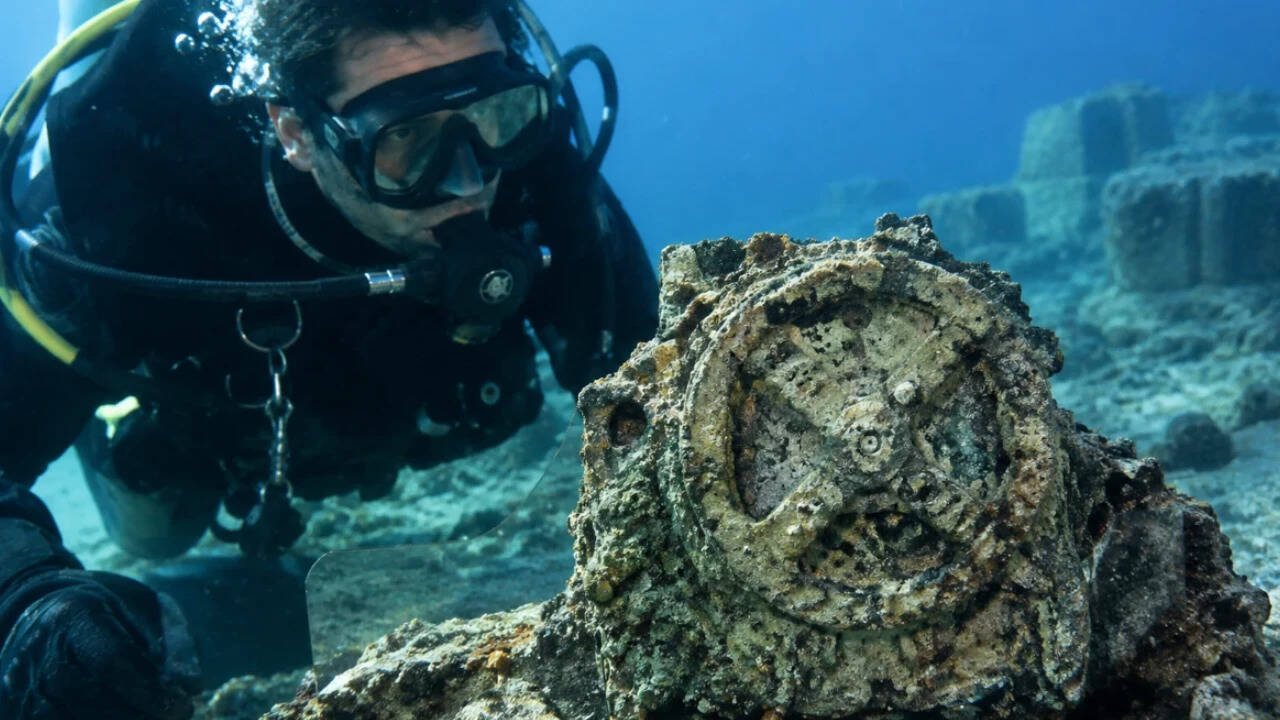
The discovery of the Antikythera Mechanism is one such story where a seemingly unostentatious piece of corroded bronze was recovered from the depths of the Mediterranean, revealing an extraordinary knowledge of astronomy and mechanical engineering that had existed more than 2,000 years ago.
asserted
that → recover → astronomy
What appeared to be a little more than a lump of metal was, in fact, later revealed to be an elaborate astronomical calculator, built by the ancient greeks to follow the movements of celestial bodies and predict events in the skies.
asserted
appeared → appear → skies
It was in 1990, when a group of Greek sponge divers discovered an ancient shipwreck off the coast of Antikythera, an island situated between Crete and Peloponnese.
asserted
group → discover → Crete
The divers who were exploring the seabed came across the remains fo a large cargo vessel,whre pottery, glassware, statues and other antique objects lay scattered.
asserted
pottery → explore → vessel
Looking at this, recovery operations followed from 1901 to well into 1920, with several artefacts eventuaslly being brought to the National Archaeolgical Museum in Athens.
asserted
artefacts → look → Athens
Among these copious objects gathered, there was also a heavily corroded mass of bronze, which at first gathered verey little interest of researchers.
asserted
which → gather → researchers
However, it was only in 1902, that when archaeolgists examined the object more closely, that this small toothedgear became prominet.
asserted
toothedgear → examine → object
The object came to be known as the Antikythera Mechanism, named after the island near which it was discovered.
asserted
it → come → which
Although its original appearance has been obscured by centuries underwater, researchers have been able to reconstruct much of its internal arrangement through modern imaging technologies.
asserted
researchers → obscure → technologies
In a
2006 study published in Nature, researchers, including Tony Freeth and his colleagues, used high-resolution X-ray tomography and surface imaging to examine the surviving fragments, revealing a sophisticated arrangement of interlocking bronze gears.
asserted
researchers → publish → gears
The study established that the mechanism was capable of calculating astronomical cycles, including the movements of the Sun and Moon, while also predicting solar and lunar eclipses.
asserted
mechanism → establish → eclipses
Why was the gear used 2,000 years ago
What makes the discovery particularly remarkable is the complexity hidden within its construction.
asserted
complexity → use → construction
The mechanism contained at least 30 bronze gear wheels, arranged in a system that allowed the movement of one component to correspond with the changing positions of celestial bodies.
asserted
movement → contain → bodies
Rather than simply marking the passage of days or months, it could represent the relationship between different astronomical cycles.
uncertain
it → mark → cycles
Apart from its astronomical calculations, the mechanism also carried a connection to the cultural life of ancient Greece.
asserted
mechanism → carry → Greece
Its calendar included an Olympiad-related display, marking the four-year cycle associated with the ancient Greek athletic competitions.
asserted
calendar → include → competitions
This is particularly interesting because it suggests that the device was not limited to observing celestial movements, but brought together astronomy, the measurement of time and the organisation of important cultural events.
uncertain
device → suggest → events
The same instrument that could calculate lunar cycles and predict eclipses could also help place human activities within a wider understanding of time.
uncertain
that → calculate → time
There is also evidence that the mechanism may have displayed the positions of planets, although much of this part of its construction has not survived.
uncertain
much → be → construction
In a 2018 review published in
Nature Astronomy, researchers John H. Seiradakis and Mike Edmunds examined the accumulated findings and discussed how the inscriptions on the surviving fragments support the possibility of planetary displays.
asserted
inscriptions → publish → displays
The researchers also highlighted the uncertainties that continue to surround its origins, construction and intended purpose.
asserted
that → highlight → origins
Why the calculator has more questions to answer
asserted
calculator → answer → questions
Despite the extraordinary amount of research carried out on the Antikythera Mechanism, several questions remain unanswered.
asserted
questions → carry → Mechanism
Its exact maker is unknown, as is the identity of the person or group for whom it was constructed.
asserted
it → construct → whom
The shipwreck itself is generally dated to the first century BC, while the mechanism is believed to have been manufactured earlier, around the second century BC.
asserted
mechanism → date → BC
How such an intricate scientific instrument came to be part of the vessel's cargo, and where it was originally intended to travel, remains uncertain.
asserted
it → come → cargo
Its discovery also raises questions about how much of ancient mechanical knowledge has been lost, particularly since no surviving device of comparable complexity appears in the historical record for many centuries afterwards.
asserted
device → raise → centuries
Today, the Antikythera Mechanism stands as one of the most extraordinary surviving examples of ancient Greek scientific ingenuity.
asserted
Mechanism → stand → ingenuity
Its fragments may be incomplete, its original purpose may never be fully established, who created it may never be known, but the calculations preserved within its corroded gears continue to reveal an entire civilisation that was keenly looking up at the skies with remarkable, unmoving precision.
uncertain
that → establish → precision
 The Aporia